
Last Updated: May 21, 2026
Normal SpO2 Range Based on Age Group (India Guide)
SpO2 refers to oxygen saturation, which indicates the amount of oxygen carried in your blood. This key medical parameter is widely utilized at homes and in medical facilities throughout India. With the recent increase in respiratory disorders and heightened consciousness due to the novel coronavirus, more Indians are monitoring their oxygen levels through pulse oximeters.
This guide covers the SpO2 range for normal levels based on age group and other essential details.
What Is SpO2?
The term SpO2 stands for peripheral oxygen saturation. It describes the amount of oxygen bound by hemoglobin in your blood as a percentage.
You can use a pulse oximeter to measure SpO2
- The device is placed on the finger
- It gives instant readings
In healthy individuals, oxygen levels usually stay between 95% and 100%.
Importance of SpO2 Monitoring in India
In India, monitoring SpO2 is especially useful because:
- Air pollution affects lung health in many regions
- Respiratory illnesses like asthma and COPD are common
- Early detection of low oxygen can prevent serious complications
Regular monitoring helps in early diagnosis and better treatment.
SpO2 Normal Range by Age
Below is a clear age-wise breakdown of oxygen saturation levels.
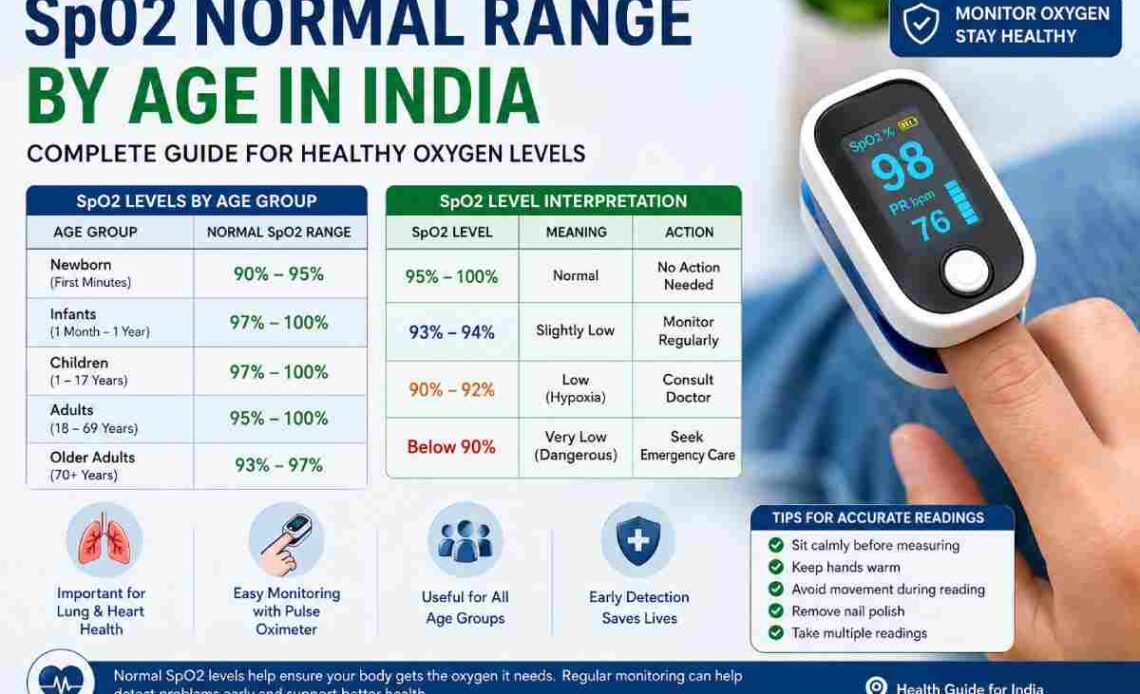
SpO2 Levels by Age Group
| Age Group | Normal SpO2 Range | Notes |
| Newborn (first minutes) | 90% – 95% | Increases after birth |
| Infants (1 month–1 year) | 97% – 100% | Stable levels |
| Children (1–17 years) | 97% – 100% | Usually high |
| Adults (18–69 years) | 95% – 100% | Standard range |
| Older adults (70+) | 93% – 97% | Slight decline possible |
Most healthy people, regardless of age, maintain oxygen levels above 95%.
Understanding SpO2 Readings
Knowing what your reading means is very important.
SpO2 Interpretation Guide
| SpO2 Level | Meaning | What to Do |
| 95% – 100% | Normal | No action needed |
| 93% – 94% | Slightly low | Monitor regularly |
| 90% – 92% | Low | Consult a doctor |
| Below 90% | Very low | Seek emergency care |
Consistently low readings should never be ignored.
Indian Population Insights
Research in India shows that healthy individuals generally maintain high oxygen levels.
Study Observations
| Parameter | Value |
| Average SpO2 (children) | Around 99% |
| Lower normal limit | Around 97% |
| Age variation | Minimal |
This means most people in India fall within the global normal range.
Factors That Affect SpO2 Levels
SpO2 readings can change due to different conditions.
Common Factors
| Factor | Effect |
| High altitude | Lower oxygen levels |
| Air pollution | Reduces lung efficiency |
| Smoking | Decreases oxygen in blood |
| Lung disease | Causes low readings |
| Infections | Sudden drop possible |
| Poor blood circulation | Inaccurate readings |
Understanding these factors helps avoid confusion during measurement.
SpO2 in Medical Conditions
Some people have slightly different target ranges depending on their health.
Condition-Based SpO2 Range
| Condition | Acceptable Range |
| Healthy person | 95% – 100% |
| Heart disease | 92% – 94% |
| COPD or lung disease | 88% – 92% |
Doctors may set personalized targets for such patients.
Symptoms of Low Oxygen Levels
Low SpO2 (hypoxia) can cause noticeable symptoms.
- Shortness of breath
- Fast heartbeat
- Headache or dizziness
- Confusion
- Bluish lips or fingers
Severe symptoms require immediate medical attention.
How to Measure SpO2 Correctly
Correct usage of a pulse oximeter ensures accurate results.
Steps to Follow
| Step | Action |
| 1 | Sit calmly for a few minutes |
| 2 | Place the device on your fingertip |
| 3 | Keep your hand still |
| 4 | Wait for the reading |
| 5 | Note the value |
Tips for Accurate Readings
- Remove nail polish before testing
- Keep hands warm
- Avoid movement
- Take multiple readings for accuracy
SpO2 During COVID-19 in India
During COVID-19, SpO2 monitoring became very important.
- Many patients had low oxygen without symptoms
- Home monitoring helped early detection
- Hospitals used SpO2 levels to decide treatment
This increased awareness about oxygen monitoring across the country.
When to Consult a Doctor
You should seek medical advice if:
- SpO2 is below 94% repeatedly
- There is a sudden drop in readings
- You feel breathless or weak
Readings below 92% usually need medical evaluation.
SpO2 vs Pulse Rate
Many people confuse SpO2 with pulse rate, but they are different.
Comparison
| Parameter | SpO2 | Pulse Rate |
| Measures | Oxygen level | Heart rate |
| Normal Range | 95% – 100% | 60–100 bpm |
| Device | Pulse oximeter | Same device |
Common Myths About SpO2
Misconceptions exist regarding oxygen levels.
- SpO2 level can never exceed 100%.
- One reading is not enough; trends matter
- Slight variations are normal
Health Tips for Maintaining Good SpO2
- Try some breathing exercises.
- Stop smoking.
- Stay physically active
- Reduce exposure to pollution
- Eat a balanced diet
Healthy lifestyle habits help maintain proper oxygen levels.
SpO2 vs Other Health Indicators
SpO2 is just one part of your overall health. It works best when considered with other indicators.
For example, blood sugar and long-term glucose control are equally important. You can learn more about this in this detailed guide on Hemoglobin A1c (HbA1c)
Similarly, understanding how your body heals after medical procedures is also useful. This comparison article explains healing patterns clearly: Pictures of Dry Socket vs Normal
While these topics are different, they all contribute to a better understanding of your health.
Frequently Asked Questions
Is 94% SpO2 normal?
It is slightly low. Regular monitoring is recommended.
Is 92% dangerous?
Yes, it may indicate low oxygen and requires medical attention.
Does age affect SpO2?
Only slightly. Older adults may have slightly lower levels.
Can SpO2 change during the day?
Yes, small fluctuations are normal.
Conclusion
There is not much difference in the range of SpO2 values for different age groups in India. People usually have their oxygen saturation level ranging from 95% to 100%.
Proper tracking of your condition along with early identification of signs and seeking treatment will prevent any potential health problems. Maintaining your oxygen levels is an easy process to keep yourself healthy.