
 Sameena Fatima
Health & Wellness Content Writer
in
Sameena Fatima writes reader-focused
health and wellness content for
HealthBloomWeb, covering fitness,
nutrition, healthy lifestyle and
everyday wellness topics.
Sameena Fatima
Health & Wellness Content Writer
in
Sameena Fatima writes reader-focused
health and wellness content for
HealthBloomWeb, covering fitness,
nutrition, healthy lifestyle and
everyday wellness topics.
 Mirza Ibrahim Ali Khan
Editorial & Content Reviewer
in
Mirza Ibrahim Ali Khan contributes to
HealthBloomWeb's editorial review process,
with a focus on content structure,
readability, search intent and overall
editorial quality.
Mirza Ibrahim Ali Khan
Editorial & Content Reviewer
in
Mirza Ibrahim Ali Khan contributes to
HealthBloomWeb's editorial review process,
with a focus on content structure,
readability, search intent and overall
editorial quality.
 Reyansh Sethi
Medical Reviewer
in
Reyansh Sethi contributes to the medical
review process at HealthBloomWeb, focusing
on clarity, responsible health context and
reader-friendly presentation of health
information.
Reyansh Sethi
Medical Reviewer
in
Reyansh Sethi contributes to the medical
review process at HealthBloomWeb, focusing
on clarity, responsible health context and
reader-friendly presentation of health
information.
If this is the case, and you are interested in transcendental meditation, it will probably be because you are seeking a unique, simple, effective way to relax, focus, and aid your well-being. Unlike many forms of meditation, TM meditation does not involve focusing on the breath or monitoring your thoughts; it appeals to your sense of the personal.
Since the 20 th century, Transcendental Meditation has been among the most studied forms of meditation in the world. Today, in 2006, ranks among the top names in the field of meditation, and is studied by students, working individuals, sports people, doctors and retirees who are seeking out an effective everyday stress-reduction aid.
This guide on How Transcendental Meditation Works, its scientific benefits, its comparison with other meditation techniques, and if it‘s worth knowing.
This Article is the Part of Meditation
Key Takeaways
- TM Transcendental Meditation transcendental meditation is a mantra-based technique, two sessions of which are practiced daily for 20 minutes.
- It is about relaxed awareness not concentration or breath control.
- Research indicates TM may help manage stress, sleep better, decrease anxiety, and aid cardiovascular health.
- TM is taught through guidance by certified teachers, who recommend the personal mantra.
- It is distinct from mindfulness meditation, guided meditation, and other general types of mantra meditation.
What Is Transcendental Meditation
Transcendental Meditation also called TM meditation is a straightforward mental practice in which you sit comfortably with your eyes closed and silently repeat a personal mantra.
Maharishi Mahesh Yogi employed the practice worldwide in the late 1950s by translating Vedic practices into a taught form that was formalized. Currently, the Transcendental Meditation technique is practiced worldwide in more than 100 countries.
In contrast to meditation techniques that require awareness of thoughts or attention on the breath, in TM the goal is for the mind to settle into a state of quiet alertness.
There is no requirement for prior experience of meditation. So there is no barrier to either experienced or novice meditators for practicing.
Why has the transcendental meditation become so popular?
In contemporary Western society, constant distraction, hectic work hours and persistent stress have left many striving for accessible, sustainable ways to enhance mental health without adding further inconvenience to their lives.
TM has gained popularity because it is:
- Simple to learn
- Beginner friendly
- Quick to use
- Non-confessional in its instruction
- Based on decades of scientific research
- *Handed down and used by individuals of various lifestyles.
However, the simplicity of its routine is easier for some people to stick with.
What Function Does Transcendental Meditation Have?
TM is based on silently repeating a personally assigned mantra during the course of the meditation.
Sonik Mantra doesn‘t try to restrain mentality nor to concentrate it but directly guides the mind into a quieter state of mind. The mentality level may still be there in practice and that merely indicates the expectation of the normal mentality state. People may just redirect focus to the sound of mantra immediately as a response.
Un troubledness and ease are what clearly separate TM from a large majority of other meditation methods.
Step-by-Step TM Meditation Technique
A typical session follows these steps:
Step 1: Find a Comfortable Place
Sit in a comfortable chair, where you will be able to stay relaxed and not be inclined to lie back.
Step 2: Close Your Eyes
Remaining relaxed and still for the first minute until you begin.
Step 3: Silently Repeat Your Mantra
Mentally repeat the assigned mantra, not attempting to control your thoughts.
Step 4: Let Thoughts Come Naturally
Maybe your mind drifts off. Just go back to the mantra again, without getting irritated.
Step 5: Maintain for approximately 20 Minutes
Conventional TM practice advocates meditating twice daily.
Step 6: End Slowly
Pause for a minute or two with your eyes closed, before opening your eyes and resuming your normal routine.
What Occurs in a TM Session?
Inexperienced people tend to ask: “am I doing it right?”
During a session, you may experience:
* Passing thoughts *Relaxation of the mind
* Diminished awareness of environment
* Intermittent emotional discharges
* Complete physical relaxation
* Better quietness later on
It‘s not required that you clear your mind completely. Thinking is a normal part of the process.
Transcendental Meditation Benefits
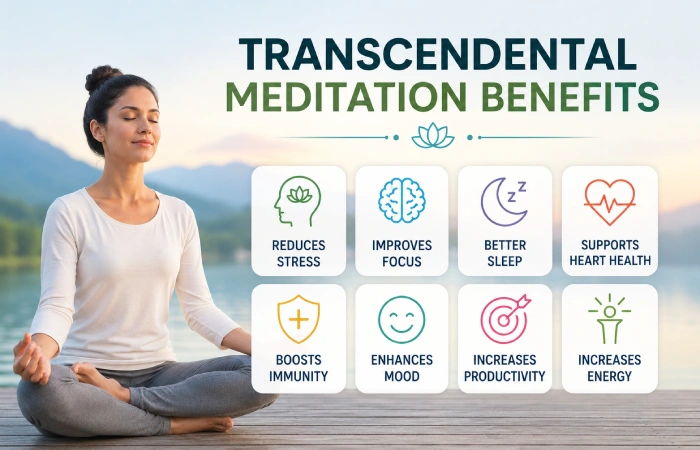
Scientific studies have investigated transcendental meditation achievement in mental health; in emotional health and in physical health. Although every individual has different experience, attending transcendental meditation has often been linked with several achievements.
1. Supports Stress Relief
Relieve stress Say you start meditating to reduce stress.
It is possible that meditation can lower perceived stress and cause relaxation by easing the stress response.
2. Improves Mental Focus
Some people experience a positive increase in concentration when practicing meditation regularly.
Potential cognitive benefits include:
- Improved attention span
- Enhanced memory
- Better creativity
- Quick decision making
- Less mental fatigue.
3. Better Emotional Well-being
Regular TM practice may contribute to:
- Better feeling
- Increased emotional strength
- Reduced irritability
- Increased patience
- Work-life balance; should include a more flexible schedules and home working.
These outcomes are often associated with better stress reduction rather than immediate emotional alterations.
4. Supports Healthy Sleep
Stress is a regular culprit of having a negative effect on sleep.
By encouraging relaxation before bedtime or after busy days, TM may help some individuals:
- Fall asleep more quickly
- Sleep less cations
- Feel more refreshed in the morning
5. May Support Heart Health
Medications, some clinical researching on the link of Meditation and cardiovascular health.
Potential benefits include:
- Better blood pressure levels
- Diminished cardiovascular stress.
- Better relaxation in general
Any use of meditation should be in conjunction with medical care or treatment recommended by a physician.
Transcendental Meditation vs Other Popular Meditation Techniques
| Feature | Transcendental Meditation | Mindfulness Meditation | Guided Meditation | Mantra Meditation |
| Uses a Mantra | Personalized | Yes | Sometimes | Yes |
| Guided Audio | No | Optional | Yes | Optional |
| Focus on Breathing | Yes | Yes | Sometimes | Optional |
| Beginner Friendly | Good | Good | Good | Good |
| Practice Time | 20 min twice daily | Flexible | Flexible | Flexible |
| Instructor Required | Yes (Traditional TM) | No | No | No |
| Primary Goal | Deep Rest | Present Awareness | Relaxation | Mental Focus |
Scientific Research Snapshot
Updates have still implied the possible beneficial effects meditation might have on mental and physical health through regular practice.
Areas Where Evidence Is Strongest
Health Outcome Evidence Strength
Stress Reduction High
Anxiety Support Moderate to High
Sleep Improvement Moderate
Focus & Attention Moderate
Emotional Well-being Moderate
Blood Pressure Support Moderate
Important: Although most studies are promising, there has been a demand for larger, independently funded long-term research into some outcomes. Meditation should be considered healthy lifestyle changes instead of a medical treatment.
Transcendental Meditation vs. Mindfulness Meditation
Feature Transcendental Meditation Mindfulness Meditation
Main emphasis. There was a silent personalized mantra. Came to present moment.
Effort Level Effortless Active attention
Thoughts During Practice Natural and acceptable Were surface thoughts about training. Were completely proper and acceptable. Were not allowed to help the researcher.
Practice Time 20 minutes, twice a day. Flexible
Beginner Difficulty Easy Moderate
Formal Instruction Usually taught by a certified instructor Optional
Conclusion
Transcendental Meditation is still one of the most popular forms of meditation for those seeking a simple, easy meditation technique for beginners to ease anxiety and enhance mental health. Its successful, relaxed meditation technique, using a mantra, make it a popular choice. It has also been studied for many years as a scientific research subject.
No matter what you are seeking–greater concentration, more restful sleep, emotional stability, or meditation as a tool for relieving stress–becoming a committed practitioner beat perfection every time. Look into your options, do some comparisons of TM to other types of meditation, and find what works best for you. When integrated with proper lifestyle habits and a set of positive, attainable goals, meditation becomes a lifelong complement to your pursuit of health and wellness.