
 Sameena Fatima
Health & Wellness Content Writer
in
Sameena Fatima writes reader-focused
health and wellness content for
HealthBloomWeb, covering fitness,
nutrition, healthy lifestyle and
everyday wellness topics.
Sameena Fatima
Health & Wellness Content Writer
in
Sameena Fatima writes reader-focused
health and wellness content for
HealthBloomWeb, covering fitness,
nutrition, healthy lifestyle and
everyday wellness topics.
 Mirza Ibrahim Ali Khan
Editorial & Content Reviewer
in
Mirza Ibrahim Ali Khan contributes to
HealthBloomWeb's editorial review process,
with a focus on content structure,
readability, search intent and overall
editorial quality.
Mirza Ibrahim Ali Khan
Editorial & Content Reviewer
in
Mirza Ibrahim Ali Khan contributes to
HealthBloomWeb's editorial review process,
with a focus on content structure,
readability, search intent and overall
editorial quality.
 Reyansh Sethi
Medical Reviewer
in
Reyansh Sethi contributes to the medical
review process at HealthBloomWeb, focusing
on clarity, responsible health context and
reader-friendly presentation of health
information.
Reyansh Sethi
Medical Reviewer
in
Reyansh Sethi contributes to the medical
review process at HealthBloomWeb, focusing
on clarity, responsible health context and
reader-friendly presentation of health
information.
Loving-kindness meditation may be the most powerful of all existing mrd hand techniques for fostering compassion, emotional strength, and long-term happiness. Another name for this is Metta meditation and it‘s an age-old Buddhist meditation that invites you to build compassion for yourself and your peers with warm, positive words.
This Article is the Part of Meditation
Amid the largely harried and over-scheduled lifestyles that characterize our days and times, more people are noting they struggle with stress, worry, troubling thoughts, and an overall feeling of emotional exhaustion. However, the sustained practice of lovingkindness meditation remains an exceptionally consistent and proven way to undermine these states as it builds positive emotion and healthy relationships, while giving us an emotional lift. According to research findings published into 2026, sustained, routine practice of this and similar forms of meditation remains very good at improving our level of stress and fostering psychological and emotional health, not to mention self-compassion.
If meditation is completely new to you, or you‘re simply researching the possibilities of enriching your mindfulness practice, such as exploring Metta meditation, this guide will give you all the information you need to know.
Loving-Kindness Meditation What is Loving-Kindness Meditation?
Love-kindness meditation is a mindfulness practice of mentally reciting phrases of good will and compassion towards your ife and person toperson.Â
Parallel to most of the meditation exercises that are concerned mainly with watching thoughts or withrespiration; Metta meditation exercises directly efforts to guide mind into positivefeelingslike:
- Kindness
- Compassion
- Thanks
- Forgiving you
- Empathy
- Acceptance
Its purpose is not “to feel happy” in meditation but “to work daily at cultivating more positive feelings. ”
Metta has different interpretations and explanations
There is also a variety of explanations of the meaning of metta The Pali word for loving kindness is:
- Loving kindness
- Universal friendliness
- Good natured, Affectionate
- unreserved goodwill
Rather than attempting to induce positive emotion, people practicing compassion then softly repeat sentiments such as:
- Seja feliz.
- Let me be well.
- May I be safe?
- I pray that I may dwell with simplicity.
Gradually these wishes are beginning to go out to members of our family and friends, to acquaintances and enemies, and ultimately to all beings.
How Loving-Kindness Meditation Works
In contrast to concentration meditation, loving-kindness meditation facilitates learning by actively reinforcing neural circuits related to feelings of success.
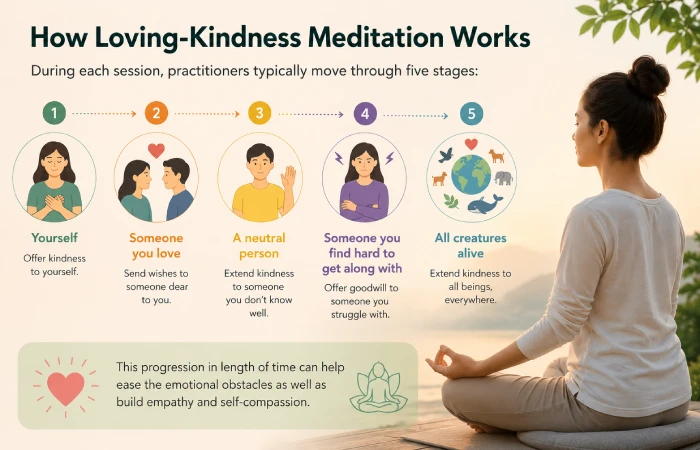
During each session, practitioners typically move through five stages:
Stage Focus:
- Yourself.
- Someone you love
- A neutral person
- Someone you find hard to get along with
- All creatures alive
This progression in length of time can help ease the emotional obstacles as well as build empathy and self-compassion.
The goal is not to stifle negative feelings but rather to face them with compassion, rather than judgment.
Why Starting with Yourself Matters
A misconception of many novices is that one should begin by trading compassion with others.
Conversely, it appears that exercises in self-acceptance are most sustainable when they are practiced first, which in the long term could make it easier to serve others with true kindness. For individuals who are highly critical of themselves, this first stage appears to be the most difficult, yet most fulfilling.
Self-compassion can build healthier relationships, help us cope more effectively with stress, and provide us with a broader repertoire for emotional resilience.
The Science Behind Loving-Kindness Meditation (2026 Research)
In the last decade the interest in meditation as an aid for happiness and emotional health has grown remarkably. Academic institutions, health organization and other bodies are still conducting research on the effect of compassion-based meditation on mental well-being.
More recent studies have observed that regular loving-kindness meditation is related to:
| Area Studied | Research Findings (2026) |
| Emotional resilience | Better ability to recover from stress |
| Self-compassion | Greater acceptance and less self-blame |
| Anxiety symptoms | Many participants indicated that perceived stress had decreased. |
| Social connection | Ending up with more sympathetic friendlier feelings and greater empathy with some understanding on their own part |
| Positive emotions | More gratitude, optimism and life satisfaction |
Although meditation cannot substitute for professional treatment of mental health, increasing evidence points that it is a useful adjunct for many.
Growth of Meditation Worldwide
The use of mediation is one of the fastest growing areas in the world today.
Year Estimated Global Meditation & Mindfulness Market
- 2022 $5.6 Billion
- 2023 US 6.3 billion
- 2024 $7.1 Billion
- 2025 $8.0 Billion
- 2026 About $9 Billion
Trend: Wider acceptance of mindfulness apps and digital mental health platforms such as those offered through workplace wellness programs is a reflection of the increased societal interest in loving-kindness meditation.
Benefits of Loving-Kindness Meditation
The fact that even today this practice is still Popular, has to do with the myriad of emotional and psychological merits it offers.
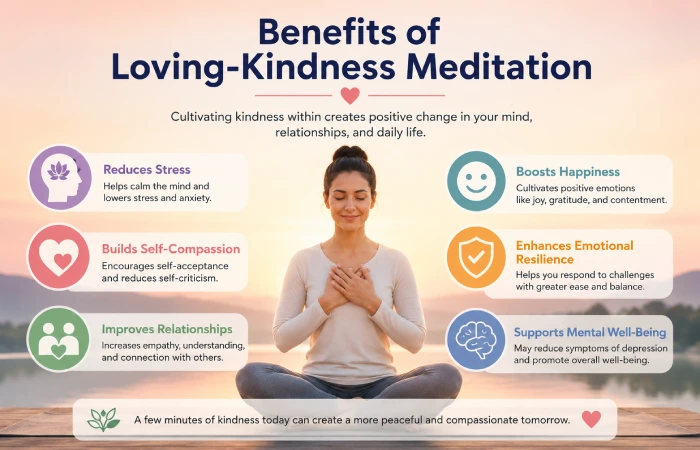
While experiences differ, many practitioners notice positive effects after several weeks of regular practice.
| Benefit | How It Helps |
| Reduces stress | Promotes relaxation and helps people stay more relaxed emotionally |
| Improves self-esteem | Tolerates failure without derision and replaces it with self-acceptance |
| Builds empathy | Increases appreciation and understanding of others |
| Supports emotional wellness | Promotes equitable emotional control |
| Enhances happiness | Encourages thankful feelings and positive emotions to flourish |
| Builds relationships | Promotes patience, forgiveness, and understanding |
| Improves resilience | Supports overcoming problems more successfully |
Loving-Kindness Meditation vs. Other Meditation Styles
Many beginners ask how loving-kindness practice differs from meditation on mindfulness or compassion.
| Feature | Loving-Kindness Meditation | Compassion Meditation | Mindfulness Meditation |
| Main objective | unconditional kindness | decrease suffering | be present to present moment |
| Focus | Positive intentions | Empathy and compassion | Observation without judgment |
| Beginner Friendly | Excellent | Excellent | Excellent |
| Uses Repeated Phrases | Good | Sometimes | Rarely |
| Emotional Focus | Happiness and goodwill | Compassion for suffering | Awareness and acceptance |
| Best For | Emotional wellness practices | Deep empathy | Stress reduction and focus |
Frequently Asked Questions
Is loving-kindness meditation different from Metta meditation?
Yes. Metta is the Pali word for loving-kindness, goodwill, and friendliness toward all beings.
What is the ideal duration for meditation?
Begin using 5–10 minutes a day. The key is regularly using the tool. Duration of sessions less important than frequency.
Is loving-kindness meditation effective for anxiety?
For many individuals, practicing daily can be a very effective means of relieving stress, and encouraging emotional relaxation. However, practicing should not be used as a substitute for other professional mental health treatment avenues.
Homestay Can I practice before sleep?
Definitely. A lot of people do the loving-kindness meditation as their evening practice because it promotes relaxation and positive feelings.
Does it have to be a Buddhist practice for me to do it?
No. Loving-kindness meditation is practiced in both Buddhist and secular mindfulness traditions.
Final Thoughts
Loving-kindness meditation is a straightforward but potentially rewarding technique for promoting well-being, compassion, and happiness.
With just a few minutes a day of repeating kind intentions, you will slowly begin to reprogram your mind to be more patient, caring, and understanding of both yourself and others.
For beginners, 5 minutes every day should suffice and let the benefits gradually happen by itself.
For a well-rounded mindfulness routine, you may also enjoy exploring:
- Guided Mindfulness Meditation
- Mindfulness-Based Stress Reduction (MBSR)
- Guided Meditation vs. Silent Meditation
- Forms of meditation.
- Palouse Mindfulness
Getting started is the most important thing.
I wish you joy I wish you health I wish you safety, I wish you long life