
 Sameena Fatima
Health & Wellness Content Writer
in
Sameena Fatima writes reader-focused
health and wellness content for
HealthBloomWeb, covering fitness,
nutrition, healthy lifestyle and
everyday wellness topics.
Sameena Fatima
Health & Wellness Content Writer
in
Sameena Fatima writes reader-focused
health and wellness content for
HealthBloomWeb, covering fitness,
nutrition, healthy lifestyle and
everyday wellness topics.
 Mirza Ibrahim Ali Khan
Editorial & Content Reviewer
in
Mirza Ibrahim Ali Khan contributes to
HealthBloomWeb's editorial review process,
with a focus on content structure,
readability, search intent and overall
editorial quality.
Mirza Ibrahim Ali Khan
Editorial & Content Reviewer
in
Mirza Ibrahim Ali Khan contributes to
HealthBloomWeb's editorial review process,
with a focus on content structure,
readability, search intent and overall
editorial quality.
 Reyansh Sethi
Medical Reviewer
in
Reyansh Sethi contributes to the medical
review process at HealthBloomWeb, focusing
on clarity, responsible health context and
reader-friendly presentation of health
information.
Reyansh Sethi
Medical Reviewer
in
Reyansh Sethi contributes to the medical
review process at HealthBloomWeb, focusing
on clarity, responsible health context and
reader-friendly presentation of health
information.
Mindful breathing is one of the easiest and most successful mindfulness practices that you can do for your mind and body. When you focus fully on each breath, simply observing it without attempting to alter it in any way, you will find that your thoughts become more clear, your tension decreases, your concentration improves and your feelings become better recognized. If you are just starting out with mindfulness or are just looking for a simple technique to add some peacefulness into your life, mindful breathing is a good place to begin.
This Article is the Part of Mindfulness
Mindful breathing is simple, straightforward, and does not have expensive equipment, memberships, or a significant time learning curve. It can be performed anywhere in the office, in the car, while you‘re waiting in line, or even before going to sleep. In our frazzled world, a little bit of time spent concentrating on one‘s breath can go a long way in improving overall mental health.
In this article, I will teach you what mindful breathing is, how it works, the science-based benefits, and some easy mindful breathing techniques you can start practicing right now.
What Is Mindful Breathing?
Other breathe awareness exercises include Mindful breathing. Mindful breathing involves simply focusing your attention on your own breath when breathing. Rather than allowing your mind to roam from work to obligations and worries, you just guide your focus to your body and breathe when you notice your thoughts drifting away.
What we‘re not attempting to do is to breathe in a certain manner or clear mind completely. We are watching our breathing with interest and as non-judgmentally as possible.
This simple awareness also helps to reinforces your mind/body connection while triggering your body natural relaxation response.
Key Characteristics of Mindful Breathing
- Focusing on every breath I took in and let out
- allowing their bodies to breathe naturally and freely without forcing the natural rhythm of the music, including the sounds of the breathing
- Noticing thoughts but not engaging with them
- Focusing on your breath whenever you become distracted
- Patience and persistent practice.
As it is, mindful breathing is too simple, so it is suggested to start with it before the longer range of breathing meditation starts, or different options of mindful exercises.
The importance of mindfully breathing?
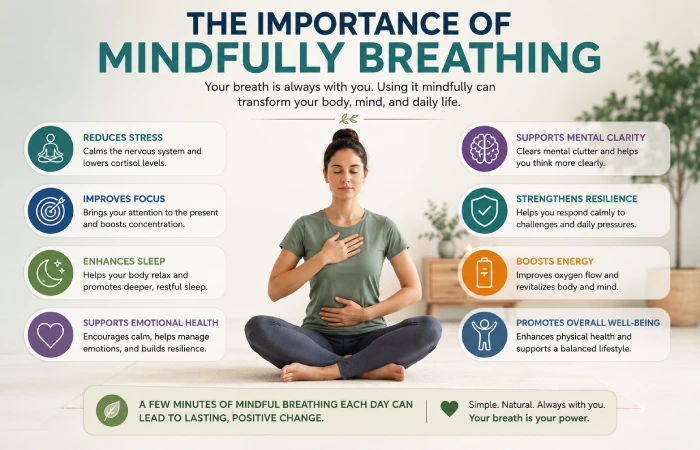
Contemporary lifestyle inundates us with alerts, deadlines and data overload. Such stresses in our mundane lives can maintain the activation of the adrenal response over extended periods, impairing focus, sleep patterns and emotional stability.
Practising a mindful breathing technique also allows one to quickly break this cycle.
When you are focused on your breathing, your nervous system adjusts itself away from a “fight or flight” response to a more relaxed “rest and digest”. This supports the recovery of your body from stress and increases the clarity of your thinking.
Most health care practitioners, Mindfulness teachers, and workplace health and wellness programs have included mindful breathing in their mental health and wellness practice because of its ease of mastery and accessibility for all ages.
How Does Mindful Breathing Function?
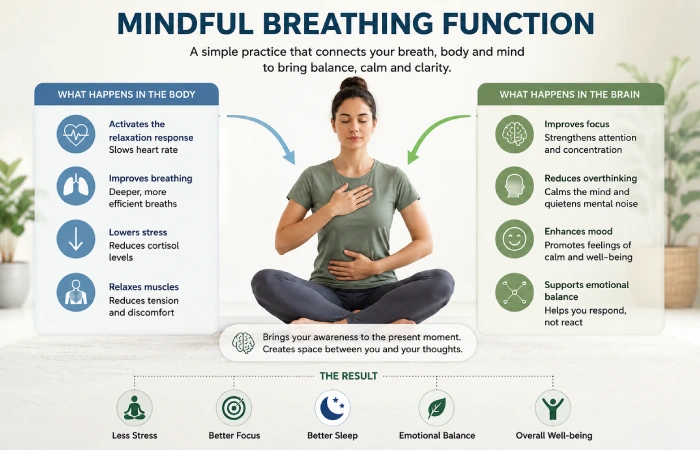
Every time you breathe, it‘s communicating with your lungs, brain and nervous system.
Sometimes, when you‘re anxious or feeling overwhelmed, your breathing will become rapid and shallow. When you are feeling calm, your breathing will become slow and deep.
Awareness of the Breath brings the mind to take a more watchful interest. Commonly experiences aren‘t liked, because Breathing can upsets the body‘s Co-ordination, and we areaprehensive. With Mindful Breathing you use the Breath to observe, and from this is the real power.
As your attention settles on your breath, several positive changes begin to occur:
- Heart rate steadily decreses
- Muscle tension drops
- Overwhelmed by thoughts fades away
- Emotion can also be learn to be easier to handle
- attention reduces becomes more selective
With practice, it will become easier to take a moment to think and respond instead of reacting to the situation.
Science Behind Mindful Breathing
Enhanced research on the positive effects of mindfulness and breathing meditation on mental and physical health
Recent studies published through 2026 suggest that consistent mindful breathing practice may help:
- Lower perceptions of stress
- Enhance attention and concentration
- Better emotion regulation
- Encourage improved sleep quality
- Alleviate mild anxiety symptoms
- Enhance general psychological health and sleep dynamics.
Researchers are still investigating the effects of mindful breathing on other important measures related to general health and wellness which includes heart rate variability (HRV).
Although medication cannot be replaced by mindful breathing, most health professionals support the use of mindful breathing as a complementary self-care strategy in addition to a healthy lifestyle.
2026 Research Summary
| Research Area | Findings |
| Stress Management | Regular sitting/asynchronous mindful breathing has been found to predict lower perceived stress. |
| Focus and Attention | Has shown that brief daily sessions improves sustain attentiveness and mental clarity. |
| Sleep Quality | Practicing breathing exercises in the evening might ease the individual into sleep. |
| Emotional Regulation | Mindfulness training enhances a person‘s understanding of their emotional states. |
| Workplace Wellness | A quick breathing exercise can help workers take time out of a busy workday. |
Expert Tip: The power of mindfulness to be planted daily, throughout the day depends upon consistency and not necessarily duration. After all, five minutes of practice a day can lay the building blocks of a lifetime mindfulness practice.
Benefits of Mindful Breathing
1. Helps Reduce Everyday Stress
Perhaps the best known use of mindful breathing is to reduce stress.
Rather than being anxiously preoccupied with thoughts of the future, or dwelling in a painful regret about the past, mindful breathing focuses you on the here-and-now. This in turn often affords you a feeling of greater calm and mastery.
2. Improves Focus and Concentration
If you‘re the type who frequently loses focus while studying, and doing work, then lots of meditation breathing will help you train your attention.
Every instance when your mind wanders and you kindly make it return to your breath is an opportunity to strengthen this ability. Additionally, with consistent mindfulness practice, we develop greater focus and efficiency over a period of time.
3. Supports Emotional Well-Being
Mindful breathing: Your breath is only yours. You can observe your breath moving in and out without having to judge it or analyze.
Instead of numbing the emotions, you simply learn to notice them and accept them more freely. This can increase emotional resilience and lead to more calm responses to difficult circumstances.
4. Encourages Better Sleep
A common mindfulness practice that people do as part of their bedtime routine is mindful breathing.
Sleep before will also be helping by practicing for five to ten minutes.
If you often find it hard to relax after a long, busy day then mindfulness breathing can be a nice way to ease yourself into a calmer state.
5. Promotes Healthy Mental Wellness Practices
Mindful breathing is often combined with other mindfulness exercises such as:
- Body scan meditation
- Walking meditation
- Loving-kindness meditation
- Mindfulness meditation (guided)
- Entries to my journal:
- Hands on yoga
These practices along with other holistic methods can help to create a healthy and sustained mental wellness regimen.
Mindful Breathing vs. Breathing Meditation
There are a few minor distinctions, despite the fact that they are often translated as synonyms.
| Mindful Breathing | Breathing Meditation |
| Focus on watching the natural breath and | develops the breath as the object of meditation |
| Can be done whenever | Usually practiced at a set time |
| Great for quick stress relief | from stress often takes longer time to practice |
| Suitable for beginners | May include other types of mindfulness practices for beginners |
Most beginners would find having a gentle introduction via mindfully breathing before relaxing into the longer breathing meditation.
How to Practice Mindful Breathing
Getting organized… Getting started is often easier than many people think.
Step 1: Choose a Quiet Space
Choose a place to sit where it will be unlikely that you will be disturbed.
Step 2: Sit Comfortably
Maintain a naturally erect but relaxed stance.
Lean forward a little and place your hands either on your lap or on your knees.
Step 3: Notice Your Breath
Breathe naturally.
Just pay attention to each breath in and each breath out.
Repeating respiratory exercises. Don‘t attempt to manipulate your airflow.
Step 4: Gently Refocus
Your attention (brain) will, in time, wander.
If this happens, kindly redirect your attention back to your breathing. Avoid harsh self-criticism.
Step 5: Practice Daily
Start with 5 minutes. 30 minutes a day.
As you gain confidence, extend your sessions to 10–15 minutes.