
 Sameena Fatima
Health & Wellness Content Writer
in
Sameena Fatima writes reader-focused
health and wellness content for
HealthBloomWeb, covering fitness,
nutrition, healthy lifestyle and
everyday wellness topics.
Sameena Fatima
Health & Wellness Content Writer
in
Sameena Fatima writes reader-focused
health and wellness content for
HealthBloomWeb, covering fitness,
nutrition, healthy lifestyle and
everyday wellness topics.
 Mirza Ibrahim Ali Khan
Editorial & Content Reviewer
in
Mirza Ibrahim Ali Khan contributes to
HealthBloomWeb's editorial review process,
with a focus on content structure,
readability, search intent and overall
editorial quality.
Mirza Ibrahim Ali Khan
Editorial & Content Reviewer
in
Mirza Ibrahim Ali Khan contributes to
HealthBloomWeb's editorial review process,
with a focus on content structure,
readability, search intent and overall
editorial quality.
 Reyansh Sethi
Medical Reviewer
in
Reyansh Sethi contributes to the medical
review process at HealthBloomWeb, focusing
on clarity, responsible health context and
reader-friendly presentation of health
information.
Reyansh Sethi
Medical Reviewer
in
Reyansh Sethi contributes to the medical
review process at HealthBloomWeb, focusing
on clarity, responsible health context and
reader-friendly presentation of health
information.
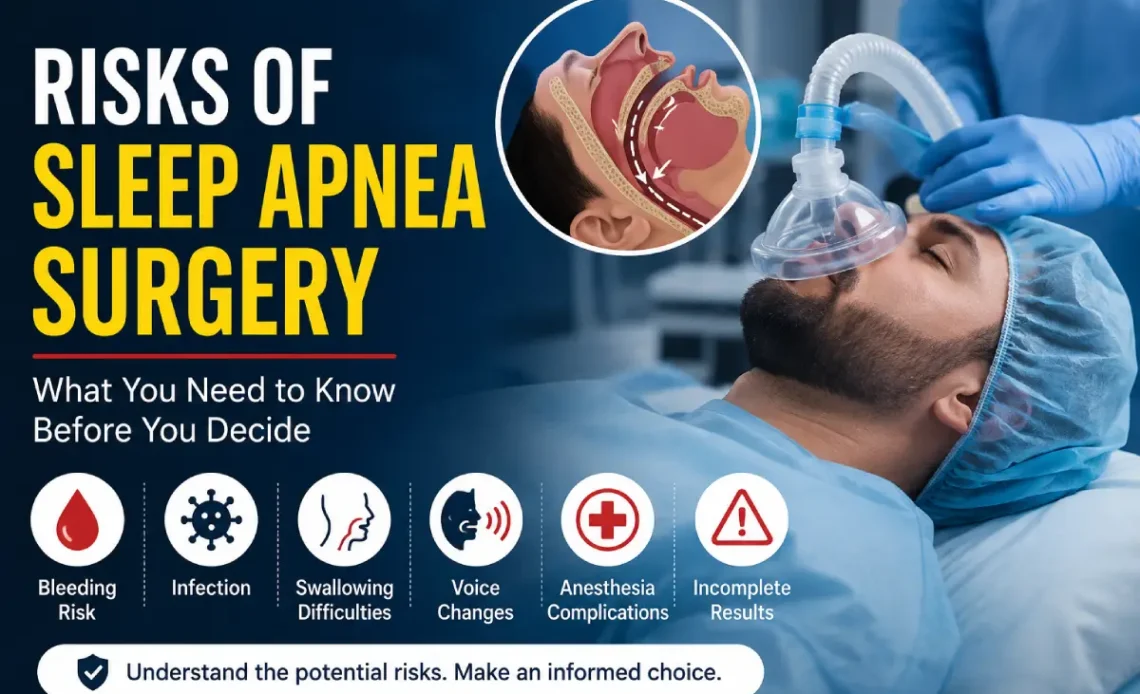
Sleep apnea surgery can be a beneficial treatment for some individuals who are unable to tolerate CPAP or have specific airway obstructions. Although the operation has the potential to improve respiration, decrease snoring, and improve sleep, it is important to understand the risks of sleep apnea surgery before deciding to proceed. Each operation has the possibility of complications and recognizing the benefits along with the potential complications allows you to discuss them with your physician.
This handout covers common surgical side effects, potential sleep apnea complications and surgical risks for various procedures. It will help you to be informed about what to expect before and after surgery.
This Article is the Part of Sleep Improvement
Sleep Apnea Surgery What Is?
Sleep apnea surgery is a collection of procedures aiming to excise or reposition tissues that obstruct the upper airway when a patient sleeps. It is generally advised for individuals with obstructive sleep apnea (OSA) that have not responded sufficiently to CPAP, oral appliances, and changes to their lifestyle.
Common procedures include:
- Uvulopalatopharyngoplasty (UPPP)
- Tonsillectomy or adenoidectomy
- Other types of nasal surgery (septoplasty or turbinate reduction)
- Reduction of the tongue base
- Maxillary-mandibular advancement (MMA).
- Inspire upper airway stimulation implant
Every operation can be different, has its own recovery period, its own success rate, and its own possibility of danger.
Is Sleep Apnea Surgery Out Safe?
“While the risks of sleep apnea surgery for most healthy patients are very small when undertaken by an experienced ENT specialist or oral and maxillofacial surgeon, “all operations, of course, carry some risk”.
Many factors, including age, obesity, diabetes, smoking, heart disease, and severity of sleep apnea may put you at higher risk for complications and will be discussed with you by your surgeon.
Common Risks of Sleep Apnea Surgery
The following surgical risks are among the most frequently discussed before treatment:
| Risk | Description |
| Bleeding | MILD Bleeding is more common than severe, which is less common but life threatening. |
| Infection | Surgical wounds can become infected. Infections can occur even if antibiotics were given prophylactically. |
| Pain | Sore throat and discomfort with swallowing are anticipated during convalescence. |
| Swelling | Temporary swelling may cause problems with breathing or swallowing. |
| Anesthesia complications | Uncommon reactions are nausea, allergic reactions, or breathing problems. |
Most of these complications are transient and resolve with appropriate postoperative management.
Short-Term Surgery Side Effects
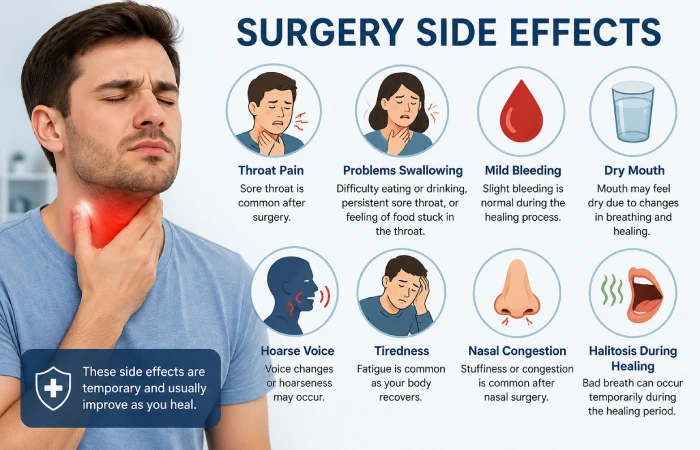
The majority of patients experience temporary surgery side effects very soon after the operation which would be seen as ‘normal’ healing.
These may include:
- Throat pain
- Problems swallowing, including finding it hard to eat and drink, experiencing a persistent sore throat that won’t go away, and a sensation of food getting stuck in your throat.
- Mild bleeding
- Dry mouth.
- Another condition that was specifically specified as an EAP is a hoarse voice.
- Tiredness
- Nasal congestion (after nasal operation)
- Halitosis during healing
Symptoms typically resolve from 1–3 weeks depending on the procedure.
Long-Term Sleep Apnea Complications After Surgery
However, there is potential for the some patients to experience longer term sequelae.
Potential long-term concerns include:
- Ongoing problems with swallowing
- Changes to Quality of Voice
- Dry mouth
- Scar tissue formation
- Persisting snoring
- Persistent sleep apnea symptoms following treatment:
- Need for further operations
It must be stressed that surgery may reduce airway obstructions but does not necessarily cure obstructive sleep apnea.
Risks by Type of Sleep Apnea Surgery
Different procedures pose different degrees of risk.
| Procedure | Common Risks |
| UPPP | bleeding, dysphagia, voice changes |
| Tonsillectomy | Bleeding, infection, dehydration |
| Nasal Surgery | Bleeding, congestion, temporary numbness |
| Tongue Reduction | bogginess, change in speech, pain on swallowing |
| Inspire Implant | Infection, device pain, tongue weakness |
| MMA Surgery | Facial swelling and numbness, jaw pain, longer recovery time |
The complications specific to the operation that most closely resembles your airway anatomy will be described to you by your surgeon.
Who is at Greater Risk for Surgical Morbidity?
Some health conditions tend to predispose to complications during or after surgery.
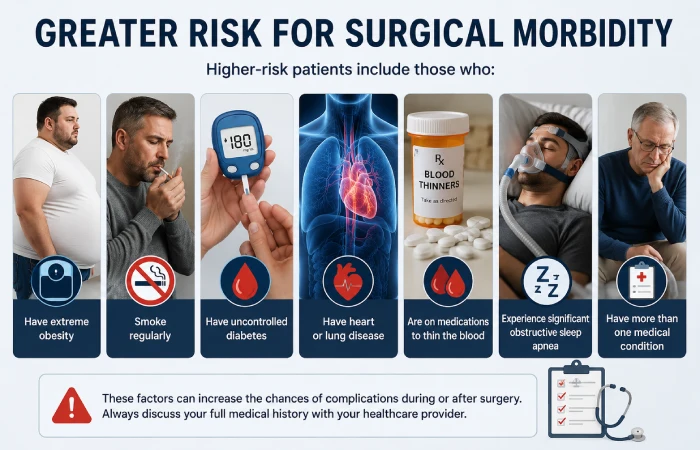
Higher-risk patients include those who:
- Have extreme obesity
- smoke regularly
- Have uncontrolled diabetes
- Have heart or lung disease
- Are on medications to thin the blood
- Experience significant obstructive sleep apnea
- Have more than one medical condition
Enhancing your health prior to surgery can lower your risks of complications.
How Surgeons Reduce Surgical Risks
Medical teams adopt a number of approaches to increasing safety prior to, during and after surgery.
These include:
- Complete sleep research
- Airway imaging including x-ray and CT; airway examination.
- Preoperative medical assessment: Secondly, its about the potential dental treatments require the assessment of the patient as a whole and the general health preoperative by means of the most common screening.
- Select and plan anesthesia well
- Antibiotics where indicated
- Follow-up visits to check healing progress
Closely adhering to your surgeon‘s instructions is the best way to decrease complications.
Recovery Tips for a Safer Healing Process
Good postoperative care can lead to a smooth recuperation.
To promote healing:
- Drink lots of fluids.
- Eat soft foods if advised to do so.
- Follow doctor’s orders and take medications exactly when instructed.
- Avoid smoking and drinking.
- Get Plenty of Sleep.
- Do not engage in heavy activity until your surgeon gives you the okay.
- Completes all follow-up visits.
Seek medical attention if you become heavily bleeding, develop a high fever, experience severe difficulty breathing, chest pains or become dehydrated.
Benefits vs. Risks of Sleep Apnea Surgery
Every decision to treat involves a risk–benefit analysis.
| Potential Benefits | Possible Risks |
| Reduced airway obstruction | Bleeding |
| Enhanced sleep quality | Infection |
| Reduced fatigue | during the day Pain |
| Less snoring | Difficulty swallowing |
| Improved oxygen saturation | Phrasing of some voice changes |
| Enhanced quality of life | Further operation desired/required |
However, in highly selected cases, the advantages of ra are likely to be greater then risk, once all nonoperative treatment options have been exhausted.
If You Decide on Surgery?
Alternatives to sleep apnea surgery may be appropriate if you:
- Unable to sit on CPAP.
- Have a distinctively witnessed airway obstruction.
- Persisting moderate to severe OSA despite other interventions.
- Are fit for major surgery, as determined by your medical assessment.
However, for some people, surgery isn‘t the first treatment option your doctor will prescribe. You may be advised to try CPAP, a dental appliance, lose weight, or sleeping position changes.
Frequently Asked Questions
Is sleep apnea surgery potentially dangerous?
Serious complications are rare but all surgery has potential risks. Selecting an experienced surgeon and following postoperative advice will reduce the likelihood of complications.
Will orthognathic surgery cure all sleep apnea?
Not always. It depends on the procedure, severity of the sleep apnea and the individual. Some still require CPAP or other further treatment.
Recovery Time?
Most people heal within 2-6 weeks, but various differing procedures can extend the healing time; for example maxillomandibular advancement.
What is the most common complication?
Persistent sore throat, in combination with pain and transient difficulty in swallowing are generally the most commonly reported side effects after an operation on the upper airway.
Key Takeaways
By knowing what to expect from sleep apnea surgery, you are in a better position to discuss treatment options with your doctor. Because most of the possible complications such as bleeding, infection, swelling and temporary swallowing difficulties can occur, the chance of serious complications develops, when surgery is performed on appropriately selected candidates. Tell your sleep specialist or doctor about your medical history, your goals and what other treatments may be available to help you determine if surgery is right for you.