
 Sameena Fatima
Health & Wellness Content Writer
in
Sameena Fatima writes reader-focused
health and wellness content for
HealthBloomWeb, covering fitness,
nutrition, healthy lifestyle and
everyday wellness topics.
Sameena Fatima
Health & Wellness Content Writer
in
Sameena Fatima writes reader-focused
health and wellness content for
HealthBloomWeb, covering fitness,
nutrition, healthy lifestyle and
everyday wellness topics.
 Mirza Ibrahim Ali Khan
Editorial & Content Reviewer
in
Mirza Ibrahim Ali Khan contributes to
HealthBloomWeb's editorial review process,
with a focus on content structure,
readability, search intent and overall
editorial quality.
Mirza Ibrahim Ali Khan
Editorial & Content Reviewer
in
Mirza Ibrahim Ali Khan contributes to
HealthBloomWeb's editorial review process,
with a focus on content structure,
readability, search intent and overall
editorial quality.
 Reyansh Sethi
Medical Reviewer
in
Reyansh Sethi contributes to the medical
review process at HealthBloomWeb, focusing
on clarity, responsible health context and
reader-friendly presentation of health
information.
Reyansh Sethi
Medical Reviewer
in
Reyansh Sethi contributes to the medical
review process at HealthBloomWeb, focusing
on clarity, responsible health context and
reader-friendly presentation of health
information.
Mindfulness for Anxiety
Inconsistent or frequent anxious thoughts can sometimes be overwhelming; meditation for anxiety or practicing mindfulness may bring you back to a peaceful state of mind. Mindfulness trains you to be mindful of the current moment rather than the past or future worries. It is not a treatment for anxiety disorders, but many studies have found mindfulness can be used as an effective way of decreasing stress, bettering mood, and promoting overall health of mind and body in conjunction with lifestyle changes or treatment.
Whether you are experienced with mindfulness and want some other options for anxiety, or a beginner, you will find information here to learn what mindfulness is, how it helps and some exercises you can do today.
This Article is the Part of Mindfulness
What is Mindful Attention for Anxiety?
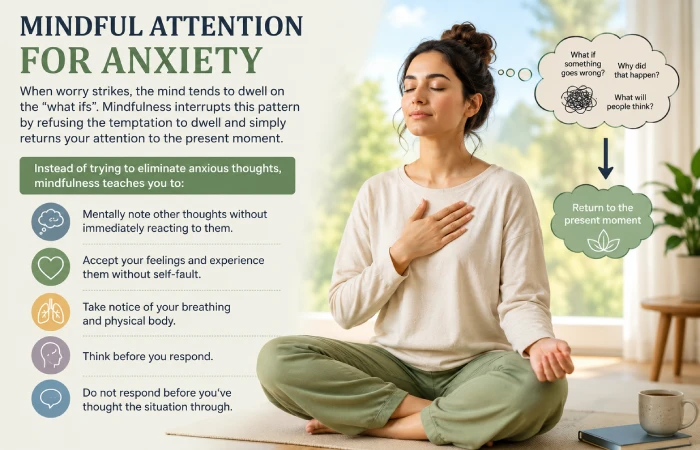
Mindfulness: paying purposeful attention to your thoughts, feelings and physical sensations, and to what is going on around you with an attitude of non-judging.
When worry strikes, the mind tends to dwell on the “what ifs”. Mindfulness interrupts this pattern by refusing the temptation to dwell and simply returns your attention to the present moment.
Instead of trying to eliminate anxious thoughts, mindfulness teaches you to:
- Mentally note other thoughts without immediately reacting to them.
- Accept your feelings and experience them without self-fault.
- Take notice of your breathing and physical body:
- Think before you respond.20 Do not respond before you‘ve thought the situation through.
These, however, can eventually alleviate emotional well-being and positively buffer thee pain and stress which feelings of stress evoke.
How Mindfulness Helps Reduce Anxiety
Anxiety triggers the body‘s stress response causing higher heart rate, more muscle tension and spinning thoughts. Mindfulness triggers the relaxation response by fostering slower breath and a focus on only the present.
Regular practice may help:
- Decrease worrying.
- Significant enhancement of emotional regulation.
- Increase self-awareness.
- Less perceived stress.
- Improves concentration.
- Promote better sleep practices.
- Develop resilience in tough times.
Additionally, many psychologists cite Mindfulness therapy techniques under evidence-based therapies such as MBSR (Mindfulness-Based Stress Reduction) and MBCT (Mindfulness-Based Cognitive Therapy).
Benefits of Mindfulness for Anxiety
Regular practice of mindfulness brings about a variety of benefits, both immediate and long term.
Immediate Benefits
- Greatest variation through which the envelope of the signal can be modulated from slower breating
- Decreases in muscle tension:
- Soothed windier under pressure
- Greater awareness of anxious thoughts
Long-Term Benefits
- The better emotional well-being
- Better stress handling.
- Convince yourself more Increased focus and concentration.
- Better relationships
- Improved sleep quality
As long as you‘re consistent, you don‘t have to be perfect. Just 10 minutes a day for two weeks can become a permanent new routine.
Simple Mindfulness Exercises for Anxiety
1. Mindful Breathing
Breathing while being mindful of it is among the simplest means to reduce anxiety.
Steps:
- Get comfortable.
- If you‘re happy to do so, then simply close your eyes.
- Breathe in all the way through your nose as slowly as you can for four seconds.
- Breathe out through your mouth softly and slowly. ( count to six).
- Just attend to the feelings of your breath.
- If your mind is wandering just bring your attention back to breathing.
Practise daily for 5–10 minutes.
2. Body Scan Meditation
The meditation which I will be doing for the body scan is a one of focus on physical feeling
Starting from your toes, gradually raise your consciousness upward along your bare body. Focus on your toes, then your feet, your lower legs, your thighs etc.
Identify points of tension without specifically trying to eliminate them. These general observations in themselves help to foster a sense of relaxation.
3. Five Senses Grounding Technique
This activity is especially beneficial when feeling anxious.
Identify:
- 5 things you observe:
- Touch on four products. (4 things you can touch).
- 3 cosas que puedes escuchar
- 2 things you can smell
- 1 item you can taste
The purpose of grounding techniques is to divert your focus away from anxious thinking and realign your attention to your environment.
4. Mindful Walking
Take a slow walk while paying attention to:
- Each stages
- What you breathe in.
- Sounds that you can hear:
- The sensation of the land underneath your feet.
Walking meditation can be useful in conjunction with meditation by helping to relax the mind and body. It is usually warm and languid and should not be hurried or forced, and the gentle motion may be useful if sitting is a problem.
Meditation for Anxiety
Using meditation to manage anxiety is common for many individuals as part of their regular health routine.
Popular meditation styles include:
- Meditation instructions
- The meditation of attention on breathing
- Loving-Kindness meditation.
- Mindfulness meditation
- Body scan meditation
Those who are new may find benefits in using the guided sessions as these can provide gentle cues and help keep the practitioner motivated.
Creating a Daily Mindfulness Routine
All session should be uniformed duration.
A simple daily routine might include:
Morning (5 minutes)
- Breathing consciously
- Have a plan or intention for the day
Afternoon (2 minutes)
- Deep breathes prior to meetings, or hard tasks
- In the evening 10 minutes Body scan meditation
Gratitude reflection
Breathing more slowly before bedtime.
The trick with working out isn‘t to pay for a gym you never go to. It‘s about sticking with the 5 minute things you‘d routinely do every day. Small daily habits work better than occasional longer durations:
Common Beginner Mistakes
Many believe they are messing up “doing” mindfulness. Actually, it is perfectly normal to be distracted.
Avoid these common mistakes:
- Attempting to suppress thoughts entirely
- Expecting immediate results
- Only during stressful times.
- Criticise yourself when you lose focus Quitting after two or three sessions
- Mindfulness means playing gently with your attention and bringing it back softly.
When Mindfulness May Not Be Enough
Mindfulness may be helpful in managing ordinary stress and mild anxiety, but is not a substitute for professional treatment for severe or chronic symptoms.
Consider speaking with a healthcare professional if anxiety:
- Interferes with daily life
- Causes panic attacks
- Prevents work or social activities
- Persists for weeks with no changes.
- Is associated with suicidal ideation.
Your mental health care provider might recommend therapy, medication, lifestyle modifications, or a mixture of treatments.
Tips for Long-Term Success
To build a lasting mindfulness habit:
- Begin by doing only five minutes at first. Practice at the same time every day.
- Use guided meditation if you are a novice.
- Have a little patience with yourself.
- Celebrate small advances.
- Integrate mindfulness with proper sleep, adequate exercise, and a balanced diet.
Keep in mind, that mindfulness is something that takes time so it should be practiced regularly.
Conclusion
Regular practice of mindfulness for anxiety can support you in recognizing your thoughts, apply stress responses with more calmness, and boost your emotional health. You can utilize Mindful breathing, grounding scripts, body scan meditation, or meditation for anxiety, but the benefits of daily minutes may add up with practice.
In everyday life, mindfulness as part of meditation and exercise (making yourself more aware and conscious of issues of all kinds) and by reaching out to professionals, you can learn better means of coping and becoming stronger in dealing with life‘s stresses.
Frequently Asked Questions
Got anxiety? It might be helped by mindfulness.
The literature indicates that practicing mindfulness on a daily basis has the potential to decrease stress levels; mitigate emotional dysregulation and may facilitate coping with symptoms of anxiety for some individuals.
10 minutes?
For new practitioners, starting at 5–10 minutes of practice per day is ideal, but as the habit is formed sessions could be extended to 20+ minutes.
Do you rethink that is meditation and mindfulness?
Not really. Meditation is a set activity and mindfulness is a technique of observing the current activity.
Is Mindfulness Safe For Beginners?
Yes. Anyone can do mindfulness and it can be learned very easily in breathing, guided meditations and in accuration exercises.