
 Sameena Fatima
Health & Wellness Content Writer
in
Sameena Fatima writes reader-focused
health and wellness content for
HealthBloomWeb, covering fitness,
nutrition, healthy lifestyle and
everyday wellness topics.
Sameena Fatima
Health & Wellness Content Writer
in
Sameena Fatima writes reader-focused
health and wellness content for
HealthBloomWeb, covering fitness,
nutrition, healthy lifestyle and
everyday wellness topics.
 Mirza Ibrahim Ali Khan
Editorial & Content Reviewer
in
Mirza Ibrahim Ali Khan contributes to
HealthBloomWeb's editorial review process,
with a focus on content structure,
readability, search intent and overall
editorial quality.
Mirza Ibrahim Ali Khan
Editorial & Content Reviewer
in
Mirza Ibrahim Ali Khan contributes to
HealthBloomWeb's editorial review process,
with a focus on content structure,
readability, search intent and overall
editorial quality.
 Reyansh Sethi
Medical Reviewer
in
Reyansh Sethi contributes to the medical
review process at HealthBloomWeb, focusing
on clarity, responsible health context and
reader-friendly presentation of health
information.
Reyansh Sethi
Medical Reviewer
in
Reyansh Sethi contributes to the medical
review process at HealthBloomWeb, focusing
on clarity, responsible health context and
reader-friendly presentation of health
information.
Anxiety can cause us to feel overwhelmed by our experiences. Millions of people around the world suffer from a range of anxieties: racing thoughts, being overwhelmed, feeling restless, and having difficulty concentrating. Thankfully, meditation for anxiety has become a simple, easy-to-learn, scientifically validated practice that can help cut stress and increase well-being.
Whatever your situation is – whether you experience sporadic anxiety, or you want to learn tools to manage anxiety on an ongoing basis – meditation will give you some good tools to make you feel more relaxed and comfortable. This book will show you how meditation works, common benefits, and the best techniques to get you started.
This Article is the Part of Meditation
What Is Meditation Intended for Anxiety?
Meditation for anxiety involves deliberately directing your attention to induce a conscious state of mental calmness and presence. Instead of trying to erase anxious thoughts, meditation guides you to observe them without judgement and to softly bring your attention back to the present state.
Daily meditation can also help cut the loop of rumination and mind wandering that can contribute to Anxiety. Practice of Mindfulness and relaxions techniques can leas you to become much more resistant to stress and emotional departures.
How Meditation Helps Reduce Anxiety
Anxiety Can trigger your stress response, making your heart beat faster, tensing your muscles, speed up your breathing and make your worry feel worse.
Meditation has this effect by promoting the relaxation response of the body.
Key Benefits Include:
- Decreases breathing & pulse rate
- Relieves muscles
- Prompts to focus on the here-and-now
- Reduces levels of stress hormones
- Enhances the regulation of emotions
- Increases alertness and concentration
Empirical evidence has also found that consistent practice of mindfulness based techniques can alleviate symptoms of anxiety as well as enhance psychological well-being.
Benefits of Meditation for Mental Health
Many other benefits of meditation make it useful in helping with anxiety and assisting other problems, too.
1. Reduces Chronic Stress
Stress and anxiety are closely related. Meditation helps relax the body to stop stress carrying over from the day.
2. Improves Emotional Awareness
When you observe thoughts and emotions without reacting, you are more prepared to come into difficult situations and respond in an appropriate and composed manner.
3. Enhances Sleep Quality
Many individuals with anxiety find that they have trouble sleeping or insomnia. Using meditation techniques prior to going to bed can calm the mind and allow for a better sleep.
4. Improves Focus and Productivity
Meditation enhances attention and concentration. The focused attention on meditation also improves our concentration which helps us to get rid of mental distractions while doing work.
5. Builds Long-Term Resilience
Frequent practice reinforces your capacity to deal with the unpredictable aspects of living and stressful situations.
Best Meditation Techniques for Anxiety
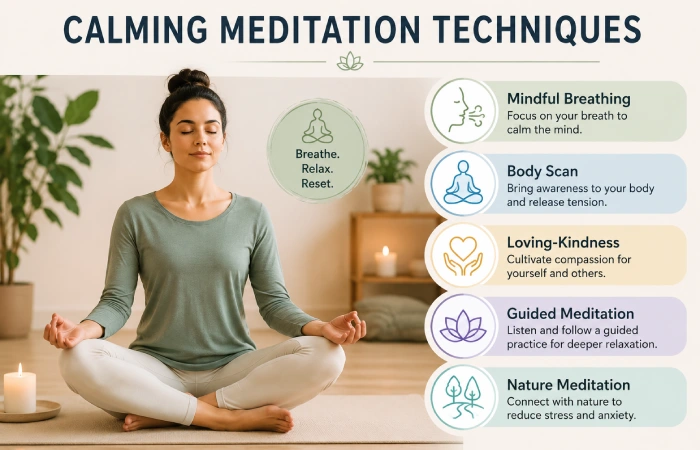
Each person is different; one style of meditation might work for one individual, but not another. Try out a number of them to see which you respond to most!
Mindfulness Meditation
Mindfulness meditation. focuses on your attention and awareness on objects such as your sensations, ideas, emotions, music.
How to Practice:
- Sit back
- Please sit back.
- Come close.
- Be aware of your thoughts as they come up.
- Softly guide your awareness back to your breath.
This method is beneficial in terms of avoiding overreacting and balancing the affective state.
Stress Relief Meditation
Stress relief meditation uses relaxation techniques along with breathing activities to relax the nervous system.
Try blowing out slowly and breathing in deeply, paying close attention to the feeling of relaxing your various muscles.
Body Scan Meditation
The practice of body scan meditation has a subject focus, where the individual is prompted to focus attention on their body in stages.
Benefits include:
- Lowered physical tension.
- Increased mind-body awareness
- Increased relaxation
- Improved sleep quality
Guided Meditation
Meditation guided by a teacher or through audio recording or meditation application.
This is generally good for beginners who may find it a challenge to meditate on their own.
Loving-Kindness Meditation
Here, the goal is to create sense of compassion towards one‘s self and others.
You silently repeat phrases such as:
- May I be safe.
- What if this is someone? I want to be healthy.
- May I be safe.
- May the others be happy and healthy.
Loving-kindness meditation reduced self-criticism and improved mood.
A Simple 5-Minute Meditation for Anxiety
If you‘ve never tried meditating, you should try this quick exercise.
Step 1: Find a Quiet Space
Find a private comfortable space that minimizes distractions.
Step 2: Sit Comfortably
Keep your back firm but relaxed.
Step 3: Focus on Your Breath
Take deep, slow breaths and then pay attention to your breathing sensations.
Step 4: Notice Thoughts
Acknowledge thoughts as they present. (Don‘t judge.)
Step 5. Back to Now
Calmly redirect your attention towards your breathe over and over again.
Taking a few minutes each day to practice can set up a sustainable mode of meditation.
Anxiety Management Tips Alongside Meditation
Meditation is even more effective when used together with other healthful life style practices.
Exercise Regularly
Physical activity helps decrease stress hormones and increase mood-boosting chemicals.
Prioritize Sleep
9 to 11 hours sleep a night is ideal.
Limit Excess Caffeine
Excessive caffeine intake could exacerbate anxiety to some extent in certain individuals.
Practice Deep Breathing
Breathing exercises are effective during the stressful situation for immediate relief.
Stay Consistent
Consistency is what is important rather than length of time. It can be beneficial to meditate for 5 minutes a day.
Common Challenges Beginners Face
Most reason they are “bad” at meditation because they can‘t stop their mind from wandering. Wandering thoughts are not bad they are natural…
Common challenges include:
- Having a difficult time concentrating
- Impatience
- Restlessness
- Expecting immediate results
- Irregular practice
Bear in mind that meditation is a skill you need to learn one that takes regular practice.
In How Long Will You Notice?
While some people feel relaxed after merely one session, others report them noticing positive changes after just a few weeks of regular practice.
Typical Timeline
| Timeframe | Potential Benefits |
| First Session | Relaxation and slower breathing |
| 1–2 Weeks | less daily stress |
| 4–8 Weeks | Better anxiety control |
| Changed ‘4–8 weeks’ | weeks’ to ‘4–8 Weeks’ for consistency. |
2–3 Months Judgment of others, emotional resilience and focus
It‘s more about establishing a consistent schedule than a quick transformation.
Meditation is it suitable for all?
Use meditation if one has an anxiety which is not too severe. Greater levels of anxiety (severer anxiety) may require the use of drugs or therapy and can‘t be effectively treated with meditation.
If anxiety is affecting your ability to cope on a day-to-day basis, consult a qualified healthcare or mental health professional.
Conclusion
Meditation for anxiety is a simple, effective, and inexpensive way to manage your stress levels, promote physical and emotional health, and secure your mental health in the long run. No matter which style of meditation for anxiety you decide to practice, the first step is just do it!
If you keep practicing meditation may be able to help you deal with anxiety, help you focus and help you relax more. Even a minute or two each day can have a positive affect.