
Last Updated: September 15, 2026
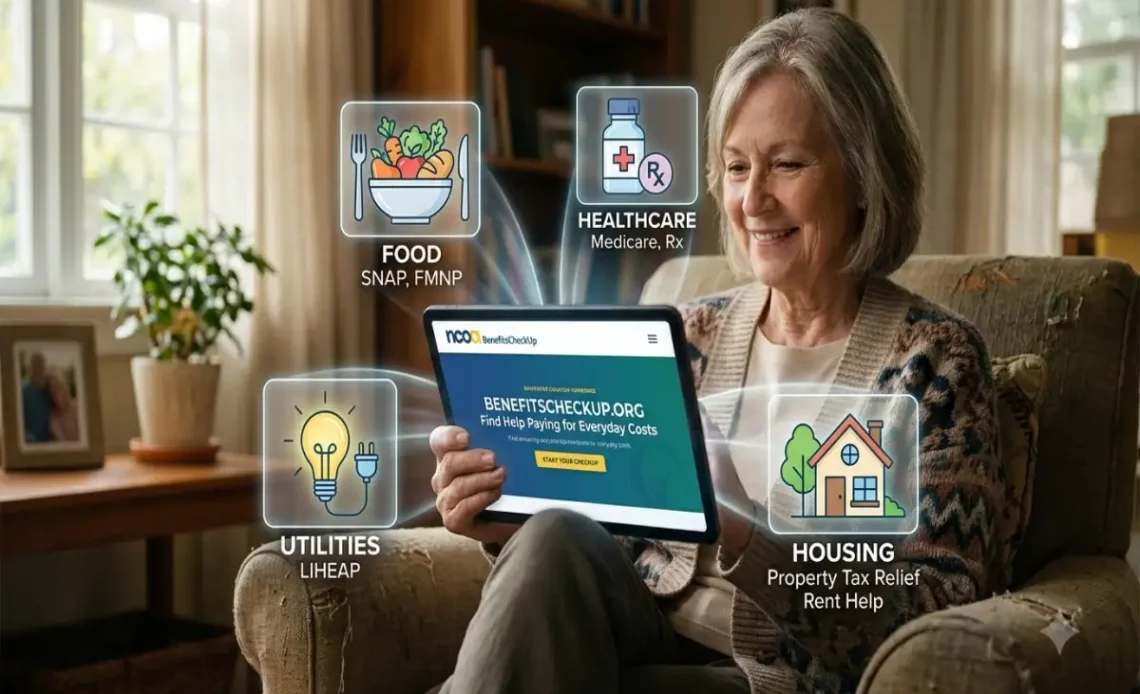
Hundreds of thousands of seniors are eligible for benefits that will ease daily expenses (groceries, prescriptions, medicare premiums, winter heating bills), never apply, and leave the cash lying around. NCOA developed BenefitsCheckUP to make that a thing of the past. It is free, private, and ‘just the facts’.
This is just about BenefitsCheckUp and the big senior benefits it links to. Here‘s a guide for what the tool does, what the big programs in 2026 really include, rough estimates of who qualifies, impact numbers, and how to get in person assistance if the electronic application is overwhelming. All written in clear simple language so anyone (old folks, adult kids, or caregivers) can use it.
Why So Many Benefits Go Unclaimed
NCOA research shows that large numbers of eligible older adults are missing out. In recent estimates, about 9.1 million people age 65 and older who could get SNAP (food help) were not enrolled. Roughly 6.6 million were eligible for but not receiving Medicare Savings Programs. Another 3.6 million were missing Supplemental Security Income. Put together, the value of those unused benefits has been estimated around $58 billion in a single recent year.
Common reasons include:
- People do not know the programs exist.
- They assume their income is too high even when it is not.
- The application process feels confusing or requires documents they cannot easily find.
- They worry about stigma or about “taking something from someone else.”
- Language or technology barriers get in the way.
BenefitsCheckUp was created in 2001 to lower those barriers. It pulls together information on more than 2,000 federal, state, and local programs in one place and matches them to an individual’s situation.
How BenefitsCheckUp Works – Step by Step
- You do not have to create an account in order to begin. Please visit BenefitsCheckUp.org (or your state‘s Spanish version, BuscaBeneficios.org). Vietnamese version is also listed.
- Type in your ZIP code. It will inform the tool about your state and local programs.
- Select the categories that are most relevant at this time in your life Food & Nutrition, Health Care, Housing & Utilities, Income, or something else.
- Respond to a series of questions regarding your age, income, household composition, sources of income (bank accounts, etc.), and any specific circumstances (e.g. disabled, veteran, etc.). The questions are simple and not time-consuming. Please pause and return.
- Look at your results. Your results provided you with a list of programs you could be eligible to apply to. It also provides a description of each program and a “next steps” to take in the application process. Your report can be downloaded or sent to your email.
Apply or receive assistance. Some programs allow you to begin an application on-line. For others you will be sent to the department you should apply through or given telephone numbers. If you would like personal assistance, follow the directions under “Get Help” to find places closer to home on the local map.
The Big Benefits BenefitsCheckUp Helps You Find

The following are some of the programs that older adults most frequently inquire about, with the 2026 figure if known. Limits vary from year to year, and may be higher in Alaska and Hawaii. Some states are even more generous than these federal minimums. Always check your own circumstances, don‘t just assume you are over the limit:
Medicare Savings Programs (MSPs)
These programs, administered by state officials, assist in paying Medicare costs for individuals with limited income and resources. Three levels of assistance are available:
Qualified Medicare Beneficiary (QMB) generally helps pay for Part A and B coinsurance, premiums, deductibles, and copays.
Specified Low-Income Medicare Beneficiary(SLMB) the Part B premium.
Qualifying Individual (QI) – alsoPays the Part B premium for those with incomes above a certain level.
In 2026 the federal monthly income limits begin at about $1,350/month for an individual in the lowest level (QMB) and increase for SLMB and QI. Resource limits are generally about $9,950/month for an individual and $14,910/month for a couple (different sources and states vary). Individuals qualifying for an MSP are generally also auto-entitled to Extra Help.
Extra Help (Medicare Part D Low-Income Subsidy)
This can reduce the cost of prescription drugs. In 2026, you may be eligible if your income is less than around $23,940 (individual) or $32,460 (married couple) and resource less than around $18,090/$36,100. Once approved, many will pay nothing toward the premium and will have low copayments (typically $5 for generic drugs and $12–13 for name-brand drugs, with doled amounts for those on Medicaid). The average value is around $5,700 per year.
SNAP (Supplemental Nutrition Assistance Program)
SNAP: Pays money on an EBT that is used to purchase food. Rules are much easier for the aged (60+) and those with disabilities. Many states used more generous income limits and disregarded some assets. The average monthly benefit for the aged in prior years was $188 or approximately $2,256/year. Participation of eligible aged has increased but remained well below 50% nationally.
Medicaid
In addition to the MSPs, full Medicaid can cover a wide range of health services, long-term care, and more. Eligibility varies significantly by state. The average annual value for older adults can be substantial—tens of thousands of dollars in some cases.
LIHEAP (Low-Income Home Energy Assistance Program)
This helps with heating and cooling bills and sometimes weatherization. Average benefits are often a few hundred dollars per year, but the help can arrive at the exact moment a high utility bill arrives.
Other common matches
Housing assistance, property tax relief, telephone or internet discounts, veterans benefits, and various state and local programs also appear in results depending on your ZIP code.
Getting Started Today
Go to open BenefitsCheckUp.org, enter your zip code, and complete the questions. If you want to speak to someone, you can call 1-800-794-6559 or find your local help map. Whichever way, the point is the same figure out what really can be done to help you, and finally do it.
The programs are there because folks who are elderly and lowincome shouldn‘t be faced with having to decide between the drug store and the grocery store or between buying some heat or getting some food. BenefitsCheckUp justhelps you get to those programs easier. For a lot of families, this is the most accessible entry points.
Look up the income and resource limits on the official sites to find the most recent (they are revised annually). State rules may also vary. When unsure, do the screening or talk to a counselor there‘s no way to be certain except to crunch your own numbers.
This is based on NCOA program descriptions, 2025–2026 impact reports, federal enrollment notices, and headlines over the last couple of weeks about Benefits Enrollment Centers and participation studies and is intended as a reference, not as legal or financial counsel.