
Written By:Sameena Fatima
Reviewed By:Mirza Ibrahim Ali Khan
Medical Reviewed By:Reyansh Sethi
Published on:Sep 21, 2026
Last Updated on:Sep 21, 2026
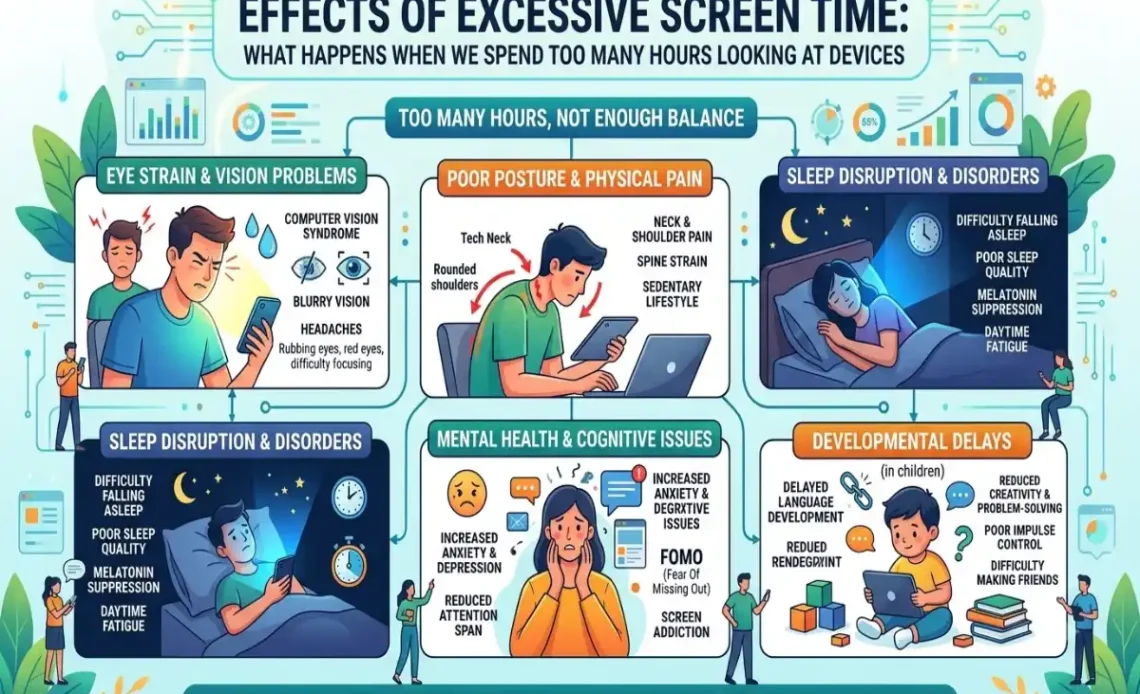
Most of us know the feeling. You pick up your phone for “just a minute,” and half an hour disappears. Or you finish a long day of work on a laptop only to settle in with a tablet or TV. Screens have become the background of modern life. The average person now spends somewhere around six and a half to seven hours a day looking at digital devices. In some countries that number climbs past nine hours. For the teenage years it can often exceed eight or nine hours a day.
Here, we examine the evidence on the physical and mental costs, the differences between children, teens and adults, the variation across countries and what the dose-response data show us. We want to be helpful, not fear-mongering. Screens are tools; to be used as appropriate, including with moderation.
Physical Effects: Eyes, Body, Sleep, and Metabolism
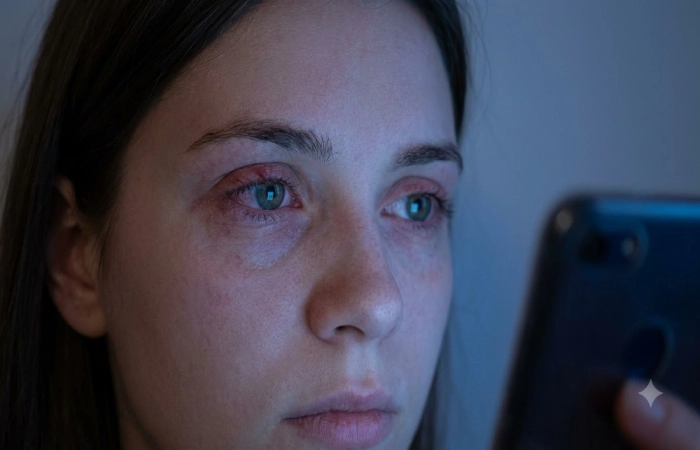
Eyes and vision. Digital eye strain (or computer vision syndrome) is extremely common. Typical signs are dryness, burning, fuzzy eyesight, complications and lack of focus.
Many research studies link display screen time to dry eyes, and a large meta-analysis identified that the extra time spent looking at a display screen, the much more likely you are to get digital eye strain.
The prevalence of myopia (nearsightedness) has skyrocketed in children and young adults in many world regions. Additional screen time was found to be associated with greater odds of myopia in some large studies, but near-work of any sort along with outdoor light exposure are major factors. The authors of some studies of myopia speculated that screens might matter especially when they displace outdoor light.
Posture and musculoskeletal pain.
Looking down at phones or sitting for hours at computers leads to neck, shoulder, upper back, and wrist pain. “Text neck” and related complaints show up frequently in studies of both students and office workers. Headaches and muscle tension are common companions.
Sleep.
Study after study has shown this to be one of the most solid correlations. Using screens in the evening, particularly ones that are bright or engaging, causes melatonin to be secreted later, makes you go to sleep later, and causes decreased sleep quality. As a result, if you don’t sleep well, you’ll not only have poor energy and concentration the next day, your mood will suffer too.
Several researchers have found a correlation to sleep quality that’s better than total sleep time.
But just removing screens from your bedroom and turning them off 30-60 minutes before bed can make a big difference.
Weight and activity levels.
Screens often replace movement. Children with more screen time are less likely to meet physical activity recommendations and have greater odds of overweight or obese in several reviews. The relationship is not always strong for body mass index in every adult or student sample, but sedentary behaviour itself is a risk factor for longer-term metabolic issues. One analysis found children with two or more hours of daily screen time had substantially higher risk of being overweight. Time spent sitting while using screens adds up across the day.
Other physical observations.
For others have noted more headaches, pain in wrists/hands as well as fatigue. Cardiovascular measure and levels of insulin resistance are noted in a few paediatric studies associated with high sedentary screen time, though lifestyle factors in general do seem to be important.
Dose-Response Patterns and Thresholds
Not every extra minute carries the same cost. Risks often rise gradually and then more steeply after certain points.
- For digital eye strain and depression symptoms in university students, problems accelerate after about 2.5 hours daily.
- Many paediatric guidelines treat more than two hours of recreational screen time as a signal to pay attention.
- OECD-style analyses of personal screen use find clearly higher odds of poor wellbeing above five hours compared with moderate (1–3 hour) use.
- Myopia risk in some meta-analyses shows nonlinear patterns—modest increases at low levels, steeper at higher daily hours.
- Sleep disruption can appear with even one hour of screens in the hour or two before bed.
These are averages from group data. Individual tolerance varies with age, existing health, the content being viewed, time of day, and whether the use is active or passive.
Differences by Age Group
Young children. Such early and intensive usage is linked to language delay, attentional problems, parent interaction problems and, later on, socioemotional difficulties. Playing outside and co-viewing or mediation by parents tend to protect children from some of these problems.
School-aged children and preteens. The increase in entertainment screen time (commonly 3.5–5.5 hours) relates to risk of myopia, sleep deficits, reduced physical activity, and nascent emotional/behavioural problems. Girls and boys can show different patterns in how screen time and socioemotional issues influence each other.
Teenagers. Peak exposure years. Many spend more time on screens than sleeping or in school. Anxiety and depression risk rises notably with four or more hours in several datasets. Body image, social comparison, and sleep suffer. Problematic social media use affects a meaningful minority (roughly one in eight girls and one in thirteen boys in some OECD figures for ages 11–15).
Adults and university students. Work screens plus personal use create long cumulative exposure. Eye strain, musculoskeletal discomfort, sleep disturbance, and mood implications common. Personal use heavily associated with to lower subjective wellbeing. Desk workers can spend the bulk of waking hours looking at screens.
Older adults. Lower average screen time but cumulative lifetime exposure and age-related eye changes can still produce dry eye and other issues.
Practical Ways to Reduce Harm
Small, consistent changes produce results for many people:
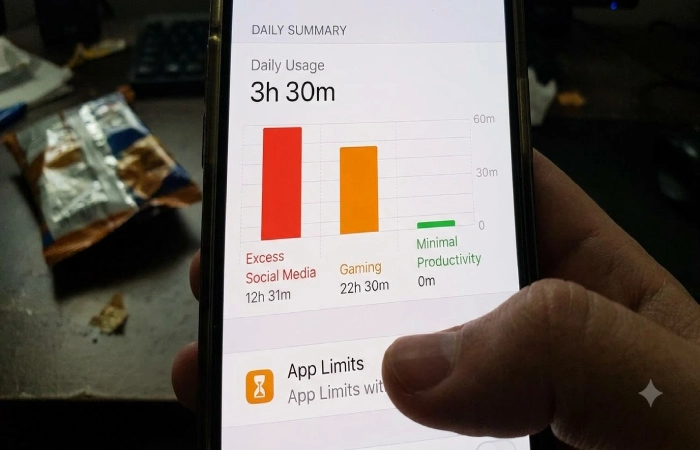
- Track your actual use for a few days. Most phones and computers have built-in reports. Awareness is often the first shift.
- Protect sleep fiercely. No screens in the bedroom if possible. Stop interactive or bright use at least 30–60 minutes before bed. Use night mode or blue-light filters earlier in the evening if needed.
- Create device-free zones and times: meals, the first hour after waking, family time, outdoor walks.
- Prioritise outdoor time, especially for children. Bright daylight helps eyes and sleep regulation.
- Move more. Break up long sitting periods. Even short walks or standing reduce some sedentary risks.
- Choose content more deliberately. Active or social use with real people often feels different from endless passive scrolling.
- For parents: delay unrestricted smartphone access when feasible, especially full social media before the early teens. Co-view and talk about content. Model the habits you want to see.
- Set app limits or grayscale modes for the most addictive platforms. Delete or log out of apps that consistently drain time and mood.
- Address underlying issues. If anxiety, low mood, or loneliness is driving heavy use, treating those directly often helps more than willpower alone.
At a broader level, schools, workplaces, and platforms can help by redesigning environments—phone-free learning periods, better ergonomics, reduced notification defaults, and clearer age-appropriate design.
Putting It Together
This is not a single problem. It‘s how it affects sleep, eyes, posture, movement, concentration, attitude, and relationships. The danger is greater with more hours, younger age, later hour use, and passive/other-compared content.
Children and teens seem most sensitive in many domains; adults also pay the price cumulatively.
But everyone has costs.
Fortunately, the research that implies problems also implicates reductions and alterations of screen use as a way to feel better. Better sleep, less eye strain, better mood, more opportunity to do other things, have been commonly reported when screen time is intentionally shortened.
Screens will be part of our lives. There’s no goal of zero screen time. The goal is sufficient knowledge and structure that devices help rather than hinder our health and relationships. Changing just one or two specific things-like protecting the hour before bedtime or ensuring daily time outside or deciding on an absolute recreational limit-can tip the scales well beyond what many anticipate.