
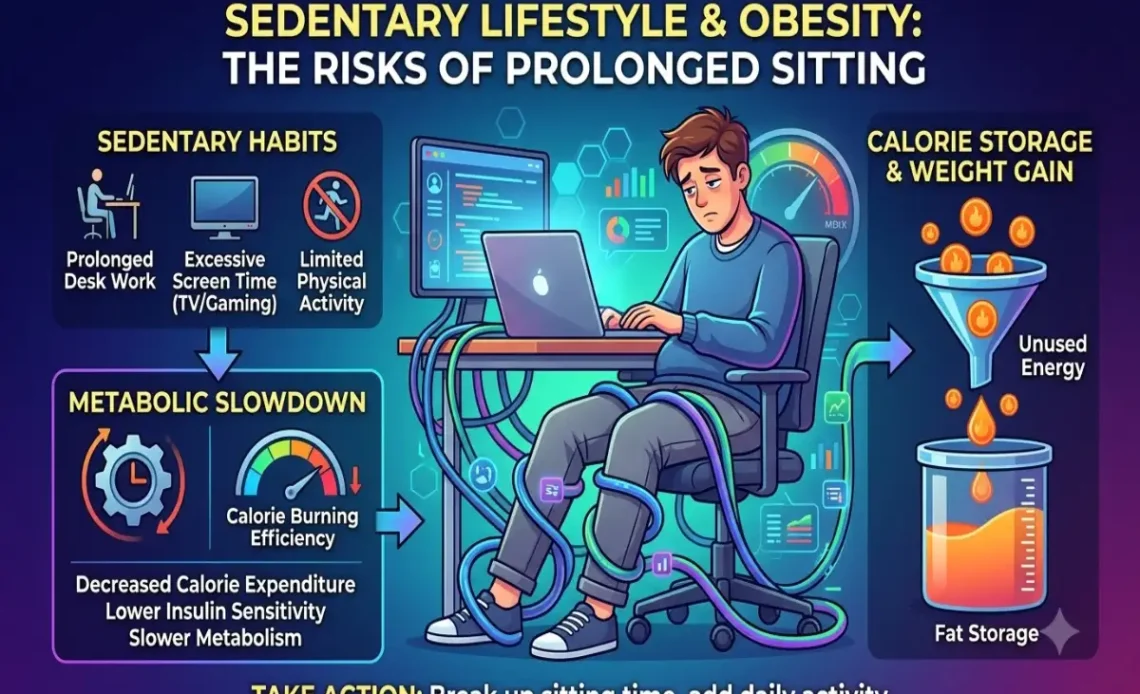
 Sameena Fatima
Health & Wellness Content Writer
in
Sameena Fatima writes reader-focused
health and wellness content for
HealthBloomWeb, covering fitness,
nutrition, healthy lifestyle and
everyday wellness topics.
Sameena Fatima
Health & Wellness Content Writer
in
Sameena Fatima writes reader-focused
health and wellness content for
HealthBloomWeb, covering fitness,
nutrition, healthy lifestyle and
everyday wellness topics.
 Mirza Ibrahim Ali Khan
Editorial & Content Reviewer
in
Mirza Ibrahim Ali Khan contributes to
HealthBloomWeb's editorial review process,
with a focus on content structure,
readability, search intent and overall
editorial quality.
Mirza Ibrahim Ali Khan
Editorial & Content Reviewer
in
Mirza Ibrahim Ali Khan contributes to
HealthBloomWeb's editorial review process,
with a focus on content structure,
readability, search intent and overall
editorial quality.
 Reyansh Sethi
Medical Reviewer
in
Reyansh Sethi contributes to the medical
review process at HealthBloomWeb, focusing
on clarity, responsible health context and
reader-friendly presentation of health
information.
Reyansh Sethi
Medical Reviewer
in
Reyansh Sethi contributes to the medical
review process at HealthBloomWeb, focusing
on clarity, responsible health context and
reader-friendly presentation of health
information.
Most of us know that sitting around a lot and packing on extra weight often go hand in hand. You finish a long day at a desk or behind a wheel, grab something convenient to eat, and the scale slowly creeps up. It feels almost inevitable. But the link between a sedentary lifestyle and obesity is not quite as simple as “sit more, burn less, gain weight.” The science shows a more layered picture involving energy use, hormones, muscle function, and even the types of sitting we do.
This article digs into how too much sitting contributes to weight gain and obesity. It looks at the mechanisms inside the body, what recent studies actually found, how the problem shows up differently across countries, and practical comparisons that make the risks clearer. The aim is to keep everything straightforward and useful so anyone can understand what is happening and why it matters.
Why Sitting and Weight Gain Are Connected
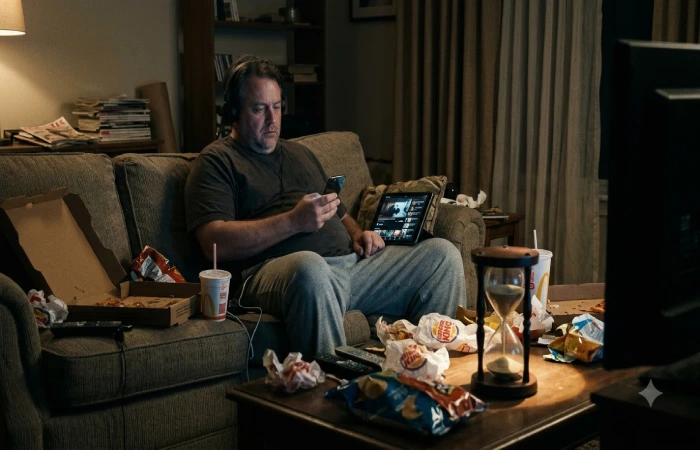
When you sit for hours, your large muscle groups — especially in the legs and core — stay almost completely quiet. Those muscles normally burn a steady stream of calories even at rest. Once they switch off, total daily energy expenditure drops. A person sitting at a desk might burn only a little more than they would lying down. Stand up and walk at a slow pace and the burn roughly doubles.
Over a full day the difference adds up. Someone who sits 10 hours instead of moving around more can easily burn several hundred fewer calories. If food intake stays the same, the body stores the extra energy as fat. Much of that fat tends to settle around the abdomen, which is the type most strongly linked to metabolic trouble.
But calorie burn is only part of the story. Prolonged sitting also changes how the body handles the calories it does take in. Muscles become less sensitive to insulin. Blood sugar stays higher after meals. Fat-burning enzymes in the muscles slow down. Over time these shifts make it easier to gain fat and harder to lose it.
What the Latest Research Shows About Causality
Some older studies left room for debate: does sitting cause weight gain, or do heavier people simply sit more? Newer genetic research helps answer that. Mendelian randomization studies — which use genetic variants as a kind of natural experiment — found that higher genetic tendency toward television watching, leisure screen time, computer use, and driving all raise the risk of obesity. The odds ratios were meaningful: television watching linked to about 55 percent higher odds, leisure screen time around 62 percent higher, and driving even stronger in some analyses.
Interestingly, not every type of sitting showed the same effect. Work-related sitting and sedentary commuting did not always come out causal in the same way. This suggests that the context and the habits that come with certain kinds of sitting (snacking while watching TV, for example) play a role alongside the pure lack of movement.
A large five-year study of younger and midlife adults found that the combination of low or moderate leisure-time activity plus higher leisure sedentary time produced the highest rates of major weight gain. People who managed vigorous activity and kept leisure sitting lower fared best. Sedentary time alone was not always statistically significant after full adjustment, but the combination clearly was.
Energy Expenditure: The Surprising Global Picture
A major international study using the doubly labelled water method (the gold standard for measuring total energy burned) looked at people from 34 different countries and cultures. It included hunter-gatherers, farmers, and office workers in wealthier nations. The surprising result: once body size was accounted for, total daily calorie burn was remarkably similar across these groups. People in more industrialized, sedentary societies did not burn dramatically fewer calories than more active traditional populations.
What differed far more was energy intake. Higher calorie consumption, especially from ultra-processed foods, explained most of the higher obesity rates in developed settings. This does not mean sitting is harmless. It does mean that diet is the bigger driver of the obesity epidemic at the population level. Sitting still matters because it reduces the buffer against overeating and worsens how the body processes food.
In practical terms, you cannot out-exercise a consistently high-calorie diet. But reducing sitting still helps by improving insulin sensitivity, supporting muscle mass, and making it slightly easier to stay in energy balance.
How Sitting Changes Metabolism and Fat Storage
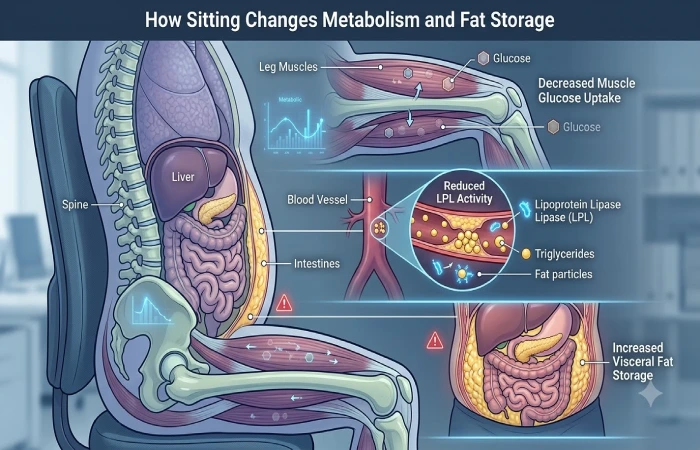
Several clear physiological changes occur with prolonged sitting:
- Muscle glucose uptake drops because the GLUT4 transporters that pull sugar into cells are less active without muscle contraction.
- Lipoprotein lipase, an enzyme that helps clear fat from the blood, becomes less active in inactive muscles.
- The body shifts toward burning more carbohydrate and less fat.
- Visceral fat (the deep abdominal fat around organs) tends to increase.
- Low-grade inflammation rises.
These changes can appear after just a few days of reduced movement. Bed-rest studies show insulin sensitivity falling within one to three days. Longer periods lead to measurable increases in total body fat and loss of muscle.
The good news is that breaking up sitting reverses many of these effects quickly. Even short walks or standing breaks improve post-meal blood sugar and insulin responses. Over weeks and months, people who successfully cut sedentary time by 30 minutes or more a day often improve metabolic flexibility — the ability to switch between burning fat and carbohydrate — and show better insulin sensitivity.
Childhood and Adolescence: An Important Window
The link starts early. Longitudinal research shows that each extra minute of sedentary time in childhood and adolescence is associated with a small but measurable increase in fat mass. One study estimated that sedentary behaviour contributed roughly 700 grams to 1 kilogram of the total fat gained from childhood to young adulthood. Light physical activity had a stronger protective effect than moderate-to-vigorous activity in some analyses — each minute of light activity was linked to a larger reduction in fat mass.
Screen time, especially television viewing, consistently tracks with higher BMI and higher odds of overweight or obesity in children. This is one reason experts now emphasize reducing prolonged sitting and increasing light movement throughout the day for young people, not just formal exercise.
Country and Regional Patterns
Obesity and physical inactivity do not line up perfectly across the world, but there are clear overlaps.
High obesity rates appear in many Pacific Island nations (often above 60–70 percent), parts of the Middle East and North Africa, the United States (around 42 percent), and several Latin American and Caribbean countries. Physical inactivity rates are also elevated in the Eastern Mediterranean, South Asia, and high-income Asia Pacific regions.
In places where inactivity is low (many African countries, parts of Oceania), obesity rates are often lower too — though this is changing with urbanisation and shifts in diet. In high-income countries the combination of desk jobs, car dependence, and abundant calorie-dense food creates a perfect environment for gradual weight gain.
Some countries with high inactivity (for example certain East Asian nations) still have lower obesity than Western countries, partly because traditional diets remain lower in ultra-processed foods and portion sizes differ. This reinforces that sitting and diet work together.
Comparison Tables for Clarity
Sitting Time and Weight-Related Outcomes (Approximate Findings from Reviews)
| Daily Sitting Pattern | Typical Association with Weight/Obesity |
| Highest vs lowest sedentary categories | About 33% higher odds of becoming overweight or obese |
| Each extra hour of sitting over time | Small increase in waist circumference (roughly 0.02 cm per hour over 5 years in one meta-analysis) |
| Low/moderate activity + high leisure sitting | Highest rates of major weight gain over 5 years |
| Vigorous activity + lower leisure sitting | Lowest rates of major weight gain |
Replacing 30 Minutes of Sitting – Effects on Body Measures
| Replacement | Approximate Change |
| Moderate-to-vigorous activity | Lower BMI (around –0.5 units), smaller waist (around –1.4 cm) |
| Light activity or standing | Modest improvements in waist and metabolic markers |
| Sleep (in some studies) | Small reduction in BMI |
These are average effects from meta-analyses. Individual results vary with starting weight, diet, and consistency.
Energy Cost of Common Activities
| Activity | Approximate Energy Cost |
| Sitting quietly | 1.0–1.5 METs |
| Standing still | Slightly higher than sitting |
| Slow walking | Roughly double sitting |
| Everyday movement (chores, light walking) | Noticeably higher daily burn when accumulated |
A few hundred extra calories burned through more standing and walking each day can make a real difference over months, especially when paired with better food choices.
Practical Takeaways That Actually Help
You do not need extreme changes. Small, repeated interruptions to sitting improve the metabolic environment even if total exercise time stays the same. Standing for a few minutes every half hour, walking while on phone calls, short walks after meals, and swapping some screen time for light activity all count.
For weight management the strongest evidence supports combining reduced prolonged sitting with higher overall movement and attention to diet quality. Light activity throughout the day appears especially useful for preventing fat gain in younger people and for improving metabolic flexibility in adults who already carry extra weight.
People who successfully cut at least 30 minutes of daily sitting often see measurable improvements in how their bodies handle fuel. That metabolic improvement can make future weight control easier.
Looking at the Bigger Picture
Obesity is driven more by what and how much we eat than by how little we move, according to the best global energy-expenditure data. Yet a sedentary lifestyle still contributes by lowering the daily calorie buffer, worsening insulin action, encouraging abdominal fat storage, and making it harder to stay active. The two factors reinforce each other.
The research continues to refine the details: certain types of sitting (especially leisure screen time and television) show clearer causal links to obesity; interrupting long bouts helps more than just reducing total time; and light movement has under-appreciated value.
Understanding these mechanisms takes some of the mystery out of gradual weight gain. It also points to realistic places to start — not with punishing workouts, but with simply interrupting the long stretches of stillness that modern life encourages. Over weeks and months those interruptions add up to a body that handles energy more efficiently and finds it easier to maintain a healthier weight.