

 Sameena Fatima
Health & Wellness Content Writer
in
Sameena Fatima writes reader-focused
health and wellness content for
HealthBloomWeb, covering fitness,
nutrition, healthy lifestyle and
everyday wellness topics.
Sameena Fatima
Health & Wellness Content Writer
in
Sameena Fatima writes reader-focused
health and wellness content for
HealthBloomWeb, covering fitness,
nutrition, healthy lifestyle and
everyday wellness topics.
 Mirza Ibrahim Ali Khan
Editorial & Content Reviewer
in
Mirza Ibrahim Ali Khan contributes to
HealthBloomWeb's editorial review process,
with a focus on content structure,
readability, search intent and overall
editorial quality.
Mirza Ibrahim Ali Khan
Editorial & Content Reviewer
in
Mirza Ibrahim Ali Khan contributes to
HealthBloomWeb's editorial review process,
with a focus on content structure,
readability, search intent and overall
editorial quality.
 Reyansh Sethi
Medical Reviewer
in
Reyansh Sethi contributes to the medical
review process at HealthBloomWeb, focusing
on clarity, responsible health context and
reader-friendly presentation of health
information.
Reyansh Sethi
Medical Reviewer
in
Reyansh Sethi contributes to the medical
review process at HealthBloomWeb, focusing
on clarity, responsible health context and
reader-friendly presentation of health
information.
Your heart is a muscle that works nonstop. It beats around 100,000 times a day, pushing blood through vessels that stretch for thousands of miles. Like any muscle, it stays stronger and more efficient when the rest of the body stays active. When most of the day is spent sitting, the heart and the vessels that feed it start to change in ways that raise the chance of trouble later.
This article focuses on how a sedentary lifestyle affects heart health. It covers the main risks, what the newest large studies show, how the effects differ for different heart problems, country patterns, and simple comparisons that make the numbers easier to grasp. Everything is kept straightforward so the information is useful whether you sit at a desk all day or just want to understand the risks better.
How Sitting Affects the Heart and Blood Vessels
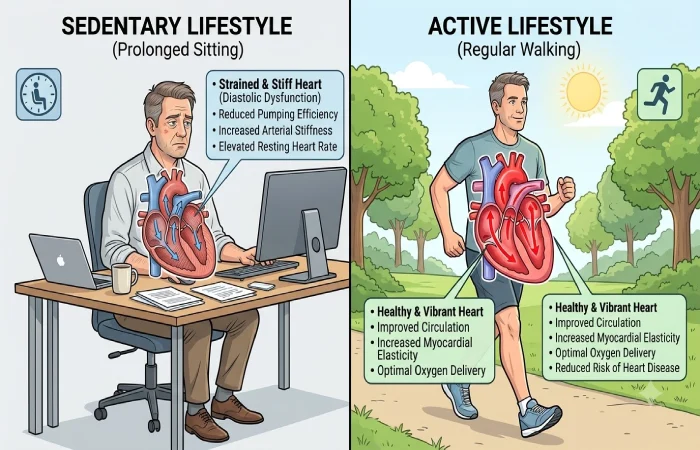
When you sit for long stretches, several things happen at once. Blood flow in the legs slows. The large arteries do not expand and contract as freely. Blood pressure can creep up. The body becomes less efficient at clearing fats and sugar from the blood after meals. Over time these changes contribute to stiffer arteries, higher blood pressure, and a greater chance of plaque building up in the vessels that supply the heart.
The heart muscle itself gets less of a workout. Regular movement helps the heart pump more blood with each beat and keeps it more flexible. Long periods of stillness remove that training effect. The result is a heart that has to work harder for the same output and is more vulnerable to problems like heart failure.
Even people who exercise regularly can still face extra risk if the rest of their day involves many hours of sitting. Recent research has made this point clearer than ever.
The Key Finding from Large Tracker Studies
One of the most important recent studies used wrist-worn activity trackers on nearly 90,000 adults in the UK Biobank. Participants wore the devices for a week, and researchers then followed their health for about eight years. The average sedentary time was 9.4 hours a day.
The clearest signal appeared at about 10.6 hours of sedentary time per day. People above that level had:
- About 40 to 45 percent higher risk of heart failure
- About 50 to 60 percent higher risk of dying from cardiovascular causes
These higher risks remained even among people who met the recommended 150 minutes of moderate-to-vigorous activity each week. Exercise helped, but it did not fully cancel the effect of very high sitting time for heart failure and cardiovascular death.
For atrial fibrillation (irregular heartbeat) and heart attacks, the risk rose more steadily with more sitting, without the same sharp threshold. The associations were smaller but still present.
A simple way to think about it: crossing the 10.6-hour mark seems to be a tipping point for the most serious heart outcomes.
What Happens After a Heart Scare
Another important study looked at people who had been in hospital with symptoms that could point to a heart attack or acute coronary problem. Those who remained sedentary for more than 14 hours a day in the following month had a much higher chance of another heart event or death within a year. Compared with the most active group, the least active group had more than 2.5 times higher risk.
Replacing just 30 minutes of sedentary time with moderate-to-vigorous activity cut the risk of further events or death by about 61 percent. Replacing the same 30 minutes with light activity still cut the risk by about 50 percent. Even swapping some sitting for extra sleep helped a little. These findings show that movement after a heart problem is especially protective.
Occupational Sitting and Everyday Risk
Work-related sitting also carries risk. In a large study of nearly half a million people, those who mostly sat at work had a 16 percent higher risk of dying from any cause and a 34 percent higher risk of dying from cardiovascular disease compared with people who mostly did not sit at work. The extra risk could be reduced by adding 15 to 30 minutes of physical activity each day.
In lower- and middle-income countries the link between high sitting time and cardiovascular events appears even stronger in some data. This may reflect differences in overall activity patterns, healthcare access, and other risk factors that travel with sedentary jobs.
How Much Risk Reduction Comes from Moving More
Compositional analyses from the tracker studies show what happens when sitting time is swapped for other activities. Among people sitting more than 10.6 hours a day:
- Cutting sedentary time by 30 minutes and replacing it with any activity lowered heart failure risk by about 7 percent and cardiovascular death risk by about 8 percent.
- Replacing the same time with moderate-to-vigorous activity produced larger reductions (around 15 percent for heart failure and 10 percent for cardiovascular death).
- Light activity still helped (roughly 6 percent lower heart failure risk and 9 percent lower cardiovascular death risk).
These numbers show that even modest changes matter, and light movement counts.
Mechanisms Behind the Risk
Several pathways explain why prolonged sitting harms the heart:
- Reduced blood flow and shear stress in the vessels lead to poorer endothelial function (the lining of the arteries works less well).
- Insulin resistance rises, which promotes inflammation and fat storage that affect the heart.
- Blood pressure regulation becomes less efficient.
- Muscle inactivity lowers the activity of enzymes that help clear fats from the blood.
- Overall fitness declines, so the heart has less reserve when it needs to work harder.
These changes can begin within hours of uninterrupted sitting and become more established with daily high sedentary time.
Country and Regional Patterns
Cardiovascular disease remains the leading cause of death worldwide. Physical inactivity contributes a meaningful share of that burden. Globally about 31 percent of adults do not meet activity guidelines. Rates are highest in the Eastern Mediterranean and South-East Asia regions (around 40 percent) and in high-income Asia Pacific (near 48 percent). Many countries in the Middle East, parts of South Asia, and some Pacific and Caribbean nations show both high inactivity and high heart disease rates.
In Central Asia some of the highest age-standardised heart disease prevalence rates appear, often linked to a mix of limited activity, diet, and other factors. In contrast, many sub-Saharan African countries still report lower inactivity, though urbanisation is changing that picture.
The economic cost of inactivity-related heart disease and other conditions runs into hundreds of billions of dollars over a decade if current trends continue. The human cost is measured in years of life lost and reduced quality of life.
Comparison Tables
Sedentary Time and Heart Outcomes (Approximate from Major Tracker Studies)
| Daily Sedentary Time | Heart Failure Risk | Cardiovascular Death Risk | Notes |
| Around 8–9.4 hours (reference) | Baseline | Baseline | — |
| Above 10.6 hours | +40–45% | +50–60% | Risk rises sharply; remains elevated even in people who exercise |
| High occupational sitting | — | +34% CVD mortality | Compared with mostly non-sitting jobs |
Replacing 30 Minutes of Sitting
| Replacement Activity | Approximate Risk Reduction |
| Any movement | 7% lower heart failure, 8% lower CV death |
| Moderate-to-vigorous | 15% lower heart failure, 10% lower CV death |
| Light activity | 6% lower heart failure, 9% lower CV death |
| After a heart event (light or moderate) | 50–61% lower risk of further events or death |
Joint Effects of Sitting and Activity
| Sitting Level + Activity Level | Relative Risk Pattern |
| High sitting + low activity | Highest risk |
| High sitting + meeting activity guidelines | Still elevated for heart failure and CV death, but lower than inactive high-sitters |
| Lower sitting + higher activity | Lowest risk |
Practical Ways to Protect Heart Health
The research points to two complementary goals: meet activity guidelines and keep total sedentary time, especially unbroken stretches, in check. Standing up and moving for a few minutes every 30 to 60 minutes improves blood flow and metabolic responses. Short walks after meals help blood sugar and vessel function. Using a standing desk for part of the day, walking during phone calls, or taking the stairs all add up.
For people recovering from a heart problem, light activity throughout the day appears almost as protective as more intense exercise when it replaces sitting. The key is consistency rather than perfection.
The Bottom Line from Current Evidence
Sitting for more than about 10.5 hours a day is linked to clearly higher risks of heart failure and dying from heart-related causes. Meeting exercise recommendations helps but does not fully remove that risk. After a heart event, high sedentary time strongly predicts further problems, and even light movement in place of sitting offers substantial protection.
The heart responds to the whole pattern of the day, not just the time spent in formal exercise. Reducing long stretches of stillness and adding more movement — even light movement — supports better blood vessel function, better blood pressure control, and a stronger, more resilient heart. Small daily changes in how much and how long we sit can make a measurable difference over the years.