
 Sameena Fatima
Health & Wellness Content Writer
in
Sameena Fatima writes reader-focused
health and wellness content for
HealthBloomWeb, covering fitness,
nutrition, healthy lifestyle and
everyday wellness topics.
Sameena Fatima
Health & Wellness Content Writer
in
Sameena Fatima writes reader-focused
health and wellness content for
HealthBloomWeb, covering fitness,
nutrition, healthy lifestyle and
everyday wellness topics.
 Mirza Ibrahim Ali Khan
Editorial & Content Reviewer
in
Mirza Ibrahim Ali Khan contributes to
HealthBloomWeb's editorial review process,
with a focus on content structure,
readability, search intent and overall
editorial quality.
Mirza Ibrahim Ali Khan
Editorial & Content Reviewer
in
Mirza Ibrahim Ali Khan contributes to
HealthBloomWeb's editorial review process,
with a focus on content structure,
readability, search intent and overall
editorial quality.
 Reyansh Sethi
Medical Reviewer
in
Reyansh Sethi contributes to the medical
review process at HealthBloomWeb, focusing
on clarity, responsible health context and
reader-friendly presentation of health
information.
Reyansh Sethi
Medical Reviewer
in
Reyansh Sethi contributes to the medical
review process at HealthBloomWeb, focusing
on clarity, responsible health context and
reader-friendly presentation of health
information.
Most people still believe the fastest way to lose weight is endless cardio and strict calorie cutting. That approach can drop the number on the scale, but it often takes muscle with it. The result is a lighter but softer body, slower metabolism, and a higher chance of regaining the weight later.
Strength training flips that outcome. When you lift weights or use resistance while in a calorie deficit, you protect (and sometimes build) muscle. Fat comes off more cleanly. You get stronger. Daily activities feel easier. Long-term weight maintenance becomes more realistic.
This pillar page brings together the key ideas behind using strength training for weight loss. It covers the science, the best exercises, practical plans for different situations, how to combine lifting with a calorie deficit, progression methods, recovery, and how home training fits in. The goal is clear, usable information rather than theory for its own sake.
Why Strength Training Matters for Fat Loss
Weight loss is driven by a calorie deficit. Exercise helps create or widen that deficit, but the type of exercise decides what kind of tissue you lose.
Cardio tends to burn more calories during the session. Strength training burns fewer in the moment but does something more valuable: it signals the body to keep muscle. Muscle is metabolically active. Losing it slows resting energy use and changes how you look even at a lower weight.
Multiple reviews and meta-analyses show the pattern clearly. Adding resistance training to a diet protects fat-free mass, increases fat mass loss relative to diet alone, and improves strength. Total scale weight may be similar, but the quality of the loss is better. People who lift while dieting lose more fat and keep more muscle than those who only diet or only do cardio.
A practical benefit appears in everyday life. Stronger legs, back, and core make walking, carrying shopping, playing with kids, or climbing stairs easier. That extra capacity often leads to higher daily movement without conscious effort.
The Core Benefits Beyond the Scale
- Better body composition: lower body fat percentage with muscle retained or increased
- Higher long-term metabolism support through muscle preservation
- Improved insulin sensitivity and metabolic health markers
- Stronger bones and joints when form is good
- Better mood, sleep quality, and confidence for many people
- Greater chance of keeping the weight off because muscle helps regulate appetite and energy use
These benefits hold across age groups and for both men and women. Beginners often see the fastest early changes because the nervous system adapts quickly.
How Strength Training and a Calorie Deficit Work Together
A moderate deficit of roughly 300–500 calories below maintenance (or about 0.5–1% of body weight per week) pairs well with lifting. Larger deficits speed fat loss but raise the risk of muscle loss and make recovery harder.
Protein becomes more important in a deficit. Targets of 1.6–2.2 grams per kilogram of body weight help protect muscle. Spreading protein across three or four meals supports muscle protein synthesis throughout the day.
Training does not need to change dramatically. Keep the main lifts challenging. Reduce total volume slightly if recovery feels limited. Focus on progressive overload where possible—adding weight or reps over time—even if progress is slower than in a surplus.
The combination of resistance training + moderate deficit + adequate protein is one of the most reliable ways to lose fat while looking and feeling stronger.
Best Exercises for Weight Loss Strength Training
Compound movements that work multiple muscle groups give the highest return. They burn more energy per set, build functional strength, and create a strong muscle-retention signal.
Key movement patterns:
| Pattern | Example Exercises | Main Muscles | Why Useful for Fat Loss |
| Squat | Goblet squat, back squat, leg press | Quads, glutes, core | High muscle recruitment, calorie cost |
| Hinge | Romanian deadlift, conventional deadlift, hip thrust | Hamstrings, glutes, back | Posterior chain strength, posture |
| Horizontal push | Bench press, push-up, dumbbell press | Chest, shoulders, triceps | Upper body strength and stability |
| Horizontal pull | Bent-over row, seated row, inverted row | Back, biceps, rear delts | Balances pushing, improves posture |
| Vertical push | Overhead press, dumbbell shoulder press | Shoulders, triceps, core | Overhead strength and core demand |
| Vertical pull | Pull-up, lat pulldown, band pull-down | Lats, upper back, biceps | Large muscle mass, posture |
| Carry / core | Farmer carry, suitcase carry, plank | Grip, core, traps | Extra calorie burn and real-world strength |
Isolation exercises (curls, lateral raises, leg extensions) can be added later for detail, but they are optional for fat-loss goals.
Sample Strength Plans for Different Situations
Beginner Full-Body Plan (2–3 days per week)
Focus on learning form and building the habit.
Workout A
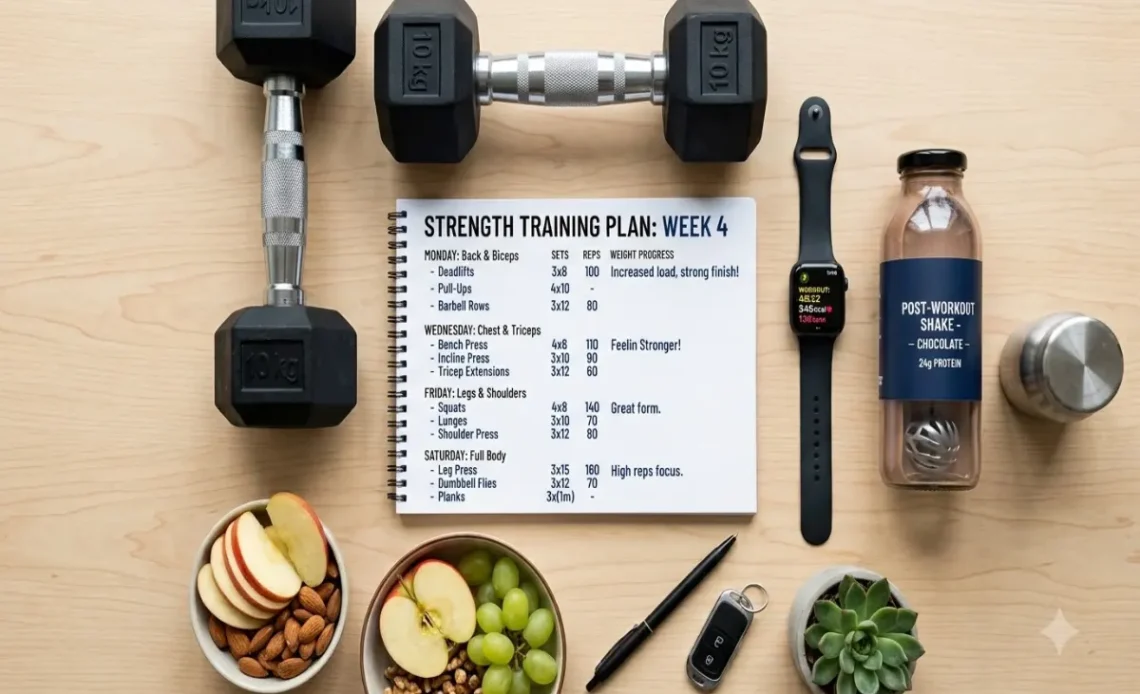
- Goblet squat or leg press — 3 sets of 8–12
- Romanian deadlift or glute bridge — 3 sets of 8–12
- Push-up or machine chest press — 3 sets of 8–12
- One-arm or seated row — 3 sets of 8–12
- Overhead press — 2–3 sets of 8–12
- Plank — 2 sets of 20–40 seconds
Alternate with a similar Workout B that varies the lower-body and upper-body angles slightly. Rest at least one day between sessions.
Intermediate Full-Body or Upper/Lower (3–4 days)
Add a bit more volume and progression.
Keep the same movement patterns but increase to 3–4 sets on the main lifts and track weights carefully. Use double progression: stay with a weight until you hit the top of the rep range on all sets, then increase the load.
Home / Minimal Equipment Version
Bodyweight and dumbbells cover the same patterns.
- Squat variation (bodyweight or goblet)
- Hip hinge (Romanian deadlift with dumbbells or single-leg)
- Push-up progression
- Inverted row or dumbbell row
- Overhead press with dumbbells
- Carry or core work
Progress by adding reps, slowing tempo, moving to harder variations, or increasing dumbbell weight.
Strength Training vs Cardio: How They Fit Together
Cardio usually produces slightly more absolute fat loss in head-to-head studies lasting 10 weeks or more. Strength training wins on muscle retention and body composition quality. Combining both is often the strongest approach for most people.
A practical weekly structure:
- 2–3 strength sessions
- 2–3 moderate cardio or walking sessions
- High daily step count
When both are done in the same day, lifting first generally protects strength performance better. Low-impact cardio (cycling, incline walking, rowing) interferes less with recovery than high volumes of running.
You do not need large amounts of either. Consistency with a moderate deficit matters more than extreme training volume.
Progression: How to Keep Getting Stronger
Progressive overload is non-negotiable if you want continued results.
Beginners can often add weight every session or every week on the main lifts. Intermediates usually progress more slowly using rep targets or weekly load increases. During a fat-loss phase the goal is often to maintain strength or make small gains while body weight drops.
Track the main lifts. When you can complete all sets and reps with good form and 1–3 reps left in reserve, increase the challenge. Form always comes first. Chasing numbers with poor technique raises injury risk and reduces results.
Making Sessions More Fat-Loss Friendly
You can keep the same exercises and raise the metabolic demand without turning the workout into pure conditioning.
- Supersets: Pair a push with a pull (bench + row) or a lower-body move with an upper-body move. Rest after the pair.
- Slightly shorter rests (45–75 seconds) once form is solid.
- Finish with a short carry or core circuit.
- Keep most sets in the 8–12 or 10–15 range. Heavier low-rep work is fine for strength, but the moderate range tends to produce higher total work and calorie cost for fat-loss goals.
Do not sacrifice form for shorter rests or more sets. Clean reps still matter most.
Progression That Actually Works
The single most important rule is progressive overload. Your body only changes when the demand slowly increases.
Simple methods:
- Add weight when you hit the top of the rep range on all sets with good form.
- Add 1–2 reps if you cannot increase weight yet.
- Slow the lowering phase (3-second eccentric) for an extra challenge.
- Add a set once every few weeks if recovery is good.
Track the weight and reps for your main lifts. If the numbers are not moving over several weeks, check sleep, protein, and total stress. Most plateaus are recovery or consistency issues, not program design.
Nutrition Basics That Pair With Full-Body Training
Strength training protects muscle best when protein is adequate. Aim for roughly 1.6–2.2 g of protein per kilogram of body weight while in a deficit. Spread it across three or four meals.
A moderate calorie deficit (300–500 calories below maintenance) is enough for most people. Aggressive cuts make training harder and increase the risk of muscle loss even with good workouts.
Daily steps still matter. Full-body training raises your capacity for activity. Use that by walking more on rest days.
Recovery and Avoiding Overtraining
Muscle is built between sessions. Most people need at least one or two full rest days per week from hard training. Sleep of 7–9 hours, adequate protein, and managed life stress make the biggest difference.
Signs recovery is lagging include:
- Strength dropping across multiple sessions
- Persistent soreness lasting more than a couple of days
- Ongoing fatigue or poor sleep
- Motivation crashing
A planned deload every 4–8 weeks (reducing volume by 40–50% for a week) helps many people stay consistent long-term, especially while dieting.
Home Training as a Complete Option
Gym access is convenient but not required. Bodyweight progressions, resistance bands, and a pair of dumbbells can deliver excellent results for fat loss and strength. The same movement patterns apply. Progression comes from harder variations, slower tempos, added reps, or increased resistance.
Home training often improves adherence because it removes travel time and scheduling friction. Pair it with daily walking and the same nutrition principles used in any other plan.
Recovery, Soreness, and Common Beginner Mistakes
Muscle growth and strength adaptations happen during recovery, not during the workout. Plan at least 48 hours between full-body sessions.
Mild muscle soreness (DOMS) is normal in the first 1–3 weeks. Sharp joint pain is not. Reduce load or range of motion if something hurts in a bad way.
Frequent mistakes to avoid:
- Adding weight before form is solid
- Training the same muscles on consecutive days
- Changing exercises every session instead of mastering a few patterns
- Ignoring progressive overload and lifting the same weights forever
- Skipping protein or sleep
- Expecting the scale to drop every single week (water, glycogen, and muscle can mask fat loss short-term)
Measure progress with more than the scale: weekly photos, how clothes fit, strength increases (are you lifting more?), energy levels, and waist circumference.
Global Context: Why This Matters Everywhere
Obesity and overweight rates remain high across many regions. Pacific Island nations show some of the highest prevalences, followed by parts of the Middle East, North America, and Latin America. In high-income countries the rise has slowed or plateaued in some groups, while it continues in many middle-income countries.
At the same time, participation in strength training has grown in places that track it. In Japan, for example, the estimated number of people doing resistance training roughly doubled between 2000 and recent years. Similar upward trends appear in other developed countries as more people recognize the health benefits beyond appearance.
The principles in this guide apply across cultures and settings. Bodyweight or band versions work where gym access is limited. The science of progressive resistance and adequate protein is universal.
Frequently Asked Questions
Will strength training make me bulky?
No. Beginners, especially women, do not suddenly gain large amounts of muscle. Building significant size requires years of dedicated training, higher calories, and often genetic predisposition. Most people look leaner and more defined.
Can I do this at home with no equipment?
Yes. Bodyweight squats, push-up variations, glute bridges, inverted rows (under a table), and planks cover the main patterns. Add household items or resistance bands later for progression.
How long until I see results?
Strength often improves within 2–4 weeks. Visible body composition changes usually appear after 6–8 consistent weeks when training, protein, and a moderate deficit line up.
Should older beginners or people with joint issues start?
Yes, with modifications. Machines or supported variations reduce load on joints. Consult a doctor if you have existing conditions. Many studies include adults over 50 and show clear benefits for muscle and function.
Do I need supplements?
No. Protein powder is convenient if you struggle to hit targets from food. Creatine monohydrate has strong evidence for strength and muscle, but it is optional. Food, training, sleep, and consistency matter far more.
Putting the Pieces Together
A realistic, effective approach looks like this:
- Create a moderate calorie deficit.
- Eat enough protein (1.6–2.2 g per kg).
- Strength train 2–4 times per week using compound movements.
- Progress the main lifts over time.
- Include some cardio or high daily steps.
- Prioritise sleep and rest days.
- Track a few key markers: strength on main lifts, waist measurement, how clothes fit, and the weekly weight average.
Results appear over weeks and months, not days. Early strength gains often come quickly. Visible body composition changes usually take consistent effort for 6–12 weeks or longer.
Strength training does not replace the need for a calorie deficit. It improves the quality of the weight you lose and supports long-term success. Whether you train in a gym, at home with dumbbells, or with bodyweight only, the principles stay the same: progressive resistance, adequate protein, moderate deficit, and recovery.
Start with a simple full-body plan two or three days a week. Focus on form. Add weight or reps when you can. Stay consistent. That combination produces stronger, leaner results than cardio or dieting alone for most people.