
 Sameena Fatima
Health & Wellness Content Writer
in
Sameena Fatima writes reader-focused
health and wellness content for
HealthBloomWeb, covering fitness,
nutrition, healthy lifestyle and
everyday wellness topics.
Sameena Fatima
Health & Wellness Content Writer
in
Sameena Fatima writes reader-focused
health and wellness content for
HealthBloomWeb, covering fitness,
nutrition, healthy lifestyle and
everyday wellness topics.
 Mirza Ibrahim Ali Khan
Editorial & Content Reviewer
in
Mirza Ibrahim Ali Khan contributes to
HealthBloomWeb's editorial review process,
with a focus on content structure,
readability, search intent and overall
editorial quality.
Mirza Ibrahim Ali Khan
Editorial & Content Reviewer
in
Mirza Ibrahim Ali Khan contributes to
HealthBloomWeb's editorial review process,
with a focus on content structure,
readability, search intent and overall
editorial quality.
 Reyansh Sethi
Medical Reviewer
in
Reyansh Sethi contributes to the medical
review process at HealthBloomWeb, focusing
on clarity, responsible health context and
reader-friendly presentation of health
information.
Reyansh Sethi
Medical Reviewer
in
Reyansh Sethi contributes to the medical
review process at HealthBloomWeb, focusing
on clarity, responsible health context and
reader-friendly presentation of health
information.
Introduction
Yoga poses for 3 are a fun way to bring friends, family members, or workout partners together for a shared fitness experience. Instead of practicing alone, three people work together to stretch, balance, and move through coordinated yoga positions. These activities are often called 3 person yoga poses, three person yoga poses, or trio yoga poses.
The good news is that you do not need to be an experienced yogi to get started. Many easy yoga poses for 3 people involve nothing more than sitting together, holding hands, or standing side by side. These simple movements can help you practice balance, body awareness, flexibility, and communication.
Some three-person poses are more challenging. Acro yoga, for example, may involve one person supporting another person’s body while a third person helps with balance. These movements require preparation, appropriate supervision, and a clear understanding of how to enter and exit each position.
In this guide, you will discover 21 yoga poses for three people, including beginner-friendly stretches, standing balances, seated formations, and a few advanced variations to explore with qualified instruction. You will also learn how to choose equipment, prepare your practice area, avoid common mistakes, and build a simple trio yoga routine.
A quick safety note: Start with poses in which all three people remain on the ground. Do not climb on another person’s back, stack bodies, or attempt unsupported lifts simply because a pose looks easy in a photograph.
What Are Three-Person Yoga Poses?
Three-person yoga poses are yoga-inspired positions in which three people coordinate their movements to create one shared formation. Participants may stand in a circle, sit facing each other, hold hands, or perform matching poses alongside one another.
Traditional yoga focuses on an individual’s posture, breathing, and awareness. Trio yoga adds a social element: participants need to communicate, maintain their own alignment, and pay attention to the other two people.
The term can describe several different activities:
- Group yoga: Three people perform individual poses together.
- Trio partner yoga: Participants connect through their hands, arms, or feet to create a shared shape.
- Acro yoga: Participants use partner support, balancing, and sometimes lifting to create more demanding formations.
These styles are related, but they are not equally challenging. A seated breathing circle is very different from a lifted acro-yoga pose.
For beginners, the best approach is to learn simple movements individually before combining them into a group formation.
Benefits of Practicing Yoga Poses for 3 People
Trio yoga can make a regular stretching session more social and engaging. The benefits depend on the poses you choose, your existing fitness level, and how consistently you practice.
1. Encourages teamwork and communication
When three people move together, they need to agree on when to start, how far to stretch, and when to stop.
A simple seated circle teaches participants to listen to each other. More complex formations require even clearer communication because one person’s movement may affect the other two.
2. Supports balance and body awareness
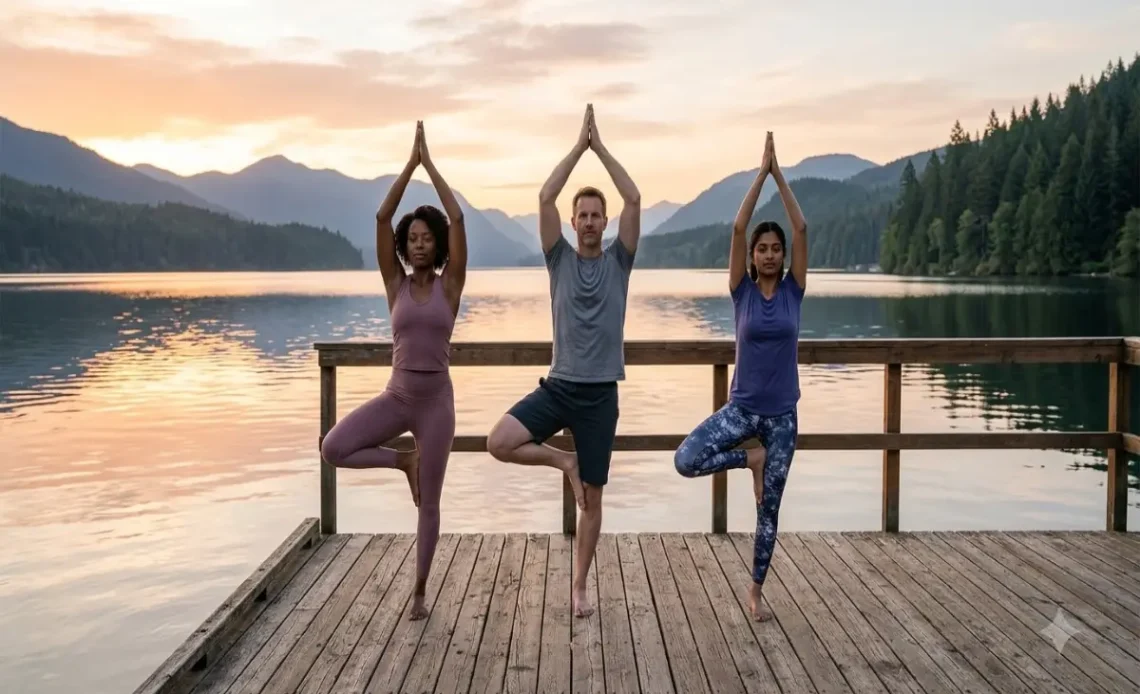
Standing poses such as Trio Tree Pose encourage participants to pay attention to their feet, posture, and center of gravity.
Light hand contact may help some people feel more stable. However, physical contact should never replace maintaining your own balance.
3. Makes stretching more engaging
A group forward fold or seated side stretch can make a familiar movement feel fresh.
The important point is to maintain a comfortable range of motion. A partner should not pull you deeper into a stretch or use body weight to force your muscles to lengthen.
4. Provides an opportunity to practice mindfulness
Three people can coordinate their breathing during a gentle yoga sequence. For example, everyone can inhale while sitting upright and exhale while gently twisting.
This encourages attention to the present moment without requiring complicated movements.
5. Makes group exercise more enjoyable
Practicing with friends may make exercise feel less repetitive. A short session can also become a social activity that everyone looks forward to.
However, trio yoga is not automatically more effective than individual yoga. Its main advantage is the opportunity to combine movement, cooperation, and shared practice.
Research summarized by the US National Center for Complementary and Integrative Health suggests that yoga may support general wellness, stress management, sleep, and balance. These findings relate to yoga more broadly, not specifically to three-person formations.
Comparison Table: Which Yoga Pose Should You Choose?
Use this table to select a pose based on your experience, available space, and comfort.
| Pose | Level | Equipment | Main focus |
| Trio Mountain | Very easy | Mats optional | Posture |
| Seated Circle | Very easy | Mat or blanket | Relaxation |
| Seated Side Stretch | Easy | Mat optional | Side-body mobility |
| Easy Pose Twist | Easy | Mat or cushion | Gentle rotation |
| Trio Child’s Pose | Easy | Mat | Rest |
| Cat-Cow Flow | Easy | Mat | Spinal movement |
| Butterfly Pose | Easy | Mat or cushion | Hip mobility |
| Standing Side Stretch | Easy | None | Flexibility |
| Triple Tree | Beginner–intermediate | Wall optional | Balance |
| Trio Chair | Intermediate | Wall optional | Lower-body strength |
| Trio Warrior II | Beginner-friendly | Mat optional | Stability |
| Trio Triangle | Beginner–intermediate | Block optional | Mobility |
| Supported Dancer | Intermediate | Wall or chair | Balance |
| Mountain-to-Star Flow | Easy | None | Coordination |
| Seated Forward Fold | Easy | Strap optional | Hamstrings |
| Happy Baby | Easy | Mat | Hip mobility |
| Reclined Twist | Easy | Mat | Gentle rotation |
| Trio Plank | Intermediate | Mats | Core stability |
| Trio Boat | Intermediate | Mat | Core control |
| Trio Bridge | Intermediate | Mat | Hip extension |
| Acro Base/Flyer/Spotter | Advanced | Mats and instructor | Partner balance |
These categories are practical guidance, not a clinical assessment. A pose that feels easy for one person may be uncomfortable for another.
How to Choose the Right Yoga Equipment for Three People
You do not need expensive equipment to begin practicing easy yoga poses for 3 people. A comfortable, non-slip surface and enough room to move are the main priorities.
Yoga mats
A yoga mat can provide cushioning and grip. For three participants, three individual mats are a practical starting point.
| Equipment | Advantages | Limitations |
| Individual yoga mats | Personal space and cushioning | Require storage and floor space |
| Shared large mat | Creates a connected practice area | May become crowded or slippery |
| Exercise or gym mat | Can provide extra cushioning | Thick surfaces may be unstable for balance |
| Bare floor | No equipment required | May be hard or slippery |
Recommendation: Choose individual non-slip mats for ordinary trio yoga. For acro-yoga, use the flooring recommended by a qualified instructor.
Yoga blocks
Yoga blocks can bring the floor closer to your hands during standing poses. They may help beginners maintain a comfortable range of motion.
| Option | Best use | Consideration |
| Foam block | General beginner practice | Lightweight and easy to carry |
| Cork block | Firm support | Heavier than foam |
| Wooden block | Firm, stable support | Hard surface; not ideal for every movement |
For most beginners, foam or cork blocks are sufficient. A block should support your own pose, not be used as a platform for lifting another person.
Yoga straps
A yoga strap can help people reach their feet during seated stretches without rounding their backs excessively.
Choose a strap with a secure buckle and enough length to accommodate the movement. Avoid using straps to pull another participant into a stretch.
Bolsters and cushions
Bolsters can support the knees, hips, or torso during seated and resting poses.
They are particularly useful when someone finds kneeling or sitting cross-legged uncomfortable. However, soft cushions are not stable platforms for standing balances or acro-yoga lifts.
Best Equipment Setup for Trio Yoga
Safety Tips Before Trying Three-Person Yoga Poses
Yoga is generally considered safe for healthy people when practiced appropriately, but injuries can still occur. The National Center for Complementary and Integrative Health identifies sprains and strains among the common yoga-related injuries and recommends learning under qualified instruction, particularly when you are new to the practice.
Three-person activities add coordination and physical-contact considerations. Follow these rules before starting.
1. Warm up for five to ten minutes
Start with gentle movements such as shoulder circles, ankle movements, Cat-Cow, and easy standing stretches.
A warm-up helps you prepare for the movements you intend to perform. It does not eliminate injury risk.
2. Agree on a stop signal
Choose a simple word such as “stop” or “down.”
Anyone should be able to use it at any time. When someone calls the signal, everyone should pause and return to a stable position safely.
3. Never force a stretch
A partner should not push your back, pull your arms, or press your knees toward the floor.
Stretching may feel mildly challenging, but sharp pain, numbness, or sudden discomfort is a reason to stop.
4. Keep weight off the neck and spine
Do not stand, kneel, or place body weight on another person’s neck, head, or lower back.
Avoid improvised human pyramids and stacked-body poses. These are not appropriate starting points for beginners.
5. Use enough space
Make sure all three people can extend their arms and legs without colliding.
Remove furniture, sharp objects, loose rugs, and anything that could cause someone to trip.
6. Avoid slippery surfaces
Use a stable floor with appropriate grip. Wet grass, polished slippery floors, and uneven ground are poor choices for balance work.
7. Modify poses for individual needs
Everyone has different levels of flexibility, strength, and balance.
A participant may need a chair, a wall, a cushion, or a simpler version of the pose. The group should adjust to the person who needs the most support.
8. Know when to seek professional advice
People with existing injuries, balance problems, certain medical conditions, or other individual health considerations may need to avoid or modify specific poses.
Pregnant participants should seek advice from their healthcare provider about appropriate activity and modifications. Beginners should avoid extreme positions and learn challenging movements under qualified instruction.
A 20-Minute Beginner Trio Yoga Routine
This routine uses simple, low-risk movements. It is designed as a general example, not a personalized exercise prescription.
| Time | Activity | Duration |
| 0:00–3:00 | Gentle warm-up | 3 minutes |
| 3:00–5:00 | Trio Mountain Pose | 2 minutes |
| 5:00–7:00 | Seated Circle Pose | 2 minutes |
| 7:00–10:00 | Seated Side Stretch | 3 minutes |
| 10:00–12:00 | Cat-Cow Flow | 2 minutes |
| 12:00–15:00 | Triple Tree Pose, with support as needed | 3 minutes |
| 15:00–17:00 | Group Butterfly Pose | 2 minutes |
| 17:00–20:00 | Child’s Pose or comfortable rest | 3 minutes |
How to follow the routine
Begin with slow movements and comfortable breathing. Do not rush to keep up with the other two participants.
For standing poses, take breaks whenever needed. If Tree Pose feels unstable, keep your toes on the floor or stand near a wall.
Finish with a comfortable resting position. The purpose of the session is to practice movement and coordination, not to achieve the most complicated shape.
Common Mistakes to Avoid
Trying advanced poses too early
A photograph may make an acro-yoga pose look simple, but it may require considerable strength, balance, and experience.
Better approach: Start with seated and standing poses. Progress only when you can perform the individual movements comfortably.
Pulling on a partner
Using another person’s arms to force a deeper stretch can place unwanted stress on their joints.
Better approach: Maintain your own range of motion and use props when needed.
Ignoring differences in height or flexibility
A pose that works for one person may not fit the other two participants.
Better approach: Adjust spacing and use individual modifications instead of forcing everyone into the same position.
Holding your breath
People sometimes hold their breath when concentrating on balance.
Better approach: Keep breathing naturally. Exit the pose if you cannot maintain comfortable breathing.
Focusing on photographs instead of technique
Trying to recreate a dramatic social media image may encourage people to attempt movements they have not learned.
Better approach: Prioritize safe positioning, controlled movement, and a planned exit over the appearance of the final pose.
How to Build a Trio Yoga Practice Over Four Weeks
A gradual approach can help your group become familiar with the poses before attempting more challenging movements.
| Week | Main focus | Suggested practice |
| Week 1 | Comfort and coordination | Mountain Pose, Seated Circle, Child’s Pose |
| Week 2 | Gentle flexibility | Side Stretch, Butterfly, Cat-Cow |
| Week 3 | Standing balance | Tree Pose, Warrior II, Triangle Pose |
| Week 4 | Combining movements | Follow the 20-minute routine |
Practice at a pace that feels comfortable. There is no requirement to progress to acro-yoga after four weeks—or at all.
If your goal is simply to exercise with friends, the beginner poses can provide a complete group session.
Yoga Poses for 3 People: What the Research Actually Says
A useful health article should distinguish general yoga research from evidence about a specific activity.
The National Center for Complementary and Integrative Health reports that research suggests yoga may help with aspects of general wellness, including stress management, sleep, and balance. It also notes that yoga-related injuries can occur and that appropriate instruction and modifications are important.
However, those findings should not be interpreted as proof that trio yoga is more effective than solo yoga or that a particular three-person pose produces a specific health outcome.
There is also no established clinical ranking that proves one of the 21 poses above is the safest or most effective for every person.
The comparison tables in this guide are practical selection tools. They are not the results of a clinical trial, a survey of yoga practitioners, or a measured 2026 ranking.
For a people-first article, avoid publishing unsupported claims such as “trio yoga reduces stress by 80%” or “three-person yoga burns twice as many calories.” Such figures would require reliable evidence specific to the claim.
Frequently Asked Questions
1. What are the easiest yoga poses for 3 people?
Trio Mountain Pose, Seated Circle Pose, Group Side Stretch, Child’s Pose, and Cat-Cow Flow are accessible starting points for many beginners. They do not require lifting or stacking bodies.
2. Can beginners do three-person yoga poses?
Yes. Beginners can start with simple seated, standing, and stretching poses. Choose movements that allow everyone to maintain their own balance and stop whenever something feels uncomfortable.
3. What is the difference between trio yoga and acro yoga?
Trio yoga is a broad term for yoga practiced by three people. Acro yoga generally involves partner-based support, balance, and sometimes lifting. Some trio yoga poses are simple group stretches, while acro-yoga formations can require specialized instruction.
4. Do I need three yoga mats?
Three individual mats are useful because they give each participant a defined practice area. For seated or standing poses, mats may be optional if the floor is clean, stable, and comfortable.
5. Can children practice yoga poses for three?
Children can participate in age-appropriate, supervised yoga activities. Choose simple movements, avoid lifting and stacking, and ensure that the activity matches each child’s abilities. A qualified children’s yoga instructor can help adapt the session.
Conclusion
Yoga poses for 3 people offer a practical way to combine movement, stretching, balance, and social connection. You can begin with simple positions such as Trio Mountain Pose, Seated Circle Pose, and Group Side Stretch before exploring more coordinated movements.
The most important part of trio yoga is not how impressive a pose looks. It is whether all three participants can perform it comfortably, communicate clearly, and return to a stable position without being forced or placed at risk.
Start with the beginner poses, use suitable equipment, and progress at your own pace. If you want to explore lifts or advanced acro-yoga formations, learn from a qualified instructor rather than attempting them from photographs alone.
With a little preparation, three people can create a fun, accessible yoga session that suits their individual abilities.
Disclaimer:
This article is for general educational purposes and is not a substitute for individualized medical advice or professional yoga instruction. Stop any movement that causes pain, dizziness, or unusual discomfort. Seek guidance from a qualified healthcare professional or yoga instructor when appropriate.