
 Sameena Fatima
Health & Wellness Content Writer
in
Sameena Fatima writes reader-focused
health and wellness content for
HealthBloomWeb, covering fitness,
nutrition, healthy lifestyle and
everyday wellness topics.
Sameena Fatima
Health & Wellness Content Writer
in
Sameena Fatima writes reader-focused
health and wellness content for
HealthBloomWeb, covering fitness,
nutrition, healthy lifestyle and
everyday wellness topics.
 Mirza Ibrahim Ali Khan
Editorial & Content Reviewer
in
Mirza Ibrahim Ali Khan contributes to
HealthBloomWeb's editorial review process,
with a focus on content structure,
readability, search intent and overall
editorial quality.
Mirza Ibrahim Ali Khan
Editorial & Content Reviewer
in
Mirza Ibrahim Ali Khan contributes to
HealthBloomWeb's editorial review process,
with a focus on content structure,
readability, search intent and overall
editorial quality.
 Reyansh Sethi
Medical Reviewer
in
Reyansh Sethi contributes to the medical
review process at HealthBloomWeb, focusing
on clarity, responsible health context and
reader-friendly presentation of health
information.
Reyansh Sethi
Medical Reviewer
in
Reyansh Sethi contributes to the medical
review process at HealthBloomWeb, focusing
on clarity, responsible health context and
reader-friendly presentation of health
information.
Most of us spend a big chunk of the day sitting. Then when we finally stand up, the backs of the thighs feel short and stubborn. Standing hamstring stretches give you a way to work on that tightness right where you are—no floor, no mat required. You can do them at the office, in the kitchen, after a walk, or while waiting for the kettle to boil.
This article sticks strictly to standing options. You’ll get clear form tips, several single-leg and both-legs variations, how to make them easier or harder, safety notes, a few useful comparisons, and some real-world flexibility data from different groups. Everything is written for everyday people who want better leg mobility without complicated routines.
Why Standing Stretches Matter
When you stand and hinge at the hips, gravity helps pull you into the stretch. That can feel different from lying or sitting versions. Standing work also challenges your balance a little, which quietly trains the smaller muscles around the hips and ankles. For many people who dislike getting down on the floor, these moves remove a big barrier.
Standing stretches are especially handy if:
- You work at a desk and want quick movement breaks
- You prefer to stay upright
- You’re warming up before a walk or light run
- You have limited space
A comparative study found that standing and supine (lying) hamstring stretches produced roughly similar improvements in knee-extension range of motion. The gains were almost identical, so the choice often comes down to preference and practicality rather than one being clearly superior.
Key Form Rules for Every Standing Stretch
Get these right and the stretches become safer and more effective:
- Hinge from the hips, not the waist. Imagine pushing your butt backward while keeping a long spine. Rounding the lower back hard shifts the load away from the hamstrings and onto the spine.
- Soft knees are okay. Fully locking the knees can stress the joint and tendons. A tiny bend is fine, especially at the start.
- Feel the stretch in the back of the thigh. Mild pulling is the goal. Sharp pain, tingling, or lower-back discomfort means ease off.
- Breathe steadily. Holding your breath tightens everything.
- Use support when needed. A wall, chair, or countertop keeps balance issues from turning a stretch into a wobble.
- Warm up a little first. A short walk or a few easy leg swings makes the tissue more receptive.
Hold times for static versions are usually 20–30 seconds per side, two or three times. Dynamic versions (moving in and out) work better before activity.
Core Standing Hamstring Stretches
1. Classic Standing Forward Fold (Both Legs)
This is the familiar toe-touch style stretch.
How to do it: Stand with feet hip-width apart, toes pointing forward. Soften the knees slightly. Hinge at the hips and fold forward, letting the arms hang or reach toward the floor or shins. Keep the weight mostly in the heels. Let the head and neck relax. Hold where you feel a solid stretch in the backs of the thighs—usually 20–30 seconds. To come up, bend the knees a bit more and roll up slowly, stacking the spine.
Beginner tip: Bend the knees more so your belly can rest closer to the thighs. This reduces strain and still stretches the hamstrings. As flexibility improves, straighten the legs gradually.
Common mistake: Forcing the hands to the floor by rounding the back aggressively. Reach only as far as the stretch stays in the thighs.
2. Single-Leg Standing Hamstring Stretch (Heel on Floor)
A focused one-sided version that many people find easier to control.
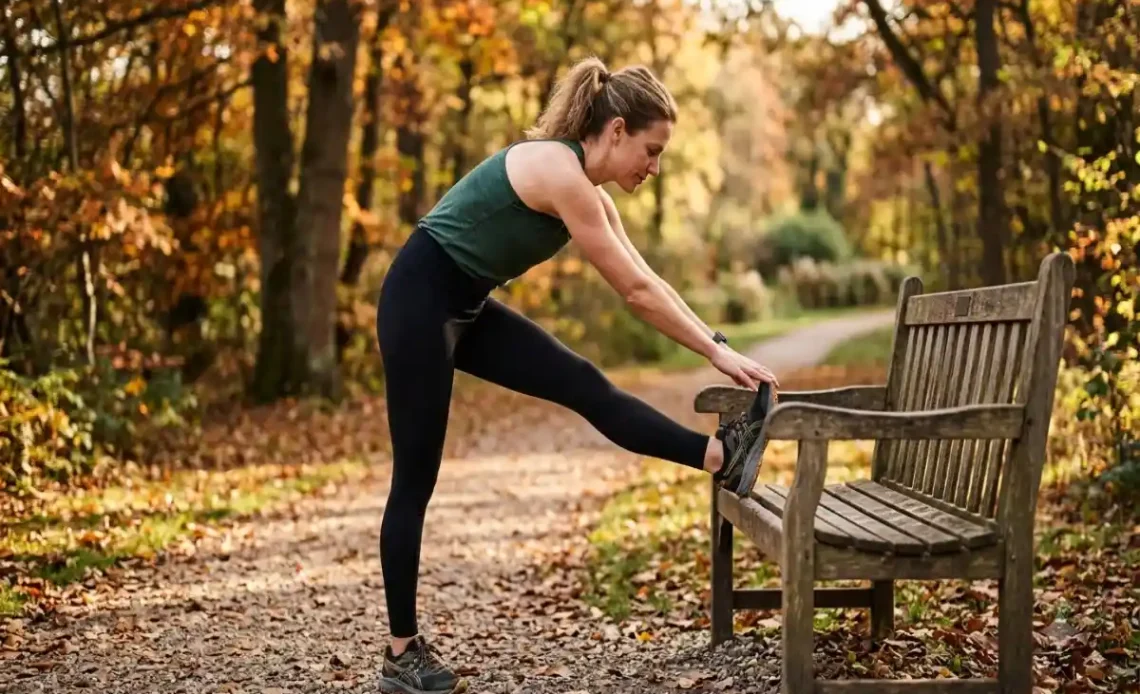
How to do it: Stand tall. Step one foot forward a short distance and plant the heel, toes pointing up. Soften the back knee. Hinge forward from the hips over the front leg, keeping the spine long. Reach toward the front shin or foot, or simply rest the hands on the thigh. Hold 20–30 seconds, then switch.
Support option: Hold a wall or chair with one hand for balance.
This stretch is useful because you can adjust the intensity simply by how far you step the front foot or how much you hinge.
3. Elevated Heel Standing Stretch (Step, Chair, or Curb)
One of the most scalable standing options.
How to do it: Place one heel on a low step, sturdy chair, curb, or even a thick book. Keep the elevated leg mostly straight and the hips square. Hinge forward from the hips until you feel the stretch along the back of the raised leg. Hands can rest on the thigh or reach toward the foot. Hold 20–30 seconds per side.
Progression: Raise the surface height as you get more flexible. Regression: Use a lower surface or keep a bigger bend in the standing knee.
This version is popular because the elevated surface does some of the work for you. It is often recommended as a beginner-friendly standing move.
4. Standing Cross-Leg Forward Fold
A subtle variation that can change the angle of the stretch.
How to do it: Stand and cross one foot in front of the other. Hinge forward at the hips. Keep both knees soft. Hold the stretch, then switch the cross.
Some people feel this more on the outer or inner part of the hamstring depending on the cross.
5. Dynamic Standing Options (Great Before Activity)
Static holds are excellent after movement. Dynamic versions warm the tissue and prepare you for walking, running, or sports.
Leg swings: Stand beside a wall for support. Swing one leg forward and back in a controlled arc, keeping the torso upright. Start with small swings and gradually increase the range. Do 10–15 per leg. The forward part of the swing gives a gentle dynamic stretch to the hamstring.
Hamstring sweeps or scoops: Step one foot forward with the heel down and toes up. Hinge and sweep the hands down the front leg, then stand tall again. Alternate sides in a smooth rhythm for 8–12 reps each.
Standing toe-touch kicks (light version): From a wider stance, gently swing one leg up while reaching the opposite hand toward the foot. Keep it controlled—no forceful kicks. This builds dynamic range.
Dynamic moves are better before exercise. Save the longer static holds for afterward or for dedicated flexibility sessions.
Comparison Table: Standing Stretch Options
| Stretch | Balance Demand | Intensity Control | Best Time of Day | Support Needed? | Notes |
| Both-legs forward fold | Moderate | Medium | After activity or evening | Optional | Classic; easy to modify with bent knees |
| Single-leg heel on floor | Low–moderate | High | Anytime | Recommended | Great for focusing on one side |
| Elevated heel (step/chair) | Low | High | Anytime | Low | Highly scalable |
| Cross-leg fold | Moderate | Medium | After activity | Optional | Changes the stretch angle |
| Dynamic leg swings | Low | Easy to adjust | Before activity | Wall helpful | Warms tissue without long holds |
| Hamstring sweeps | Low | Easy to adjust | Before or during day | Optional | Flowing movement |
Use the table to match the stretch to your energy level and setting.
How Standing Stretches Fit into Real Life
Many people find standing versions easier to stick with simply because they require less setup. You can do a 30-second elevated-heel stretch while the coffee brews or a few leg swings while waiting for the elevator. Consistency matters more than perfect depth.
Recent research continues to support regular stretching for improving range of motion. One practical takeaway from flexibility studies is that short, frequent sessions often outperform rare long ones. Standing options make frequency easier for busy schedules.
Flexibility Patterns Across Groups
Flexibility is not uniform. Data from different populations show clear patterns:
- In a large Nigerian study using the modified sit-and-reach test (which involves both hamstrings and lower back), females generally scored higher than males across age groups. Flexibility tended to peak at different ages for each sex.
- Among Japanese children and adolescents, girls showed better average values on several lower-limb flexibility measures than boys. Sex differences were statistically significant.
- School-age children in Malaysia and Sri Lanka showed tightness rates around 43–52% on passive straight-leg raise testing, with a positive link between higher physical activity and better flexibility.
- In one group of workers with prolonged standing hours, bilateral hamstring tightness was relatively low (around 15%), suggesting that standing itself is not automatically a cause of tightness—sitting and lack of movement appear more relevant in many studies.
- Among Dutch amateur male soccer players, sit-and-reach scores varied widely, and population reference values were established so coaches could identify very low or low flexibility.
These differences remind us that age, sex, activity level, and daily posture all influence baseline flexibility. Standing stretches can help almost anyone improve from their own starting point.
Common Mistakes and Simple Fixes
- Rounding the back to “get lower.” Fix: Think “hips back, chest forward.” Stop when the stretch is clear in the thighs.
- Locking the knees hard. Fix: Keep a soft micro-bend.
- Holding the breath. Fix: Count slow breaths during the hold.
- Bouncing. Fix: Stay still in static versions. Save movement for dynamic warm-ups.
- Ignoring one side. Fix: Always do both legs, even if one feels tighter.
- Doing deep static stretches before intense activity. Fix: Use dynamic versions first; save longer holds for later.
Sample Standing-Only Routines
Quick desk or kitchen break (3–5 minutes): Elevated heel stretch – 25 seconds each side
Single-leg heel-on-floor – 20 seconds each side
A few gentle leg swings
After a walk or light workout (8–10 minutes): Both-legs forward fold – 2 × 30 seconds
Elevated heel – 2 × 25 seconds each side
Cross-leg fold – 20 seconds each side
Finish with slow standing marches
Pre-activity warm-up (5 minutes): Leg swings – 12 each leg
Hamstring sweeps – 10 each side
Light single-leg hinges – 8 controlled reps each side
Progress and Expectations
Most people notice less stiffness within a couple of weeks of regular standing stretches. Measurable gains in how far you can hinge or how straight the leg feels often show up in 4–8 weeks. Progress is rarely linear—some days feel tighter than others. Track simple real-life markers: Is tying your shoes easier? Do you feel less pull when you bend to pick something up?
If one side stays noticeably tighter, give it a little extra attention but keep the difference modest. Pairing the stretches with simple glute and core work (bridges, bird-dogs, or just standing tall with good posture) supports better long-term results.
Special Considerations
People with osteoporosis or significant spinal issues should approach deep forward folds carefully; a physical therapist can advise on safer alternatives. Anyone with recent hamstring strains, sciatica, or balance problems should start with support and smaller ranges. When in doubt, get a professional check.
Standing stretches are not a complete solution for every case of tightness. Sometimes the issue involves the nerves, the pelvis position, or overall strength. If consistent gentle work for several weeks brings no change or increases discomfort, a movement specialist can help identify the missing piece.
Wrapping Up
Standing hamstring stretches remove the biggest excuse many of us have—needing space or time to get on the floor. They fit into ordinary days, require almost no equipment, and deliver real improvements when done consistently with good form. Start with the elevated-heel or single-leg versions if you are new to this. Use support freely. Keep the intensity at a comfortable pull. Breathe. Repeat most days.
Over time the backs of your thighs will feel less restricted, bending will feel freer, and everyday movement will become a little easier. That is the practical payoff of showing up for these simple standing stretches.
This information is general education. Individual needs vary, so consult a healthcare professional for personal advice, especially if you have existing injuries or medical conditions.