
 Sameena Fatima
Health & Wellness Content Writer
in
Sameena Fatima writes reader-focused
health and wellness content for
HealthBloomWeb, covering fitness,
nutrition, healthy lifestyle and
everyday wellness topics.
Sameena Fatima
Health & Wellness Content Writer
in
Sameena Fatima writes reader-focused
health and wellness content for
HealthBloomWeb, covering fitness,
nutrition, healthy lifestyle and
everyday wellness topics.
 Mirza Ibrahim Ali Khan
Editorial & Content Reviewer
in
Mirza Ibrahim Ali Khan contributes to
HealthBloomWeb's editorial review process,
with a focus on content structure,
readability, search intent and overall
editorial quality.
Mirza Ibrahim Ali Khan
Editorial & Content Reviewer
in
Mirza Ibrahim Ali Khan contributes to
HealthBloomWeb's editorial review process,
with a focus on content structure,
readability, search intent and overall
editorial quality.
 Reyansh Sethi
Medical Reviewer
in
Reyansh Sethi contributes to the medical
review process at HealthBloomWeb, focusing
on clarity, responsible health context and
reader-friendly presentation of health
information.
Reyansh Sethi
Medical Reviewer
in
Reyansh Sethi contributes to the medical
review process at HealthBloomWeb, focusing
on clarity, responsible health context and
reader-friendly presentation of health
information.
If the back of your thighs often feels stiff after sitting, running, walking, or working out, the right hamstring stretching exercises can help you work on flexibility and comfortable movement. The hamstrings are a group of muscles at the back of the thigh that help bend the knee and extend the hip. A good stretching routine does not need to be complicated. In many cases, a few controlled stretches performed consistently are enough to build a useful flexibility habit.
Research supports stretching as a way to improve flexibility and range of motion, although the best routine depends on the person, activity, and goal. A 2025 systematic review and meta-analysis involving 189 studies and 6,654 adults found that both acute and longer-term static stretching improved flexibility, with larger improvements generally seen in people who started with poorer flexibility. The researchers estimated that flexibility benefits were maximized at about four minutes of stretching in a session and about 10 minutes of cumulative stretching per week for chronic improvements.
This guide explains how to stretch hamstrings, which exercises are suitable for beginners, how standing and seated stretches differ, when to use static or dynamic movements, and what to do if stretching causes pain.
Important: This article is general fitness information, not a diagnosis or individualized treatment plan. If you have a recent hamstring injury, significant pain, swelling, bruising, weakness, numbness, or difficulty walking, speak with a qualified healthcare professional before starting or changing an exercise routine.
What Are the Hamstrings?
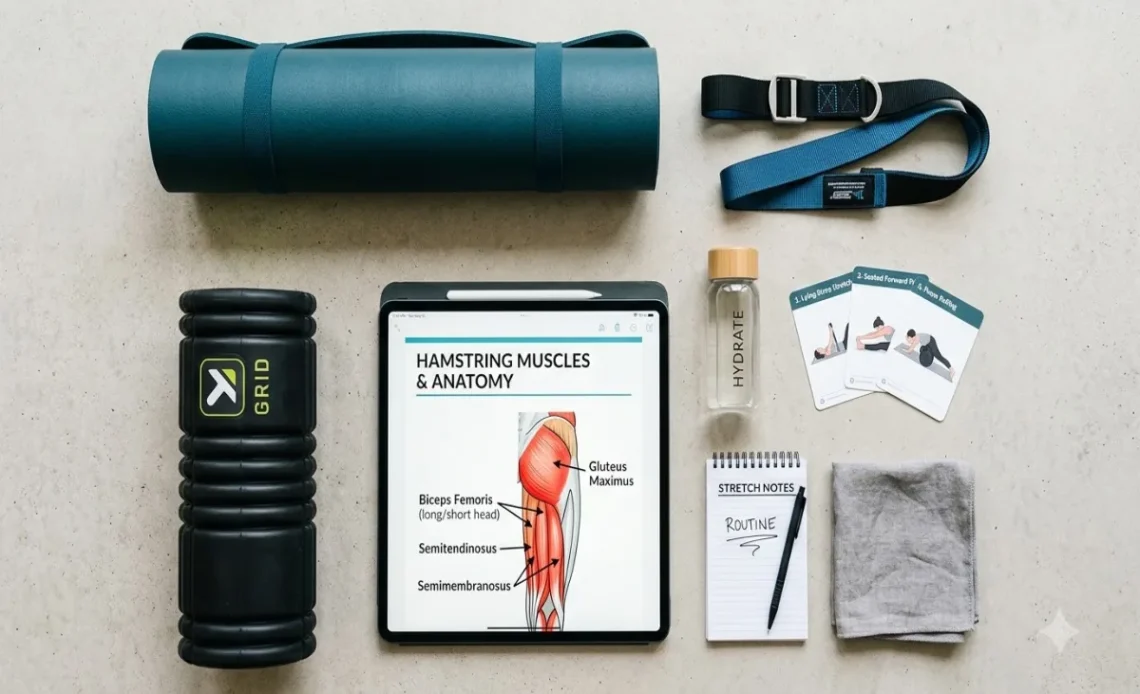
The hamstrings are located along the back of your thigh. The group includes the biceps femoris, semitendinosus, and semimembranosus.
These muscles work during everyday movements such as walking, climbing stairs, getting up from a chair, and bending your knee. They also play an important role in running, jumping and other sports.
When someone says their “hamstrings are tight,” that does not necessarily mean the muscle is physically shortened. A feeling of tightness can have several possible causes. Mayo Clinic sports medicine guidance notes that perceived stiffness does not always mean a muscle simply needs more stretching; in some cases, strengthening or assessment of another source may be appropriate.
That is why a useful hamstring routine should combine flexibility work with sensible movement and, when appropriate, strength training.
Benefits of Hamstring Stretching Exercises
Stretching is mainly useful for improving flexibility and helping joints move through a comfortable range of motion. It should not be presented as a cure-all for every type of leg pain.
Research on hamstring stretching consistently shows improvements in range of motion. A systematic review of 27 randomized controlled trials involving 606 participants found that both dynamic and static stretching could improve hamstring range of motion, with repeated static stretching producing greater long-term improvements than dynamic stretching in that analysis.
Potential benefits include:
- Improved hamstring flexibility
- Greater comfortable range of motion
- Easier movement during daily activities
- A useful part of a post-workout flexibility routine
- Better tolerance for positions that require hip flexion and knee extension
- A simple way to maintain mobility over time
The important word is potential. Stretching does not automatically prevent every injury or eliminate every cause of stiffness.
What Does the Research Say About Stretching?
Current evidence gives us a more useful picture than the old idea that everyone needs to stretch as hard as possible.
Recent evidence at a glance
| Research finding | What it means for you |
| Static stretching improves flexibility | Regular gentle static stretches can be useful for flexibility |
| Chronic stretching has a larger flexibility effect than a single session | Consistency matters more than one long stretching session |
| People with poorer starting flexibility may improve more | Beginners may notice meaningful changes with regular practice |
| Dynamic and static stretching can both improve hamstring ROM | The best choice depends partly on when and why you are stretching |
| Stretching intensity did not clearly determine flexibility gains in the 2025 meta-analysis | Harder is not automatically better |
| Evidence does not identify one universally “best” hamstring stretch | Choose a comfortable exercise you can perform correctly and consistently |
The 2025 dose-analysis included adults and found a moderate acute effect and large chronic effect of static stretching on flexibility. It also found no additional flexibility benefit beyond approximately four minutes per session or 10 minutes per week for chronic stretching under the models examined.
How to Stretch Hamstrings Safely
Before trying the exercises below, keep a few basic rules in mind.
Warm up first
If you are about to perform a longer stretching routine, start with light movement. Mayo Clinic recommends warming up with about 5 to 10 minutes of light activity before stretching and suggests that major muscle groups can be stretched after exercise when the muscles are warm.
A short walk, easy cycling, or another gentle activity can work.
Stretch to tension, not pain
You should generally feel a gentle pulling or stretching sensation. Sharp, burning, electric, or increasing pain is different.
Mayo Clinic advises against painful stretching and recommends smooth movements without bouncing.
Do not bounce
Fast bouncing can make it harder to control the amount of force placed on the tissue. Move slowly into the position and breathe normally.
Keep both sides in mind
One leg may naturally be more flexible than the other. Pay attention to major differences rather than trying to force both sides into exactly the same position.
Best Hamstring Stretches for Beginners
You do not need advanced yoga poses or expensive equipment to start.
Here are practical options that can be adjusted to different fitness levels.
1. Seated Hamstring Stretch
This is one of the easiest ways to learn the basic hip-hinge movement.
How to do it:
- Sit near the front of a stable chair.
- Extend one leg forward with the heel resting on the floor.
- Keep your back relatively straight.
- Hinge forward from your hips.
- Move only until you feel a comfortable stretch along the back of your thigh.
- Hold the position and breathe normally.
- Return slowly and switch sides.
Cleveland Clinic gives a similar seated chair variation and recommends maintaining a straight spine while leaning from the hips rather than collapsing forward.
Beginner tip: If reaching toward your toes makes you round your back or creates discomfort, do not force the reach. The stretch does not become more effective simply because your fingers touch your foot.
2. Standing Hamstring Stretch
A standing variation is convenient when you do not want to get onto the floor.
How to do it:
- Stand near a wall or another stable support.
- Place one heel slightly forward.
- Keep the extended leg comfortable rather than aggressively locking the knee.
- Hinge gently at the hips.
- Keep your torso controlled.
- Stop when you feel a mild stretch behind the thigh.
- Hold and breathe normally before switching legs.
This is particularly convenient after walking or during a workplace mobility break.
3. Lying Hamstring Stretch
A lying stretch reduces the need for balance and can be easier for beginners.
How to do it:
- Lie on your back.
- Bend one knee and keep the other leg relaxed.
- Slowly raise one leg.
- Use your hands behind the thigh or a strap if necessary.
- Bring the leg toward you until you feel gentle tension.
- Hold without pulling aggressively.
- Lower the leg slowly and repeat on the other side.
Cleveland Clinic describes a similar lying hamstring stretch and notes that a towel can be used when reaching the leg directly is difficult.
4. Towel or Strap Hamstring Stretch
A towel or yoga strap can provide extra reach without requiring you to touch your toes.
How to do it:
- Lie on your back.
- Raise one leg.
- Place a towel or strap around the foot.
- Hold the ends with your hands.
- Gently guide the leg toward you.
- Keep the movement controlled.
- Stop at a comfortable stretch.
Cleveland Clinic describes a passive towel hamstring stretch using a towel or fitness strap and recommends holding the position for up to 30 seconds.
Important: The strap is an assistance tool, not something you should pull hard.
Standing Hamstring Stretching Exercises
Standing stretches are useful when you want a quick mobility break without using a mat.
Standing single-leg stretch
Place one heel forward and hinge from the hip while keeping the supporting leg stable.
Supported standing stretch
Use a wall, countertop, or sturdy chair for balance. This can make the exercise more comfortable for beginners.
Dynamic standing hamstring movement
Instead of holding the position, move slowly through a comfortable range. This is more appropriate when your goal is to prepare for activity rather than perform a traditional static flexibility exercise.
Dynamic stretching is generally characterized by controlled movement rather than holding a position. A 2025 meta-analysis found that dynamic and ballistic stretching can acutely improve flexibility, although the research should not be interpreted as a reason to use aggressive bouncing movements.
Seated Hamstring Stretching Exercises
Seated stretches are useful at home, at work, or during a gentle mobility session.
Chair hamstring stretch
This is particularly beginner-friendly because the chair provides support.
| Step | What to do |
| 1 | Sit toward the front of a stable chair |
| 2 | Extend one leg forward |
| 3 | Rest your heel on the floor |
| 4 | Keep your back controlled |
| 5 | Hinge forward from the hip |
| 6 | Stop at gentle tension |
| 7 | Hold and breathe normally |
Avoid using a rolling office chair for this exercise. A stable chair is safer.
Mayo Clinic’s seated stretching guidance similarly recommends a stable chair and describes extending one leg with the heel on the floor before gently leaning forward from the hip.
Hamstring Stretches for Tight Hamstrings
If your hamstrings feel tight after sitting all day, start with easier positions rather than immediately attempting an extreme stretch.
A simple sequence could be:
- Five minutes of easy walking.
- Seated chair hamstring stretch.
- Lying hamstring stretch.
- Gentle dynamic leg movement.
- Repeat the easier stretches if they feel comfortable.
Remember that the sensation of tightness does not always mean the hamstring needs more stretching. Mayo Clinic sports medicine guidance specifically notes that persistent tension may sometimes require evaluation and strengthening rather than simply more stretching.
If tightness keeps returning despite a consistent routine, consider discussing it with a physical therapist or sports medicine professional.
Hamstring Flexibility Exercises
Stretching is one part of flexibility training, but flexibility also depends on how comfortably you can control a joint through its available range.
Useful exercises include:
- Seated hamstring stretches
- Supine strap stretches
- Controlled leg raises
- Active hamstring stretches
- Gentle dynamic movements
- Hip mobility exercises
- Appropriate lower-body strengthening
Active stretching can also be useful. Cleveland Clinic describes active hamstring stretching as raising the leg while using your own muscles to control the position.
The goal is not to become extremely flexible. For most people, a more practical goal is comfortable, controlled movement.
Hamstring Mobility Exercises
Mobility and flexibility overlap, but they are not exactly the same.
Flexibility generally refers to how much range is available.
Mobility includes how well you can actively and comfortably control that range.
For example, you might be able to move your leg far when someone helps you, but have difficulty controlling the same position yourself. That is one reason a balanced program can include both passive stretches and active movements.
Try:
- Controlled straight-leg raises
- Gentle dynamic hamstring sweeps
- Hip hinges
- Slow leg swings
- Active hamstring stretches
- Light strength exercises when appropriate
Keep dynamic movements smooth. The objective is controlled movement, not maximum height.
Static vs. Dynamic Hamstring Stretches
One of the most common questions is whether you should hold a hamstring stretch or keep moving.
| Feature | Static stretching | Dynamic stretching |
| Movement | Hold a position | Controlled movement |
| Main purpose | Flexibility | Movement preparation |
| Typical use | After activity or dedicated flexibility work | Warm-up |
| Example | Seated hamstring stretch | Controlled leg swings |
| Intensity | Gentle tension | Smooth and controlled |
| Main mistake | Forcing the position | Swinging aggressively |
Research suggests both approaches can improve hamstring range of motion. A systematic review and meta-analysis of 27 randomized trials found no significant difference between a single bout of static and dynamic stretching for acute hamstring ROM, while repeated static stretching showed stronger long-term effects in that analysis.
The practical takeaway is simple:
Use controlled dynamic movement when preparing for activity, and use comfortable static stretches when working specifically on flexibility.
How Long Should You Hold a Hamstring Stretch?
There is no need to hold a hamstring stretch for several minutes at a time.
Mayo Clinic’s general stretching guidance recommends holding a stretch for about 30 seconds, repeating it on both sides, and performing major-muscle stretching at least two to three days per week.
The exact duration can vary depending on the exercise and person.
| Goal | Practical approach |
| Beginner flexibility | Around 20–30 seconds |
| General static stretching | Around 30 seconds |
| Very stiff area | Progress gradually rather than forcing a longer hold |
| Dynamic warm-up | Controlled repetitions instead of long holds |
| Painful area | Stop and investigate the cause rather than stretching harder |
The 2025 meta-analysis adds an interesting research perspective: across the studies analyzed, flexibility improvements were maximized around four cumulative minutes per session for acute effects and 10 minutes per week for chronic effects.
That does not mean everyone should follow exactly those numbers. It means more stretching is not necessarily better.
When Should You Stretch Your Hamstrings?
Timing depends on your goal.
Before exercise
Use a general warm-up and controlled dynamic movements.
If you are preparing for running, jumping, football, basketball, or another explosive activity, avoid turning your warm-up into a long session of intense static stretching.
Mayo Clinic notes that static stretching immediately before an event can temporarily reduce hamstring strength, which is one reason dynamic preparation is often preferred before vigorous activity.
After exercise
After your workout, gentle static stretching can be a convenient time to work on flexibility.
On rest days
You can also perform a short flexibility session after a brief warm-up.
The key is consistency rather than searching for one “perfect” time.
A Simple Hamstring Stretching Routine for Beginners
If you are new to stretching, start small.
8–10 minute routine
| Exercise | Suggested time |
| Easy walking warm-up | 3–5 minutes |
| Seated chair stretch | 20–30 sec/side |
| Lying hamstring stretch | 20–30 sec/side |
| Towel or strap stretch | 20–30 sec/side |
| Gentle dynamic movement | Controlled repetitions |
| Easy cool-down | 1–2 minutes |
You do not need to complete every exercise every day.
A few consistent sessions each week can be more practical than an ambitious routine you stop after a few days.
Common Hamstring Stretching Mistakes
1. Trying to touch your toes
Touching your toes is not the goal.
If your hamstrings feel a gentle stretch before your hands reach your feet, you are already doing the exercise.
2. Rounding your back excessively
A hamstring stretch should not become a competition to get your chest to your knees.
Focus on controlled movement from the hips.
3. Bouncing
Bouncing makes the movement harder to control.
Use slow, smooth movements instead. Mayo Clinic specifically recommends avoiding bouncing during stretching.
4. Stretching through pain
A gentle pulling sensation can be expected.
Sharp or worsening pain is a reason to stop.
5. Doing intense static stretching immediately before explosive exercise
For activities involving sprinting or jumping, a warm-up with controlled dynamic movements is generally more appropriate than prolonged intense static stretching.
6. Assuming every tight hamstring needs more stretching
Persistent tightness can have different causes. If stretching repeatedly fails to help, professional assessment may be more useful than increasing the intensity.
Hamstring Stretching After an Injury
This is where general fitness advice needs to be separated from rehabilitation.
A recently injured hamstring should not automatically be treated like an ordinary tight muscle.
For a hamstring strain, early treatment may focus on reducing pain and swelling and temporarily avoiding strenuous activity. Mayo Clinic explains that a healthcare professional or physical therapist may introduce gentle stretching and strengthening as recovery progresses, with strengthening added after pain and swelling have improved.
A 2025 systematic review also examined different rehabilitation approaches for hamstring injuries, highlighting that rehabilitation involves more than stretching alone and may include strengthening and progressive loading.
Get professional advice if you have:
- Sudden severe pain
- A popping sensation during injury
- Significant bruising
- Noticeable swelling
- Difficulty walking normally
- Significant weakness
- Numbness or unusual sensations
- Pain that continues or worsens
- Repeated hamstring injuries
Do not use this article as a substitute for an individualized rehabilitation plan.
Can Hamstring Stretching Help With Back Pain?
This question needs careful context.
A 2024 systematic review and meta-analysis of 14 randomized controlled trials involving 735 people with low back pain found that hamstring stretching was associated with reductions in pain and improvements in some functional measures. However, the included studies covered different types of low back pain, and some outcomes showed substantial heterogeneity.
That means hamstring stretching may be useful for some people with back problems, but it should not be presented as a universal treatment for back pain.
If back pain travels down the leg, causes numbness or weakness, or is severe or persistent, medical assessment is appropriate.
Do You Need Equipment for Hamstring Stretches?
No.
Most beginner hamstring stretches can be performed without equipment.
| Equipment | Useful for | Do you need it? |
| None | Standing and seated stretches | No |
| Stable chair | Supported seated stretches | Optional |
| Yoga strap | Assisted lying stretches | Optional |
| Towel | Home alternative to a strap | Optional |
| Yoga mat | Floor comfort | Optional |
| Foam roller | Mobility/self-massage work | Optional |
A towel can be particularly useful because it is inexpensive and already available in many homes.
How Often Should You Do Hamstring Stretching Exercises?
For general flexibility, a few sessions each week can be a reasonable starting point.
Mayo Clinic recommends stretching major muscle groups at least two to three days per week, while also emphasizing regularity and gentle technique.
You can build a simple routine around your schedule:
Monday: Hamstring flexibility
Wednesday: Mobility + light stretching
Friday: Hamstring flexibility
Weekend: Optional gentle mobility
You do not need a complicated daily program unless your sport, rehabilitation plan, or professional guidance calls for one.
Final Takeaway
The most effective hamstring routine is not necessarily the most difficult one.
For most beginners, start with simple hamstring stretching exercises such as a seated chair stretch, standing stretch, lying stretch, or towel-assisted stretch. Work within a comfortable range, avoid bouncing, and do not confuse pain with productive stretching.
The research available through 2026 supports stretching as a useful tool for improving flexibility and range of motion. Recent evidence also suggests that consistency matters and that doing more is not automatically better.
If your goal is general flexibility, a short routine performed regularly can be enough to make progress. If your goal is returning from a hamstring injury or dealing with persistent pain, stretching should be considered only one part of a broader assessment and rehabilitation plan.
Medical Disclaimer
This article is for general educational and fitness information only. It does not diagnose, treat, or prevent any medical condition and does not replace advice from a doctor, physical therapist, or other qualified healthcare professional. Exercise should be modified or stopped if it causes pain or unusual symptoms. People recovering from an injury or living with a medical condition should obtain individualized professional guidance.