
 Sameena Fatima
Health & Wellness Content Writer
in
Sameena Fatima writes reader-focused
health and wellness content for
HealthBloomWeb, covering fitness,
nutrition, healthy lifestyle and
everyday wellness topics.
Sameena Fatima
Health & Wellness Content Writer
in
Sameena Fatima writes reader-focused
health and wellness content for
HealthBloomWeb, covering fitness,
nutrition, healthy lifestyle and
everyday wellness topics.
 Mirza Ibrahim Ali Khan
Editorial & Content Reviewer
in
Mirza Ibrahim Ali Khan contributes to
HealthBloomWeb's editorial review process,
with a focus on content structure,
readability, search intent and overall
editorial quality.
Mirza Ibrahim Ali Khan
Editorial & Content Reviewer
in
Mirza Ibrahim Ali Khan contributes to
HealthBloomWeb's editorial review process,
with a focus on content structure,
readability, search intent and overall
editorial quality.
 Reyansh Sethi
Medical Reviewer
in
Reyansh Sethi contributes to the medical
review process at HealthBloomWeb, focusing
on clarity, responsible health context and
reader-friendly presentation of health
information.
Reyansh Sethi
Medical Reviewer
in
Reyansh Sethi contributes to the medical
review process at HealthBloomWeb, focusing
on clarity, responsible health context and
reader-friendly presentation of health
information.
If you’ve ever tried to touch your toes and felt like your legs were made of concrete, or if sitting for long stretches leaves the backs of your thighs screaming, you’re not alone. Tight hamstrings are one of the most common complaints among beginners, desk workers, new runners, and anyone who spends a lot of time sitting. The good news? You don’t need advanced flexibility or complicated yoga poses to start improving them. Simple, gentle stretches done consistently can make a real difference.
This guide focuses only on beginner-friendly hamstring stretches. No advanced moves, no forcing your body into positions it isn’t ready for, and no jargon. Everything here is practical, safe for most people starting out, and designed so you can feel better without risking injury. We’ll cover why hamstrings get tight, the safest ways to stretch them, step-by-step instructions for easy stretches, how to progress, common mistakes, and some useful comparisons and real-world data.
Why Hamstrings Get Tight (Especially for Beginners)
Your hamstrings are the group of three muscles that run along the back of each thigh: the biceps femoris, semitendinosus, and semimembranosus. They help you bend your knee, extend your hip, and stabilize your pelvis. When they’re tight, everyday movements like bending over to pick something up, walking, or even standing up from a chair can feel restricted. Tightness can also pull on the pelvis and contribute to lower back discomfort.
Common reasons beginners develop tight hamstrings include:
- Long hours of sitting (desk jobs, studying, driving)
- Sudden increase in activity without proper warm-up or recovery
- Weak glutes or core muscles that force the hamstrings to overwork
- Natural flexibility differences (some people are simply tighter by genetics)
- Lack of regular movement or stretching habits
Research and clinical observations show that prolonged sitting is strongly linked to reduced hamstring flexibility. Studies among university students have reported very high rates of tightness—sometimes over 90% in certain groups—often tied to hours spent seated. Among national-level athletes in one Sri Lankan study, prevalence was lower (around 35%), but still notable, and higher in contact sports. In children aged 9–11 in Malaysia and Sri Lanka, roughly 43–52% showed tightness on passive straight-leg raise tests. These numbers highlight that tightness is widespread across ages and activity levels, not just an “athlete problem.”
The encouraging part is that flexibility responds well to consistent, gentle work. Recent reviews and trials (including 2024–2026 research on static stretching, neurodynamic techniques, and simple daily protocols) show measurable gains in range of motion within 4–8 weeks when people stretch regularly. One practical finding is that even short sessions—such as 5 minutes of static stretching a few times a week—can produce meaningful improvements for people with mild tightness.
Safety First: Rules Every Beginner Should Follow
Before any stretch, keep these guidelines in mind. They matter more than doing the “perfect” form.
- Warm up lightly. Five to ten minutes of walking, marching in place, or gentle leg swings raises blood flow and makes stretching more comfortable and effective. Stretching completely cold muscles is less ideal.
- Feel a gentle pull, never sharp pain. Mild discomfort or a stretching sensation is normal. Sharp pain, burning, tingling, or numbness means stop immediately.
- Breathe. Hold your breath and the muscles tighten. Slow, steady breaths help you relax into the stretch.
- No bouncing. Bouncing triggers the stretch reflex and can increase injury risk. Hold steady.
- Keep a relatively straight (neutral) spine. Rounding the lower back to reach farther often loads the spine more than the hamstrings. Hinge from the hips.
- Start where you are. Use props (towel, strap, chair, wall, or even a belt) so you don’t force range.
- Consistency beats intensity. Short daily or near-daily sessions work better than occasional long, aggressive ones.
- Listen to your body and consult a professional if needed. If you have recent injury, sciatica, significant back pain, or any medical condition, check with a doctor or physical therapist first. These stretches are for general tightness, not injury rehabilitation.
Hold times for beginners are typically 15–30 seconds per stretch, repeated 2–3 times per side. Do this most days of the week if possible. Progress by slightly increasing the depth or hold time only when the current level feels easy.
Best Beginner Hamstring Stretches: Step-by-Step
Here are the most accessible, low-risk options. They work for people who can barely bend forward. Choose 3–4 that feel comfortable and rotate them.
1. Lying Hamstring Stretch with Towel or Strap (Safest Starting Point)
This is widely recommended by physical therapists as the gentlest option because the floor supports your back.
How to do it:
- Lie on your back on a mat or carpet.
- Bend one knee and keep the foot flat on the floor (or straighten it if comfortable).
- Loop a towel, yoga strap, belt, or even a dog leash around the ball of the other foot.
- Gently straighten that leg toward the ceiling while keeping the knee as straight as feels okay (a soft bend is fine).
- Use the towel to pull the leg toward you until you feel a mild stretch along the back of the thigh.
- Keep your hips and lower back flat on the floor. Do not let the pelvis tuck or lift.
- Hold 20–30 seconds, breathing slowly. Lower and switch sides.
- Repeat 2–3 times per leg.
Why it works for beginners: You control the intensity precisely. No balance required. Minimal stress on the lower back.
Modification: Keep a greater bend in the knee at first. As flexibility improves, straighten more.
2. Legs Up the Wall
A passive, relaxing stretch that many beginners find surprisingly effective.
How to do it:
- Sit sideways next to a wall.
- Lie back and swing both legs up so they rest against the wall. Your hips should be close to the wall (a few inches away is fine if the stretch is strong).
- Keep legs relatively straight or with a soft knee bend.
- Arms rest by your sides or on your belly.
- Stay here 30–60 seconds or longer if comfortable. Breathe.
- To come out, bend the knees and roll to the side.
Variation: Open the legs slightly into a gentle straddle for a different sensation.
Why beginners like it: Gravity does the work. Very low effort. Also helps with circulation and can feel calming.
3. Seated Chair Hamstring Stretch
Perfect for office or home use when you don’t want to get on the floor.
How to do it:
- Sit on the edge of a sturdy chair.
- Extend one leg straight in front of you, heel on the floor, toes pointing up.
- Keep the other foot flat on the floor for support.
- Sit tall, then hinge forward from the hips (lead with the chest, not the head).
- Reach toward the extended leg or simply rest hands on the thigh. Stop when you feel a gentle stretch.
- Hold 20–30 seconds. Switch sides.
- Repeat 2–3 times.
Tip: Place a folded towel under the sit bones if it helps keep the pelvis upright.
4. Standing Hamstring Stretch with Support (Heel on Step or Chair)
Easy to scale and useful after a walk.
How to do it:
- Stand facing a low step, sturdy chair, or curb.
- Place one heel on the elevated surface, leg mostly straight, toes up.
- Keep hips square (don’t twist).
- Hinge forward from the hips with a long spine until you feel the stretch in the back of the raised leg.
- Hold 20–30 seconds. Switch.
- Use a higher surface as flexibility improves, or keep it low to start.
Modification: Soften the standing knee slightly for balance and comfort.
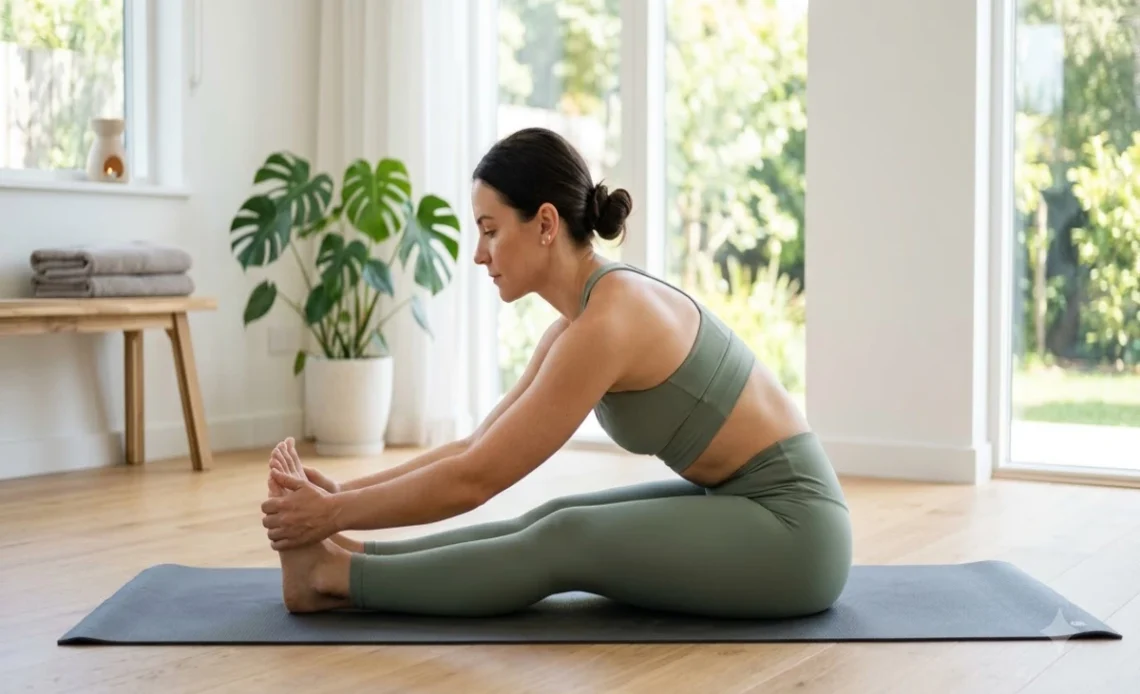
5. Simple Seated Floor Stretch (One Leg or Both)
A classic that works well once you can sit on the floor comfortably.
How to do it (one-leg version, often easier):
- Sit with one leg extended straight.
- Bend the other leg and place the sole of that foot against the inner thigh of the straight leg (hurdler position).
- Sit tall, then hinge forward from the hips toward the straight leg.
- Reach only as far as a gentle stretch allows. Hands can rest on the shin or floor.
- Hold 20–30 seconds. Switch.
Both-legs version: Extend both legs and hinge forward carefully. Many beginners find the one-leg version more accessible and less stressful on the back.
6. Supine 90/90 or Bent-Knee Assisted Stretch
Another floor option that isolates the hamstring nicely.
How to do it:
- Lie on your back.
- Bring one knee toward your chest and hold behind the thigh (or use a towel).
- From that position, slowly straighten the knee until you feel the stretch in the back of the thigh.
- Keep the other leg bent or straight on the floor.
- Hold 15–30 seconds. Switch.
This reduces the load compared to a fully straight-leg raise and is excellent for very tight beginners.
Sample Beginner Routine (10–15 Minutes)
Do this 4–6 days a week after a short warm-up:
- Legs Up the Wall – 45–60 seconds
- Lying towel stretch – 2–3 holds of 25 seconds per leg
- Chair seated stretch – 2 holds of 25 seconds per leg
- Standing heel-on-step stretch – 2 holds of 20–25 seconds per leg
Finish with a few easy leg swings or gentle walking. That’s enough. You do not need to do every stretch every day.
How Progress Typically Looks
Most beginners notice reduced stiffness within 1–2 weeks of consistent practice. Measurable range-of-motion gains (for example, better ability to straighten the leg or reach farther) often appear in 4–8 weeks according to multiple studies on static stretching protocols. One recent trial found that even a simple 5-minute static stretching session three times a week improved flexibility in people with mild tightness.
Gains come from both actual muscle and connective tissue adaptation and improved stretch tolerance (your nervous system allowing more range). Combining gentle stretching with light strengthening (such as glute bridges or controlled hip hinges) can support long-term results, but pure stretching is a solid start.
Comparison Table: Beginner Stretch Options
| Stretch | Difficulty | Equipment Needed | Back Stress | Best For | Hold Time |
| Lying towel/strap | Very easy | Towel/strap | Lowest | Absolute beginners, back issues | 20–30 sec |
| Legs up the wall | Very easy | Wall | Very low | Relaxation, passive stretch | 30–60+ sec |
| Chair seated | Easy | Chair | Low | Desk workers, limited mobility | 20–30 sec |
| Standing heel elevated | Easy–moderate | Step/chair | Low–moderate | After walking, progression | 20–30 sec |
| Seated floor (one leg) | Easy–moderate | Floor/mat | Moderate | Once comfortable on floor | 20–30 sec |
| Supine 90/90 | Easy | None/towel | Low | Controlled isolation | 15–30 sec |
This table helps you pick based on your current situation. Start with the lowest-stress options.
Country and Population Insights
Tightness is common worldwide, but patterns differ by lifestyle. University students in parts of South Asia have shown extremely high prevalence (often 90%+) linked to prolonged sitting. School-age children in Malaysia and Sri Lanka showed roughly 43–52% tightness. Among competitive athletes in Sri Lanka the rate dropped to about 35%, suggesting that regular physical activity helps but does not eliminate the issue. In general Western sedentary populations, clinical experience and smaller studies point to high rates among office workers and people with low activity levels. These differences underline that environment and daily movement habits matter as much as genetics.
Common Mistakes and How to Fix Them
- Rounding the back hard to “reach farther.” Fix: Think of lengthening the spine and hinging at the hips. Reach only until the stretch is felt in the thigh.
- Locking the knee aggressively. Fix: Allow a soft micro-bend if it feels better; the stretch still works.
- Stretching only when already sore or after long sitting without warm-up. Fix: Move a little first.
- Expecting overnight results or comparing yourself to flexible people online. Fix: Track your own progress (e.g., how far you can reach or how straight the leg feels).
- Skipping the non-dominant side or rushing. Fix: Treat both sides equally and take your time.
Additional Useful Tips for Lasting Results
- Stretch after activity when muscles are warmer, or use a warm shower beforehand on rest days.
- Pair stretching with daily movement: stand up every 30–45 minutes if you sit a lot, take short walks, or do simple glute squeezes.
- Hydration and overall recovery support tissue health.
- If one side is noticeably tighter, spend a little extra time there, but keep the difference small to avoid imbalance.
- Track simple markers: Can you sit more comfortably? Does bending to tie shoes feel easier? These everyday wins matter more than perfect form photos.
Recent evidence continues to support static stretching for flexibility gains in beginners and people with tightness. Techniques such as neurodynamic “sliders” (gentle nerve-friendly movements) and even certain strengthening approaches can complement traditional stretches, but they are not required when you are just starting. Foam rolling or light massage can feel good beforehand for some people, though studies show it is not always superior to stretching alone for range-of-motion improvements.
When to Seek Extra Help
Stop and consult a healthcare professional if:
- You feel sharp or radiating pain
- Tightness is sudden after an injury
- Symptoms include numbness, weakness, or significant swelling
- Stretching for several weeks produces no improvement or worsens symptoms
A physical therapist can assess whether the tightness is purely muscular or involves other factors (nerve mobility, pelvic position, strength imbalances) and tailor a plan.
Final Encouragement
Improving beginner hamstring flexibility is not about becoming a contortionist. It is about moving more comfortably, reducing everyday stiffness, and lowering the chance of minor strains as you become more active. The stretches in this guide are deliberately simple so you can start today with almost no equipment. Choose two or three, do them consistently for a few weeks, and notice how your body responds.
Most people who stick with gentle, regular practice feel a clear difference. Start where you are, respect the mild-pull rule, breathe, and keep showing up. Your hamstrings (and your lower back) will thank you.
This article is for general educational purposes. Individual results vary, and professional medical advice should be sought for personal concerns.