
 Sameena Fatima
Health & Wellness Content Writer
in
Sameena Fatima writes reader-focused
health and wellness content for
HealthBloomWeb, covering fitness,
nutrition, healthy lifestyle and
everyday wellness topics.
Sameena Fatima
Health & Wellness Content Writer
in
Sameena Fatima writes reader-focused
health and wellness content for
HealthBloomWeb, covering fitness,
nutrition, healthy lifestyle and
everyday wellness topics.
 Mirza Ibrahim Ali Khan
Editorial & Content Reviewer
in
Mirza Ibrahim Ali Khan contributes to
HealthBloomWeb's editorial review process,
with a focus on content structure,
readability, search intent and overall
editorial quality.
Mirza Ibrahim Ali Khan
Editorial & Content Reviewer
in
Mirza Ibrahim Ali Khan contributes to
HealthBloomWeb's editorial review process,
with a focus on content structure,
readability, search intent and overall
editorial quality.
 Reyansh Sethi
Medical Reviewer
in
Reyansh Sethi contributes to the medical
review process at HealthBloomWeb, focusing
on clarity, responsible health context and
reader-friendly presentation of health
information.
Reyansh Sethi
Medical Reviewer
in
Reyansh Sethi contributes to the medical
review process at HealthBloomWeb, focusing
on clarity, responsible health context and
reader-friendly presentation of health
information.
Losing weight or maintaining weight loss boils down to burning more calories than you consume but still feeling satisfied enough to maintain that calorie deficit. Eating enough protein accomplishes both. Protein is the most satiating of the three macronutrients, so your face-stuffing meals featuring substantial amounts of the stuff will keep you full for longer, and preventing the loss of muscle tissue during fat loss is important to how you look and feel as well as to maintaining a healthy metabolism.
A good ballpark for most people in a deficit is 1.6-2.2 g/kg of body weight (that’s about 25-40 grams per meal). Then add in a ton of low calorie-volume foods (vegetables especially) and you get satisfying meals that don’t eat up your calories too fast.
In this guide, you’ll learn about practical, every day high protein meals for weight loss. You’ll discover the best protein for a low calorie meal, easy meal formulas, simple ideas that are under 500 calories, comparison tables and tips on making it a sustainable way of eating.
Why Higher Protein Helps with Weight Management
Because it stimulates satiety hormones and suppresses hunger hormones, protein will help you feel fuller for longer than the same amount of calories from carbohydrate or fat will. Protein has a higher thermic effect (your body actually needs more calories to digest it). When dieting on a calorie deficit, protein spares muscle mass so more of the weight you lose comes from fat.
You don’t need super doses. Usually a couple of 25-40 gram doses spread out through the day will outperform the big push. Don’t aim for perfection.
Best High-Protein, Lower-Calorie Foods
These deliver a lot of protein relative to calories:
| Food | Typical Serving | Protein | Approx. Calories | Notes |
| Chicken breast (cooked) | 120–150 g | 35–45 g | 165–200 | Very lean staple |
| White fish (cod, tilapia) | 150 g | 30–40 g | 120–160 | Light and filling |
| Shrimp | 150 g | 30–35 g | 140–160 | Extremely protein-dense |
| Turkey breast or lean ground turkey | 120–150 g | 30–40 g | 150–200 | Versatile |
| Nonfat or low-fat Greek yogurt | 200 g | 18–25 g | 110–150 | Easy base |
| Low-fat cottage cheese | 200 g | 24–28 g | 140–180 | High volume |
| Egg whites + 1 whole egg | 4–6 whites + 1 egg | 20–30 g | 150–220 | Flexible |
| Tofu (firm) | 200 g | 20–25 g | 150–180 | Plant option |
| Canned tuna in water | 1 can drained | 20–25 g | 100–120 | No-cook |
| Lean beef (sirloin etc.) | 120 g | 30–35 g | 200–250 | Occasional |
Focus on these anchors, then add volume with non-starchy vegetables and controlled portions of higher-calorie items.
Simple Plate Formula for Weight Management
- Start with 120–180 g of lean protein (or equivalent plant/dairy source).
- Fill half the plate with non-starchy vegetables (broccoli, leafy greens, zucchini, peppers, green beans, cauliflower, etc.).
- Add a moderate portion of carb if desired (½ cup cooked rice/quinoa, small potato, or beans).
- Use measured fats (1 tsp oil, small amount of avocado, light dressing).
- Season well so the food tastes good.
This structure keeps calories moderate while protein and volume stay high.
Easy High-Protein Meal Ideas Under ~500 Calories
Breakfast (25–40 g protein)
- Greek yogurt (200 g) + berries + cinnamon or a small amount of seeds (25–35 g protein, 200–300 calories)
- Egg-white scramble with vegetables + one whole egg and a slice of toast (25–35 g)
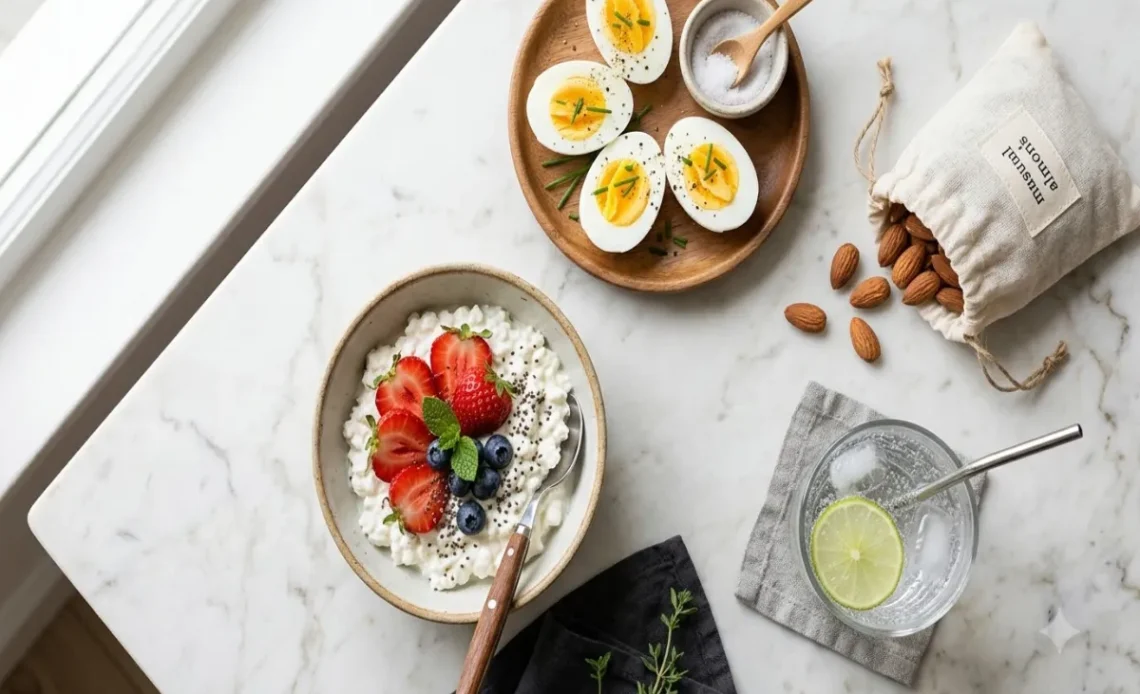
- Cottage cheese bowl with tomato, cucumber, and herbs or fruit (25–30 g)
- Protein smoothie with Greek yogurt or protein powder + spinach + berries (30–40 g)
Lunch (30–45 g protein)
- Grilled chicken or turkey over a large salad with light dressing and optional beans (35–45 g)
- Tuna mixed with Greek yogurt or mustard + lots of vegetables or in lettuce wraps (30–40 g)
- Cottage cheese or Greek yogurt savory plate with vegetables and a small amount of whole-grain crackers
- Shrimp or chicken stir-fry with lots of vegetables over cauliflower rice or a small portion of regular rice
Dinner (30–45 g protein)
- Baked or air-fried chicken breast or fish with roasted vegetables and a small potato or quinoa
- Lean ground turkey or chicken chili with beans and plenty of vegetables
- Shrimp or white fish with green beans, broccoli, or asparagus
- Tofu or tempeh stir-fry loaded with vegetables and a light sauce
- Sheet-pan chicken or fish with mixed vegetables
Snacks that support the deficit
- Cottage cheese or Greek yogurt
- Hard-boiled eggs
- Edamame or roasted chickpeas in measured portions
- Turkey slices or lean deli meat with vegetables
Comparison Table: Sample Meals for Weight Management
| Meal | Example | Approx. Protein | Approx. Calories | Best Feature |
| Breakfast | Greek yogurt + berries | 25–35 g | 200–300 | No-cook, high satiety |
| Lunch | Chicken salad (yogurt-based) over greens | 35–45 g | 300–400 | Portable |
| Lunch | Tuna + white beans + veggies | 30–40 g | 300–400 | High volume |
| Dinner | Chicken + roasted vegetables | 35–45 g | 350–450 | Simple sheet-pan |
| Dinner | White fish + green beans | 30–40 g | 250–350 | Very light |
| Dinner | Turkey chili | 30–40 g | 350–450 | Batch-friendly |
Practical Tips That Make It Sustainable
- Prioritize protein at every meal so you feel fuller on fewer total calories.
- Use volume: large salads, lots of non-starchy vegetables, cauliflower rice, zucchini noodles, or broth-based soups.
- Measure oils, nut butters, cheese, and dressings—these add up quickly.
- Season generously. Bland food is hard to stick with.
- Prep lean proteins in bulk (chicken, turkey, hard-boiled eggs, tofu) so assembly is fast.
- Allow flexibility. A higher-protein approach works best when it includes foods you actually enjoy.
- Track roughly at first so you learn portion sizes that fit your calorie target.
- Combine with strength training if possible—protein + resistance work helps keep muscle while losing fat.
Sample Day Structure (Approximate)
Breakfast: Greek yogurt bowl – 30 g protein, ~250 calories
Lunch: Large chicken or tuna salad – 40 g protein, ~350 calories
Snack: Cottage cheese + vegetables – 20–25 g protein, ~150 calories
Dinner: Baked fish or chicken with vegetables – 40 g protein, ~400 calories
Total roughly 130–140 g protein in around 1,150–1,200 calories from the main meals, leaving room for adjustments based on your personal calorie needs.
Common Questions
Do I have to eat low-carb?
No. Higher protein works with moderate carbs. Just keep overall calories in check and choose mostly whole-food sources.
Will higher protein make me gain weight?
Not if total calories are controlled. Protein itself is not fattening; excess calories from any source can lead to weight gain.
What if I get hungry between meals?
Increase vegetable volume, check that protein portions are adequate, and make sure you are sleeping and managing stress. Sometimes a small higher-protein snack helps.
Is this approach only for short-term weight loss?
No. Many people find a moderately higher-protein pattern easier to maintain long-term for weight management because of the satiety benefit.
High-protein meals for weight management succeed when they keep you full enough to stay in a mild calorie deficit without feeling constantly deprived. Build each plate around a lean protein source, load up on vegetables, keep added fats measured, and choose flavors you like. Start with a few of the simple ideas above, notice how your hunger and energy respond, and adjust portions to fit your body and lifestyle. Consistency with satisfying food beats perfect tracking every time.