
Last Updated: September 14, 2026
National Council on Aging: Aging resources, guidelines to benefits, tips for health aging and Senior Wellness
The National Council on Aging (NCOA) has been dedicated for over three decades to one simple concept: all older adults should have the opportunity to age with health, financial security and independence. Established in 1950, it is the oldest national organization focused exclusively on aging issues. Its programs and services span from benefits access, health programs and services, and senior centers, to employment, and scam prevention and control, to advocacy. Its aspirational long-term objective is reaching an additional 100 million “better birthdays” by 2040-after having already exceeded its initial milestone of 40 million.
The Guide encompasses the key NCOA services and supports. Including more information about the organization, free tools and resources worldwide, local community programs, and recommendations for seniors, caregivers, and professionals. The content is paraphrased from NCOA publications, program descriptions, and updated through 2025–2026. The content may be subject to change, so check ncoa.org for the most current information and consult local providers for additional assistance.
A Brief History and What NCOA Does Today
NCOA was founded in response to the postwar American landscape. Older Americans experienced forced retirement, sparse insurance options, and very few organized advocates. Over the course of more than thirty years, the group contributed to enhancing the health and economic security of seniors through the passage of Medicare, Medicaid, the Older Americans Act, and finally more recent policy reforms like tighter prescription drug safeguards. NCOA created concrete new resources and educated countless local leaders.
Today NCOA operates as a national nonprofit that does four main things:
Creates accessible, reliable online resources and tools for patients and their families
- Provides technical assistance to community-based organizations on training, data systems, and best practices
- Supports for programs that older adults depend on.
- Measures objectively and reports to the public.
The national organization operates via networks of centers for economic well-being, the healthy aging network, and senior centers and mature workers. It generally does not cook in and it does not have the vans. Instead it consolidates and builds the capacity of local groups that do and directs people to where help is available.
Latest impact testimonies include hundreds of millions of dollars in benefit applications made through partner agencies, tens of thousands of clients completing chronic disease and falls prevention workshops, thousands of older workers trained through employment programs, And billions of hours of community service. Each dollar raised puts a high percentage directly into programs.
Free Tools Anyone Can Use Right Away
Among NCOA‘s most useful ideas are a number of free online tools, which do not require membership or fees.
BenefitsCheckUp
This is the most well known of these tools. It helps identify over 2,000 federal, state and local benefits for community members age 55 and older (or younger adults with disabilities). Users input a ZIP code and provide information on income, household and needs. The outcomes provide a list of programs that may help with prescription medications, Medicare costs, food, utilities, heating and cooling, rent and housing costs and other needs. The website is available in English, Spanish and Vietnamese. With recent updates the keyword search function became more efficient and an improved directory of local organizations willing to assist with applications was added. There is also a toll-free helpline for those who prefer to speak with someone.
Many older adults leave meaningful help unclaimed because they simply don‘t know the program exist or don‘t believe they‘re eligible. BenefitsCheckUp was designed to bridge that gap. (Local Benefits Enrollment Centers are community organizations funded to provide individual level counseling) Use the same tool and guide people through the paperwork. In recent election cycles, these centers have offered assistance in dozens of states and territories to help tens of thousands of applicants submit applications for hundreds of millions of dollars in funds.
Age Well Planner and other educational resources
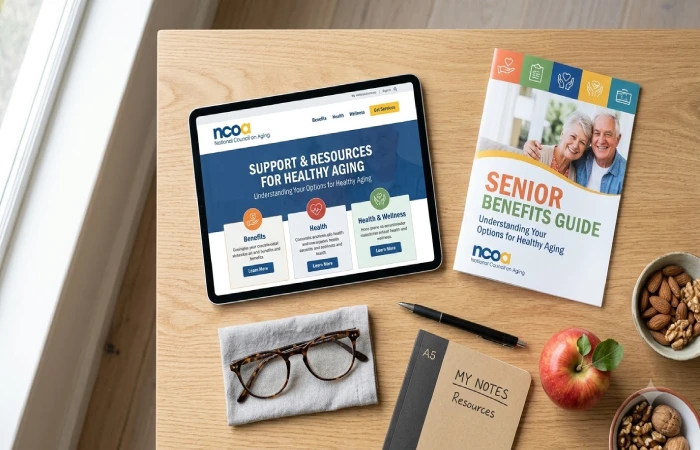
NCOA provides simple, easy-to-understand information about: Medicare coverage options; Budgeting for a healthy retirement; Making homes safer; Preventing falls; Becoming active and eating right; Preparing for caregiving; and much more.
Information about the product.
NCOA also has reviews and comparisons of products and services that help people Age-in-Place, smarter with limited dollars.
Benefits Access and Economic Security
Much of what NCOA does every day is committed to linking eligible individuals with the programs that lower their monthly costs. The Center for Economic Well-Being supports this work. These include:
- Medicare Savings Programs (these can also pick up Part B premiums and sometimes deductibles, coinsurance.)
- Extra Help (subsidy for poor) on Medicare prescription drug coverage.
- SNAP for food purchasing
- LIHEAP on utility bills
- Medicaid (where offered by the states)
- Various new local and state aids
Income and resource limits are adjusted annually and may be higher in Alaska and Hawaii. Other states may be more liberal than federal minimums, which makes accurate determination the best method for each situation by the completion of a screening or consultation. NCOA research has consistently found millions of eligible older persons who are not enrolled. Participation rates are generally less than 50 percent nationally for major programs, with disparities across counties and states.
Boost Your Budget Week usually in April spotlights a concentrated outreach effort when many of our local partners offer enhanced application assistance. It also serves as a good reminder to verify your eligibility following any change in income, household size, or health requirements.
Medicare and Healthcare Guidance
Medicare is complicated. Premiums, deductibles, choices in plans, and enrollment periods are constantly changing. NCOA offers understandable information about Original Medicare, Medicare Advantage, Part D drug coverage, and Medigap, and advocates for free, unbiased counseling by State Health Insurance Assistance Programs (SHIPs). Each state has a network of SHIPS that provides one-on-one assistance with plan selection, enrollment, and appeals. NCOA directs readers to those counselors rather than to marketing materials from plan representatives.
Open Enrollment is from October 15 to December 7. There are Special Enrollment Periods for life events such as moving and losing other coverage. NCOA issues calendars and tip sheets so people don‘t miss critical windows. Cheap programs such as Medicare Savings Programs and Extra Help are there time and again, as they will save many people a bundle.
Healthy Aging and Evidence-Based Programs
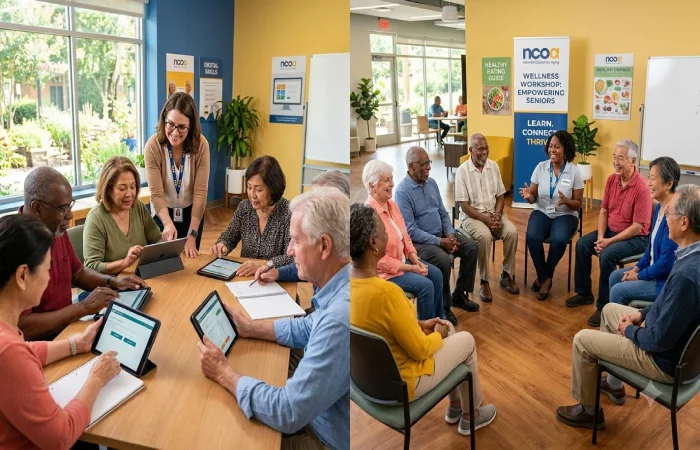
The Center for Healthy Aging emphasizes programs that have been rigorously tested and proven effective in improving strength, balance, and confidence as well as in self management of chronic diseases. Two specific areas are significant.
Falls prevention:
It can have a positive effect on the risk of falls in older people by taking precautions like providing adequate lighting and smooth floors. It is considered effective to reduce falls.
Falls are a significant health problem for seniors. Evidence-based interventions (such as A Matter of Balance, Tai Ji Quan: Moving for Better Balance, the Otago Exercise Program, Stepping On, and Enhance Fitness) provide skills that improve balance and strength and are effective in reducing falls. These interventions earn the federal government’s criteria to be paid for with Older Americans Act Title III-D and other federal monies. Data for dozens of programs over many years show participation numbers totaling hundreds of thousands of people and reductions in falls and use of those services. Return-on-investment studies show significant economic return from fewer emergency room visits and hospitalizations.
Chronic disease self-management:
Self-management of a long-term condition is complex, lacking a consistent definition. One way to describe it is: Chronic disease self-management is a process by which individuals with, or at risk of, a chronic illness anticipate and address healthcare needs. It includes activities involved in managing the condition and the impact it has on their lives.
Workshops train people to deal with diabetes, arthritis, heart disease, and chronic pain. They learn symptom management, medication skills, effective communication with doctors, eating healthfully, and pacing activity. Most of these are offered in senior centers, clinics, libraries, and faith communities. Versions are also available on the web or over the telephone.
The Healthy Aging Programs Integrated Database (HAPID) compiles all information from the workshops to enable organizations to improve quality and share outcomes. NCOA is involved in providing support for state falls prevention coalitions and innovation projects to explore more adaptable approaches based on individual community capacity.
Examples of habits which support current programs are the include exercise for strength and balance, routine home hazard check, medication review and management, proper nutritional intake and social contact. The support of others in class provides encouragement to establish consistent.
Senior Centers and Community Support
Senior centers local places where seniors obtain dinner, exercise, companionship, assistance with benefits, and information. There are an estimated 10,000-11,000 senior centers in the U. S., with many receiving some OAA funds. The NCOA- supported National Institute of Senior Centers (NISC) offers free affiliate membership, best-practices sharing, staff development, national standards, and an annual Programs of Excellence competition.
The awards celebrate innovative programs that promote social engagement, health and wellness, intergenerational programming, and modernization. Successful programs are disseminated to other centers to adapt. Other resources offered by NISC include toolkits for National Senior Center Month, online learning at a discount for staff, and information on digital literacy, fraud prevention, and economic security.
Similar community services paid for mainly by the Older Americans Act such as congregate and home delivered meals, transportation, homemaker and personal care assistance, adult day services, and caregiver support through the National Family Caregiver Support Program. Call or visit the Eldercare Locator (1-800-677-1116) to find the local Area Agency on Aging or other relevant organization in the county.
Mature Workers and Employment Support
Numerous individuals wish or must remain employed past the traditional age of retirement. The Senior Community Service Employment Program (SCSEP) is a U. S. Department of Labor sponsored program that assists low-income adults age 55 and older who are unemployed. SCSEP offers training and community service placements that help build essential skills and confidence as a step toward employment. Over the past few years, NCOA has run the largest portion of this program, helping thousands of participants to work hundreds of thousands of hours in community service placements before placing hundreds into unsubsidized positions.
For these programs, eligibility is primarily age 55+, unemployed, and income less than or equal to 125% federal poverty level. Local offices are also able to verify up-to-date availability.
Financial Wellness and Scam Prevention
In addition to benefits screening, NCOA makes available information on budgeting, debt reduction, taking full advantage of social security, and protecting assets. One of its highest priorities, though, is scams. It is estimated that fraud takes billions of dollars away from older people annually. Such cons range from grandparent emergency scams, tech support schemes, authorities impersonators, romance fraud, and the like. Prevailing red flags include a sense of urgency and the pressure to discuss things in secrecy.
NCOA‘s Savvy Saving Seniors campaign also provides a handout to educate older adults to recognize scams and take eight simple protective measures: avoid providing personal info to unfamiliar callers, hang up and call back on a known number, create strong passwords and establish two-factor authentication, consult with a trusted individual before sending money. Available reporting agencies include the National Elder Fraud Hotline, Federal Trade Commission, the FBI‘s Internet Crime Complaint Center, and local AEDs.
Advocacy and Policy Work
NCOA advocates for stable funding and improvements to the programs older adults rely on. This includes the Older Americans Act, Medicare low-income subsidies, falls prevention, the direct care workforce, and related issues. The organization provides policy updates and tools so individuals and local groups can contact lawmakers. It has a long history of contributing to major legislation and continues to push for permanent or multi-year funding for successful outreach efforts such as MIPPA.
How the Pieces Fit Together
NCOA’s work is most effective when the different parts reinforce one another. A person who uses BenefitsCheckUp may discover both SNAP and a Medicare Savings Program. The same person might then attend a falls prevention class at a local senior center that is part of the NISC network. A caregiver might use the same center for respite information while checking benefits for the household. An older worker might train through SCSEP and later volunteer or take classes at the senior center.
Local partners—Area Agencies on Aging, senior centers, Benefits Enrollment Centers, SHIPs, and community nonprofits—deliver most of the direct services. NCOA supplies tools, training, data systems, national visibility, and advocacy so those local efforts can reach more people with higher quality.
Practical Next Steps
- Visit BenefitsCheckUp.org and complete a screening if cost is a concern.
- Call the Eldercare Locator at 1-800-677-1116 to find your local Area Agency on Aging.
- Contact a State Health Insurance Assistance Program for free Medicare counseling.
- Ask your nearest senior center about meals, exercise classes, and social activities.
- Review scam prevention tips and share them with family.
- If work is still needed, inquire about SCSEP in your area.
- Check ncoa.org for the latest guides, fact sheets, and program updates.
Looking Ahead
NCOA will evolve to meet emerging challenges such as digital literacy, mental health, more flexible ways to deliver programs, and increased evidence of what works. But the core mission remains; enable the circumstances in which everyone can age in good health, security, and with meaning. The resources and community relationships are already in place and provide older adults and their families a guiding light to help them take that next step.
This summary is based on NCOA‘s general public website information, annual reports and program descriptions, impact data, and details on federal programs through 2025–2026. Program descriptions, funding levels, and eligibility requirements are subject to change. Always check the latest information with NCOA or a local counselor to fit your needs. The availability of free national services and good local partners is among the most helpful resources in aging well in the US.