
 Sameena Fatima
Health & Wellness Content Writer
in
Sameena Fatima writes reader-focused
health and wellness content for
HealthBloomWeb, covering fitness,
nutrition, healthy lifestyle and
everyday wellness topics.
Sameena Fatima
Health & Wellness Content Writer
in
Sameena Fatima writes reader-focused
health and wellness content for
HealthBloomWeb, covering fitness,
nutrition, healthy lifestyle and
everyday wellness topics.
 Mirza Ibrahim Ali Khan
Editorial & Content Reviewer
in
Mirza Ibrahim Ali Khan contributes to
HealthBloomWeb's editorial review process,
with a focus on content structure,
readability, search intent and overall
editorial quality.
Mirza Ibrahim Ali Khan
Editorial & Content Reviewer
in
Mirza Ibrahim Ali Khan contributes to
HealthBloomWeb's editorial review process,
with a focus on content structure,
readability, search intent and overall
editorial quality.
 Reyansh Sethi
Medical Reviewer
in
Reyansh Sethi contributes to the medical
review process at HealthBloomWeb, focusing
on clarity, responsible health context and
reader-friendly presentation of health
information.
Reyansh Sethi
Medical Reviewer
in
Reyansh Sethi contributes to the medical
review process at HealthBloomWeb, focusing
on clarity, responsible health context and
reader-friendly presentation of health
information.
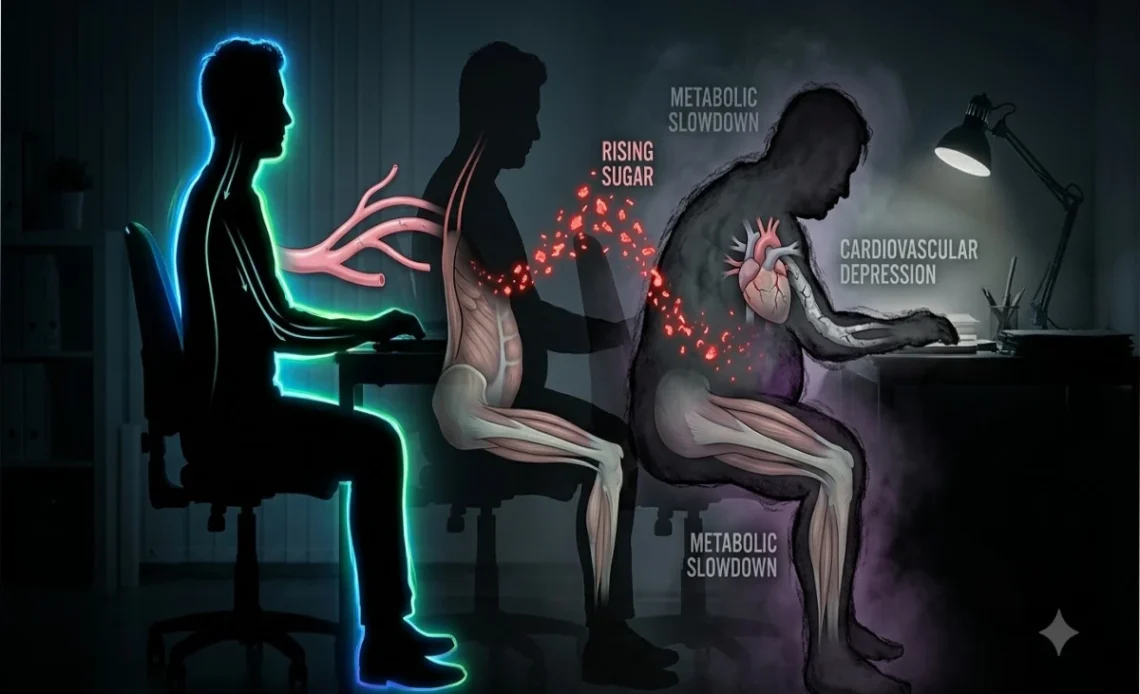
Most of us spend a huge chunk of our day sitting. At a desk, in a car, on the couch, or staring at a screen. It feels normal. Work demands it. Commutes demand it. Even rest often means sitting. But the body was built to move, and staying still for hours on end quietly changes how it works. Over time those changes add up. They show up as higher blood sugar, stiffer arteries, extra weight around the middle, weaker muscles, lower mood, and a greater chance of serious disease.
This article looks at what happens when sitting becomes the default. It covers the short-term and long-term effects on different body systems, the latest research numbers, how the problem looks in different countries, and practical comparisons that make the risks clearer. The goal is simple: give you a clear picture of why too much sitting matters and what the science actually shows.
What Counts as a Sedentary Lifestyle?
Sedentary behaviour means any waking activity done while sitting or reclining that uses very little energy. Watching television, working at a computer, driving, reading, or scrolling on a phone all count. Experts usually measure it in hours per day. Many adults now clock 8 to 10 hours or more of sitting time outside of sleep. Some office workers and drivers go well beyond that.
Physical inactivity is related but slightly different. It means not meeting the recommended amount of moderate-to-vigorous activity (at least 150 minutes a week for adults). You can exercise regularly and still sit too much the rest of the day. Recent studies show that even people who hit their exercise goals still face extra risk if they sit for more than about 10.5 hours a day.
How Common Is the Problem Worldwide?
Nearly one-third of adults worldwide do not get enough physical activity. That is about 1.8 billion people. The number has risen from 26 percent in 2010 to 31 percent in 2022. If the trend continues, it could reach 35 percent by 2030. Women are less active than men by about 5 percentage points on average. Inactivity also rises sharply after age 60.
The picture varies by region. High-income Asia Pacific and South Asia show the highest rates (around 45–48 percent). The Eastern Mediterranean region is also high. Oceania and sub-Saharan Africa have lower rates. Some individual countries stand out. The United Arab Emirates has rates above 60 percent. Kuwait, South Korea, and several Gulf states also sit near the top. In contrast, many African countries and parts of Europe report lower figures. Spain and Germany, for example, have relatively better numbers than Portugal or Italy.
These differences matter because the health burden is not shared equally. Middle-income countries carry a large share of the total deaths linked to inactivity simply because of population size. High-income countries often show higher rates of sitting at work and during leisure, while lower-income countries may have more active transport or labour but rising office and screen time.
Immediate Effects of Sitting for Long Periods
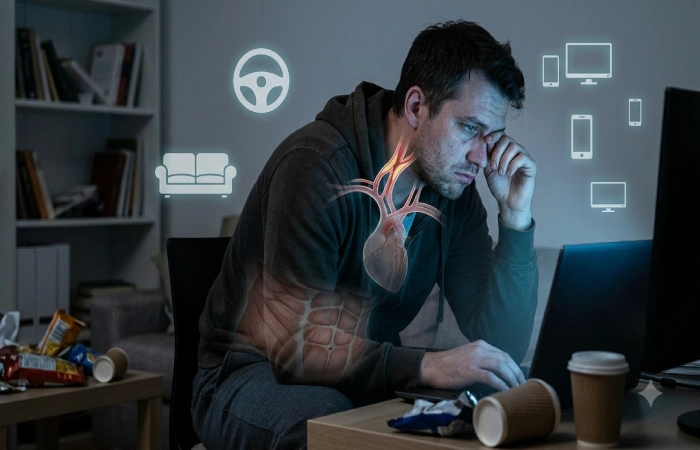
Even a single long stretch of sitting changes the body. After about 30 to 60 minutes of uninterrupted sitting, blood flow in the legs slows. The large arteries behind the knees and in the lower legs do not expand as well. Blood sugar rises more after a meal. Triglycerides climb. Muscle activity drops almost to zero, so fewer calories are burned.
People often notice stiffness in the hips, lower back, and neck. Focus can slip. Energy dips in the afternoon. These short-term changes reverse when you stand up and move for a few minutes. The problem is that many of us sit for hours without a break, so the body stays in that low-activity state for most of the day.
Effects on Metabolism and Weight
When muscles are inactive, they become less sensitive to insulin. The body needs more insulin to keep blood sugar in check. Over months and years this can lead to higher fasting glucose and a greater risk of type 2 diabetes. Studies consistently show that people who sit the most have higher rates of metabolic syndrome — the cluster of high blood pressure, high blood sugar, excess belly fat, and unhealthy cholesterol levels.
Calorie burn also drops. Sitting burns far fewer calories than standing or walking. Appetite regulation can shift as well. Some research points to changes in hormones that control hunger and fullness. The result is often gradual weight gain, especially around the waist. Abdominal fat is particularly linked to inflammation and further metabolic trouble.
A useful comparison: people who sit more than 8 hours a day with little activity have a risk of early death similar to the risk from obesity or smoking, according to large reviews that pooled data from more than a million people. The good news is that 60 to 75 minutes of moderate activity a day can largely offset that risk for many outcomes.
Heart and Blood Vessel Effects
The heart is a muscle. Like any muscle, it weakens with disuse. Prolonged sitting is linked to higher blood pressure, stiffer arteries, and poorer cholesterol profiles. Blood tends to pool in the legs, and the endothelial lining of blood vessels functions less well.
Recent large studies using activity trackers give clearer numbers. In one analysis of nearly 90,000 adults, those who were sedentary for 10.6 hours or more per day had roughly 40 percent higher risk of heart failure and 54 percent higher risk of dying from cardiovascular causes compared with people who sat less. Even people who met the recommended 150 minutes of moderate-to-vigorous activity still showed elevated risk for heart failure and cardiovascular death if their sitting time stayed that high. Exercise helped, but it did not fully cancel the sitting effect for these outcomes.
Another way to look at it: replacing 30 minutes of sitting with light activity or walking lowers risk noticeably. After a cardiac event, people who remain sedentary for more than 14 hours a day face a sharply higher chance of another event or death within a year. Small swaps — standing more, short walks — produce meaningful reductions in that risk.
Cancer Risk
Sitting time is associated with higher incidence and mortality for several cancers, especially those linked to obesity and diabetes: colorectal, breast, endometrial, ovarian, pancreatic, liver, and others. The pattern of sitting matters. Prolonged, uninterrupted bouts (30 minutes or longer without a break) appear more harmful than the same total sitting time broken into shorter stretches.
In a study of more than 91,000 people followed for over 12 years, each extra hour of prolonged sedentary behaviour raised the risk of cancer death by about 9 percent. Interrupted sitting showed the opposite pattern — lower risk. Replacing one hour of prolonged sitting with light physical activity was linked to a 12 percent lower risk of cancer death. Even 30 minutes of moderate activity or 5 minutes of vigorous activity in place of prolonged sitting produced meaningful reductions.
These findings suggest that simply standing up and moving every half hour or so may offer protection beyond total exercise minutes.
Effects on Muscles, Bones, and Joints
Muscles that are not used lose strength and size. The large muscles of the legs and core are especially affected. Posture suffers. The hip flexors shorten from constant sitting, the glutes weaken, and the lower back takes extra strain. Many people develop chronic low-back pain, tight hamstrings, and neck tension.
Bones also respond to loading. Without regular weight-bearing activity, bone density can decline, raising the risk of osteoporosis later in life. Joints need movement for cartilage health and lubrication. Long periods of stillness reduce that natural maintenance.
Brain Health, Mood, and Mental Well-Being
The brain benefits from blood flow and the release of growth factors that come with movement. Sedentary behaviour is linked to higher rates of depression, anxiety, and cognitive decline. Recent data show that more sitting time raises the risk of dementia, stroke, sleep disorders, and mood problems. People who get moderate-to-vigorous activity have 14 to 40 percent lower odds of these conditions depending on the disease and activity level.
Even short breaks help mood and reduce fatigue. One practical finding is that a five-minute movement break every hour improves energy and mood more effectively than longer but less frequent breaks for many people.
Practical Implications for Everyday Life
You do not need to eliminate sitting. You need to interrupt it and reduce the total. Standing for a few minutes every half hour, taking short walking breaks, using a standing desk for part of the day, or walking during phone calls all help. After meals, a 10–15 minute walk improves blood sugar handling. Building more movement into the workday and evening leisure hours lowers the overall load.
For people with desk jobs, the combination of meeting activity guidelines plus breaking up sitting produces the best outcomes. For those recovering from heart events or living with chronic conditions, reducing prolonged sitting is especially important.
Looking Ahead
Global physical inactivity is still rising. The world is not on track to meet the target of a 15 percent relative reduction by 2030. The economic cost is already substantial — hundreds of billions of dollars in healthcare spending if trends continue. At the individual level the effects are more personal: higher chance of diabetes, heart problems, certain cancers, weaker muscles, and lower daily energy.
The science is clear. Long periods of sitting change the body in ways that raise disease risk. The changes start quickly but are largely reversible with regular movement breaks and overall higher activity. Understanding the effects is the first step. The next is finding realistic ways to sit less and move more in the life you already live.
This is not about perfection. It is about stacking small, consistent choices that protect the systems most affected by stillness — metabolism, circulation, muscle, bone, and brain. The research keeps confirming the same message: the body thrives on movement, and it notices when movement disappears for hours at a time.