

 Sameena Fatima
Health & Wellness Content Writer
in
Sameena Fatima writes reader-focused
health and wellness content for
HealthBloomWeb, covering fitness,
nutrition, healthy lifestyle and
everyday wellness topics.
Sameena Fatima
Health & Wellness Content Writer
in
Sameena Fatima writes reader-focused
health and wellness content for
HealthBloomWeb, covering fitness,
nutrition, healthy lifestyle and
everyday wellness topics.
 Mirza Ibrahim Ali Khan
Editorial & Content Reviewer
in
Mirza Ibrahim Ali Khan contributes to
HealthBloomWeb's editorial review process,
with a focus on content structure,
readability, search intent and overall
editorial quality.
Mirza Ibrahim Ali Khan
Editorial & Content Reviewer
in
Mirza Ibrahim Ali Khan contributes to
HealthBloomWeb's editorial review process,
with a focus on content structure,
readability, search intent and overall
editorial quality.
 Reyansh Sethi
Medical Reviewer
in
Reyansh Sethi contributes to the medical
review process at HealthBloomWeb, focusing
on clarity, responsible health context and
reader-friendly presentation of health
information.
Reyansh Sethi
Medical Reviewer
in
Reyansh Sethi contributes to the medical
review process at HealthBloomWeb, focusing
on clarity, responsible health context and
reader-friendly presentation of health
information.
Sitting itself is not the enemy. Most of us need to sit for work, travel, or rest. The real issue is how long we stay in one position without moving. When sitting stretches past 30 minutes or an hour without a break, the body starts to respond in ways that can affect muscles, blood vessels, blood sugar, and longer-term disease risk. Researchers sometimes call the pattern of long, unbroken sitting “prolonged sedentary behaviour.” It is different from total sitting time, and the distinction matters.
This article looks at what happens during and after those long stretches of sitting. It covers the immediate physical changes, the links to later health problems, how breaking up sitting helps, and practical ways to make the day less static. The information draws from recent tracker studies, laboratory experiments, and large population data so the picture stays clear and useful.
What Counts as Prolonged Sitting?
Prolonged sitting usually means remaining seated or reclining for 30 minutes or longer with very little movement. In research that uses activity monitors, a bout is often defined as at least 30 minutes where 90 percent or more of the time is sedentary. Many office workers, drivers, and people watching screens accumulate several of these long bouts every day.
Total daily sitting time and the pattern of that sitting both matter. Two people can sit for the same eight hours, but the one who stands or walks every half hour shows better metabolic responses than the one who stays seated for three- or four-hour stretches.
Immediate Changes in the Body
Within the first hour of uninterrupted sitting, blood flow in the legs slows. The arteries in the lower body become less responsive. Laboratory studies measuring flow-mediated dilation (a test of how well arteries expand) show clear drops after a few hours of sitting. Pulse-wave velocity, a marker of arterial stiffness, also rises during prolonged uninterrupted sitting.
Blood sugar and insulin levels stay higher after a meal when people remain seated. Short walking breaks every 20 to 30 minutes lower those post-meal spikes noticeably. Even one-minute or five-minute breaks help blood pressure. Higher-frequency breaks (every 30 minutes) tend to work better for glucose control, while even less frequent short breaks can still lower blood pressure.
Muscles that are not contracting lose some of their ability to take up glucose and clear fats from the blood. Enzymes involved in fat metabolism become less active. These changes reverse when movement resumes, which is why frequent interruptions work.
Musculoskeletal Effects
Long hours in a chair change posture and muscle balance. The hip flexors shorten, the gluteal muscles weaken, and the lower back takes more load. Neck and shoulder tension are common when the head stays forward over a screen. Over months and years these imbalances contribute to chronic low-back pain, tight hamstrings, and reduced mobility in the hips.
Office workers often report high rates of work-related musculoskeletal discomfort. The longer the unbroken sitting time, the more likely these complaints become. Standing or walking breaks give the muscles a chance to lengthen and activate, which helps counteract the tightness.
Bone density also responds to loading. Without regular weight-bearing movement, bones receive less stimulus to stay strong. This effect is gradual but adds to overall risk as people age.
Metabolic and Vascular Consequences
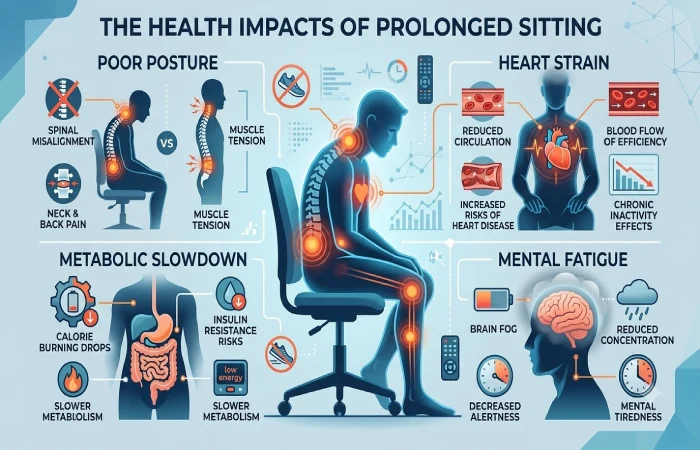
Prolonged sitting is linked to higher waist circumference, less healthy cholesterol patterns, and greater insulin resistance. These changes form part of the pathway toward metabolic syndrome and type 2 diabetes. Visceral fat (the fat deep in the abdomen) tends to increase when daily movement is low and sitting bouts are long.
On the vascular side, reduced shear stress (the friction of blood against the vessel wall) leads to lower nitric oxide production and poorer artery function, especially in the legs. Some studies show that interrupting sitting partially protects against the rise in arterial stiffness, though it does not always fully prevent it.
Cancer Risk and the Pattern of Sitting
A large UK Biobank study that tracked more than 91,000 people with activity monitors for a week and then followed them for over 12 years found an important distinction. Each extra hour of prolonged (uninterrupted) sedentary behaviour was linked to about a 9 percent higher risk of dying from cancer. Interrupted sitting showed the opposite pattern — lower risk.
Replacing one hour of prolonged sitting with light physical activity was associated with a 12 percent lower risk of cancer death. Replacing 30 minutes with moderate activity lowered risk by about 8 percent, and even five minutes of vigorous activity in place of prolonged sitting produced a larger reduction. The cancers most clearly linked included those related to obesity and type 2 diabetes.
The message is not that sitting causes cancer, but that long unbroken periods of sitting are associated with higher risk, and breaking those periods appears protective.
Heart and Circulation Risks Revisited Through the Lens of Prolonged Bouts
Earlier research already showed that high total sedentary time raises heart failure and cardiovascular death risk, especially above roughly 10.5 hours a day. Looking at the pattern adds another layer: long uninterrupted bouts contribute to the vascular stiffness and blood-flow changes that feed into those risks. After a heart-related hospital stay, people who remain highly sedentary face markedly higher chances of further events, and replacing sitting with even light movement cuts that risk substantially.
Standing for long periods is not a perfect solution either. Some data suggest that very high standing time can raise the risk of certain circulatory problems in the legs, so the better approach is regular movement rather than simply swapping sitting for static standing.
Mental Energy, Mood, and Fatigue
People often notice that long sitting sessions leave them feeling mentally flat or more tired by late afternoon. Studies that tested movement breaks in real-world settings found that short walks or light activity every 30 to 60 minutes reduced fatigue and improved mood. Hourly breaks offered a good balance between effectiveness and how easy they were to keep doing. The benefits appeared both immediately and over a couple of weeks of consistent practice.
How Breaking Up Sitting Helps — What the Experiments Show
Laboratory trials have tested different “doses” of breaks:
- Walking for 2 minutes every 20 minutes lowers post-meal glucose and insulin.
- Five-minute walks every 30 minutes produce clear benefits for blood sugar.
- Even one-minute breaks every hour can lower blood pressure.
- Light-intensity movement works nearly as well as moderate intensity for many metabolic markers in inactive adults.
Longer-term interventions that help people sit less and move more show small but meaningful improvements in waist size, body weight, blood pressure, and some blood markers. The changes are modest because most interventions only reduce sitting by 30 to 90 minutes a day, yet they still move health markers in the right direction.
Comparison Tables
Prolonged vs Interrupted Sitting
| Pattern | Associated Risk Direction | Key Finding |
| Prolonged bouts (≥30 min continuous) | Higher cancer mortality (~9% per extra hour) | Stronger link to adverse outcomes |
| Interrupted sitting (breaks built in) | Lower cancer risk | Opposite pattern to prolonged |
| Replacing 1 hour prolonged with light activity | ~12% lower cancer death risk | Practical and achievable |
Break Frequency and Benefits
| Break Pattern | Main Benefits Observed |
| Every 20–30 min for 2–5 min | Better post-meal glucose and insulin, improved blood pressure |
| Every 60 min for 1–5 min | Blood pressure reduction, some metabolic help, good feasibility |
| Hourly movement breaks in daily life | Lower fatigue, better mood, sustainable for many people |
Immediate Physiological Changes During Prolonged Sitting
| System | Change After 1–3+ Hours Uninterrupted |
| Blood vessels (legs) | Reduced flow-mediated dilation, higher stiffness |
| Blood sugar | Higher post-meal levels |
| Muscle enzymes | Lower activity of fat-clearing enzymes |
| Blood pressure | Tendency to rise; reversed by short breaks |
Practical Ways to Interrupt Prolonged Sitting
The most effective approaches are simple and frequent rather than intense. Set a timer or use a reminder to stand and move for one to five minutes every half hour. Walk while taking phone calls. Stand during parts of online meetings. Take the long way to the printer or kitchen. After meals, a short walk is especially helpful for blood sugar.
For people who drive or have jobs that keep them seated, planned stops or stretches at regular intervals make a difference. At home, alternating sitting with standing or light chores during television time reduces long bouts.
Standing desks help some people, but the key is still to move rather than stay static in a new position. The goal is to turn long stretches into shorter ones.
Putting It in Perspective
Prolonged sitting is common in modern life, yet the body is clearly built for regular movement. The risks are not dramatic for every single long bout, but they accumulate. The pattern of sitting — how long the unbroken periods last — appears to matter as much as the total hours. Breaking those periods with light activity improves blood flow, blood sugar handling, artery function, and longer-term disease markers.
You do not need to eliminate sitting. You need to interrupt it often enough that the body never stays in the low-movement state for too long. Small, repeated breaks throughout the day are one of the most practical ways to protect muscles, vessels, metabolism, and overall health while still getting work and rest done. Over weeks and months those interruptions add up to a body that functions better and faces lower risk from the sedentary parts of modern life.