
 Sameena Fatima
Health & Wellness Content Writer
in
Sameena Fatima writes reader-focused
health and wellness content for
HealthBloomWeb, covering fitness,
nutrition, healthy lifestyle and
everyday wellness topics.
Sameena Fatima
Health & Wellness Content Writer
in
Sameena Fatima writes reader-focused
health and wellness content for
HealthBloomWeb, covering fitness,
nutrition, healthy lifestyle and
everyday wellness topics.
 Mirza Ibrahim Ali Khan
Editorial & Content Reviewer
in
Mirza Ibrahim Ali Khan contributes to
HealthBloomWeb's editorial review process,
with a focus on content structure,
readability, search intent and overall
editorial quality.
Mirza Ibrahim Ali Khan
Editorial & Content Reviewer
in
Mirza Ibrahim Ali Khan contributes to
HealthBloomWeb's editorial review process,
with a focus on content structure,
readability, search intent and overall
editorial quality.
 Reyansh Sethi
Medical Reviewer
in
Reyansh Sethi contributes to the medical
review process at HealthBloomWeb, focusing
on clarity, responsible health context and
reader-friendly presentation of health
information.
Reyansh Sethi
Medical Reviewer
in
Reyansh Sethi contributes to the medical
review process at HealthBloomWeb, focusing
on clarity, responsible health context and
reader-friendly presentation of health
information.
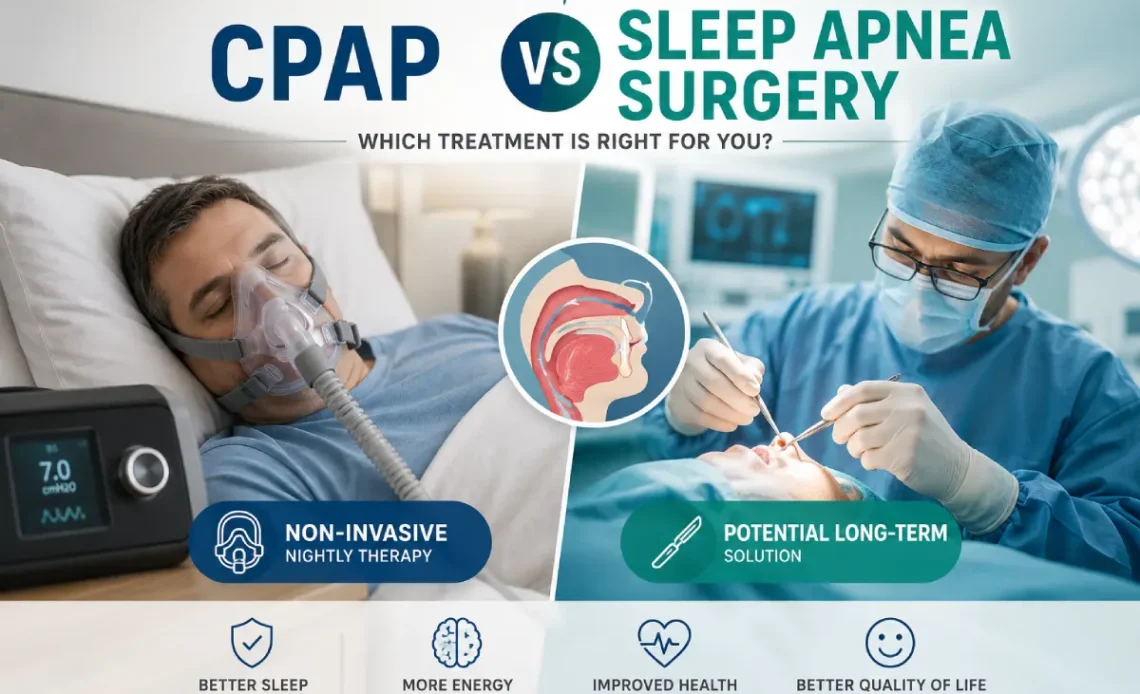
Sleep apnea affects millions of adults around the world, so CPAP vs sleep apnea surgery is one of the most frequent questions someone may have when they are seeking out a sleep apnea consultation. Although definitive recommendations are not always possible, the first line use of the Continuous Positive Airway Pressure is recommended for moderate-to-severe OSA, while surgical intervention may be used for selected patients who fail CPAP therapy, or have certain focal airway obstructions. This debate over the various treatments can initially be confusing to anyone suffering from OSA, so knowing the benefits, limitations, and long-term results from each procedure can allow you to speak with your sleep specialist more efficiently.
This Article is the Part of Sleep Improvement
What Is CPAP Therapy
CPAP is a form of treatment that is applied during sleep through a mask worn over the face. This provides a flow of pressurized air that maintains the airway open preventing interruptions to breathing.
Benefits of CPAP
- Very effective in mild, moderate and severe OSA
- Non-surgical and reversible.
- Enhances oxygenation during sleep
- decreasing fatigue during the day and morning headaches
- May reduce high blood pressure, heart disease, and stroke when used regularly
Common Challenges
- Mask discomfort
- Dry mouth or blocked nose
- Air leakages
- Problems adapting to working a night shift
- Routine cleaning or replacement of equipment
Troubleshooting Tip: if CPAP is uncomfortable, it can often be improved by trying different mask styles, humidification levels, or changing pressure settings prior to consideration of other CPAP options. It is surprising how many patients feel better after professional fitting of masks and optimization of device settings.
What is Sleep Apnea Surgery?
The surgery for sleep apnea involves removal or the repositioning of tissues that block the upper airways. The exact procedure varies based on the location of the airway obstruction.
Common procedures include:
- Uvulopalatopharyngoplasty (UPPP): Excises the redundant tissue of the throat.
- Inspire Therapy: An implanted device that stimulates airway muscles during sleep.
- Maxillomandibular Advancement (MMA) moves the upper and lower jaw forward to help enlarge the airway.
- Correction of structural problems that are causing the breathing problems. For example-
- Nasal Surgery corrects structural problems in the nose.
- Tonsillectomy–removal of enlarged tonsils which are blocking airway.
Different from CPAP, surgery is usually a one-off treatment and it is not guaranteed to result in a full cure.
CPAP vs Sleep Apnea Surgery: Comparison Table
| Feature | CPAP Therapy | Sleep Apnea Surgery |
| First-line treatment | Yes | Usually after assessment |
| Invasive | No | Yes |
| Recovery time | None | Days to weeks (procedure dependent) |
| Instantaneous effect | Generally instantaneous | Often takes weeks to months |
| Maintenance | team will clean date and supplies daily | One off event but follow up needed |
| Long-term plan | Daily usage | One-time procedure, but follow-up required |
| Success is | Use of the con | In the proper patient |
| Ideal for | Most mild to severe OSA | CPAP intolerance or anatomical obstruction |
Sleep Apnea Treatment Comparison
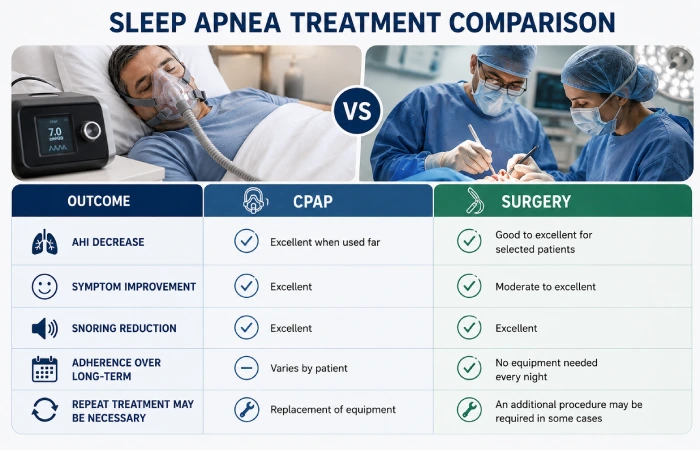
This current clinical evidence supports the use of CPAP as the most predictable treatment for the reduction of the AHI with certain surgical procedures providing modest benefits in correctly selected cases.
| Outcome | CPAP | Surgery |
| AHI decrease | Excellent when used far | good to excellent for selected patient |
| Symptom improvement | Excellent | Moderate to excellent |
| Snoring reduction | Excellent | Excellent |
| Adherence over long-term | Varies by patient | No no equipment needed every night |
| Repeat treatment may be necessary | Replacement of equipment | An additional procedure may be required in some cases |
Who Should opt for CPAP?
CPAP is often recommended if you:
- At least moderate or severe obstructive sleep apnea
- Have already been diagnosed recently
- Would like to try a treatment that is non-invasive
- Does not have major anatomical airway abnormalities
- Looking for a therapy that can be titrated/altered as you progress
Proper mask fitting and regular nightly use will result in the majority of patients achieving good symptom control.
Identify who may be helped by sleep apnea surgery
Surgery may be appropriate if you:
- Unable to tolerate CPAP after many trials
- Have very large tonsils or considerable obstruction of the airway
- Abnormalities of one‘s jaw or facial bone structure.
- Be symptomatic and not get better with conservative measures.
- Have been diagnosed as meeting the criteria by an ENT surgeon and sleep specialist.
Not all patients are appropriate surgical candidates, and further sleep testing may need to be performed before proceeding.
Pros and Cons
CPAP Therapy
Advantages
- Confirmed success
- Not invasive
- Treatment that can be altered
- 30 seconds recovery period
- Appropriately for the majority of patients.
Disadvantages
- Needs to be used every night
- Equipment upkeep
- Hide discomfort for some users
- Traveling with equipment can be difficult
Sleep Apnea Surgery
Advantages
- No nightly machine, Available during the day but not at night.
- May enhance quality of living
- Can also help to reduce snoring
- Aids with certain anatomical indications
Disadvantages
- the risks and complications of surgery
- Recovery period
- Not solely curative.
- But some patients still end up using it afterwards
Is surgery able to take the place of CPAP?
Perhaps the most important question when it comes to sleep apnea treatments comparisons is if surgery can prevent one from having to use the CPAP.
It‘s hard to say, it depends on the person.
In some patients, surgery provides such a significant benefit that they are able to cease therapy altogether, or require much lower pressures. Follow-up sleep studies are generally performed a few months postoperatively to compare to preoperative values.
People come to sleep specialists not seeing surgery or CPAP as mutually exclusive, but as complementary treatments. In certain patients a surgical procedure opens the airway providing a better environment in which CPAP can work.
CPAP Alternatives
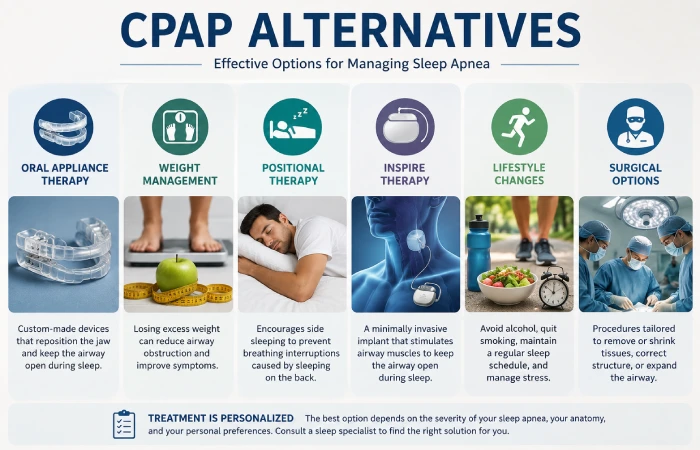
If CPAP alternatives is not tolerated, your doctor may consider other treatment options for your apnea such as:
- Oral appliance therapy
- Weight management
- Positional therapy
- Inspire Therapy
- Lifestyle changes
- String of procedures selected for the study
Your optimal treatment will focus on your sleep study findings, presenting symptoms and your general health.
Frequently Asked Questions
Is CPAP superior to sleep apnea surgery?
CPAP continues to be the treatment of choice for most patients with moderate to severe obstructive sleep apnoea because it has been demonstrated to be effective and is not invasive. Surgery is usually used as a last resort after an attempt at this therapy.
Is it possible for sleep apnea surgery to be a definitive solution for OSA?
Certain procedures may greatly lessen symptomatology but no operation can be said to be curative for everyone. Long term follow-up is absolutely necessary.
Indications for not having sleep apnea surgery:
Patients with uncontrolled medical issues, overly high expectations, or those who are not good candidates based on airway anatomy may not be suitable candidates.
Is it more costly to operate than to use CPAP?
Usually operation has initially more charges meanwhile CPAP is a lot more expensive every year as it involves cost for equipment, masks and replacement items.
What are the best CPAP alternatives?
In some cases there are other options such as oral appliances, weight control, positional therapy, Inspire Therapy and some surgical procedures depending on the cause of your sleep apnea.
Having a stay in hospital, will I still need my CPAP after the operation?
Yes. A number of patients use CPAP after surgery, but at lower pressures.
Final Thoughts
Ultimately, the decision of CPAP vs sleep apnea surgery is up to the individual, taking into account the current medical evidence, sleep study results, and expert recommendations. CPAP remains the definitive treatment for obstructive sleep apnea due to its indisputable efficacy and non-invasive, flexible nature. Surgery can be a great choice for certain individuals with specific anatomy or who are CPAP-intolerant after optimization.
The most effective results are obtained by closely working with an experienced sleep medicine specialist and ENT surgeon to tailor a treatment program that suits your health requirements and lifestyle.