
 Sameena Fatima
Health & Wellness Content Writer
in
Sameena Fatima writes reader-focused
health and wellness content for
HealthBloomWeb, covering fitness,
nutrition, healthy lifestyle and
everyday wellness topics.
Sameena Fatima
Health & Wellness Content Writer
in
Sameena Fatima writes reader-focused
health and wellness content for
HealthBloomWeb, covering fitness,
nutrition, healthy lifestyle and
everyday wellness topics.
 Mirza Ibrahim Ali Khan
Editorial & Content Reviewer
in
Mirza Ibrahim Ali Khan contributes to
HealthBloomWeb's editorial review process,
with a focus on content structure,
readability, search intent and overall
editorial quality.
Mirza Ibrahim Ali Khan
Editorial & Content Reviewer
in
Mirza Ibrahim Ali Khan contributes to
HealthBloomWeb's editorial review process,
with a focus on content structure,
readability, search intent and overall
editorial quality.
 Reyansh Sethi
Medical Reviewer
in
Reyansh Sethi contributes to the medical
review process at HealthBloomWeb, focusing
on clarity, responsible health context and
reader-friendly presentation of health
information.
Reyansh Sethi
Medical Reviewer
in
Reyansh Sethi contributes to the medical
review process at HealthBloomWeb, focusing
on clarity, responsible health context and
reader-friendly presentation of health
information.
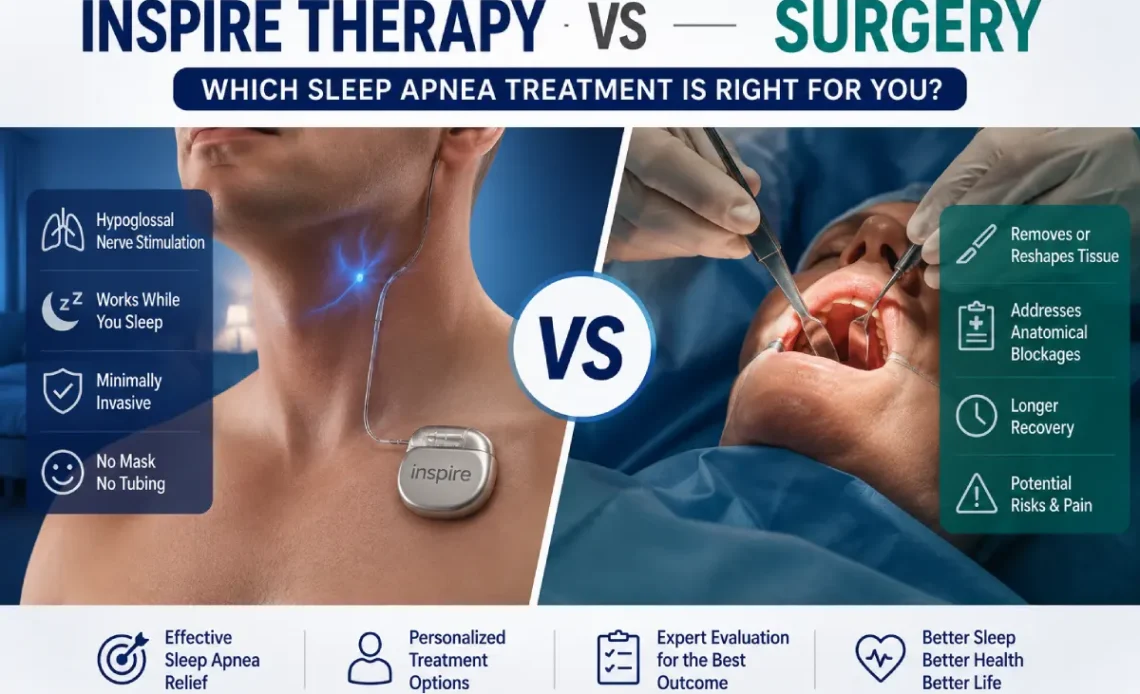
If you haven’t been successful with continuous positive airway pressure (CPAP), then you are in good company. Many with obstructive sleep apnea (OSA) find it difficult to maintain consistent use of CPAP and are interested in other sleep apnea treatments. Here are two options: Inspire therapy (hypoglossal nerve stimulation) and sleep apnea surgery that have proved effective in treating OSA:
Both of these therapies are designed to keep your airway open during sleep, but they function in very different ways. A knowledgeable sleep specialist can help you decide which is the best choice for you by explaining the advantages and disadvantages of each of the options.
Define.2proach.39: Strategy for Thinking2 for an Education of the Whole Person This educational approach is based on the following assumption: that the purpose of education (while certainly remaining ecological) is to nurture the whole person of the student so as to evoke and follow the course of his natural development.
This Article is the Part of Sleep Improvement
What Is Inspire Therapy?
Inspire therapy is an implantable device approved by the FDA for use in adults with moderate to severe OSA who are CPAP intolerant.
Unlike CPAP, Inspire does not pump air through your nose or mask. It‘s a gentle electrical stimulation of a nerve controlling the tongue, the hypoglossal nerve. When you are asleep it prevents the tongue from obstructing your airway.
Key Features
- Placed via a quick outpatient procedure using local anesthesia
- Operating is with a wireless remote
- Only enable during sleep
- no mask or external tubing
- Usually lasts a few years before resulting in the need to replace the batteries
What Is Sleep Apnea Operation?
Surgery for sleep apnea involves removing or repositioning tissues that cause obstruction to the airway.
Two or more procedures may be advised by the surgeons, according to the pathology of the airway obstruction.
Common surgical options include:
- Uvulopalatopharyngoplasty (UPPP) – Excises redundant tissue of the throat.
- TONSILLECTOMY – Excises the enlarged tonsils
- Nasal surgery will correct the obstruction within the nasal passages.
- Tongue base reduction – Decreases tongue tissue that contributes to the blockage.
- MMA – Maxillomandibular Advancement (MMA) is an operation that repositions the maxilla (upper jaw) and the mandible (lower jaw) to increase the width of the airway.
The most effective method varies depending on your anatomy and the severity of your sleep apnea.
The requirement of having one day (24 hours) and one week of reading from a book shall apply only to participants in the experimental group.
Inspire Therapy vs Surgery: Side-by-Side Comparison
| Feature | Inspire Therapy | Traditional Surgery |
| Method | Implantable device | Removal of tissue or reconstruction |
| Invasiveness | Minimally invasive | Varies according to the procedure |
| Hospital Stay | Usually outpatient | Outpatient or possibly overnight |
| Recovery Time | About 1–2 weeks | 2–8 weeks depending on operation |
| Reversible | Yes, device can be removed | Usually permanent |
| Daily Use | Remote activated prior to sleeping | No daily device needed |
| Ideal Candidate | CPAP-intolerant patients who still meet eligibility requirements | Patients who have simple corrections to their anatomical airway |
Effectiveness of Inspire Therapy vs Surgery
Both treatments have been shown to improve sleep apnea symptoms significantly when patients are appropriately selected.
Inspire Therapy
Clinical studies have shown that many patients experience:
- Reduced Apnea-Hypopnea Index (AHI)
- Reduced daytime sleepiness
- Decreased snoring
- Improvement in sleep quality
- Reduced social costs.
Must be eligible (which includes finding on a drug-sedated sleep endoscopy (DISE).
Sleep Apnea Surgery
Surgical success varies depending on:
- The severity of the procedure
- Airway anatomy
- Body weight
- The average body weight of all samples within entire sample was predicted based on the equation
- Severity of sleep apnea
- Surgeon experience
Generally, procedures such as the MMA have higher long-term success rates than soft-tissue procedures, such as UPPP, but are more invasive.
Lee and Nie (1997) test the number of lakes; their test is that the lakes haven an equal chance of having each modification in the HICs. We find out that the good form has no better chance of having all the dimensions changed compared to the bad form.
So the null hypothesis is not rejected. So the good form does better (63% of the time) than the bad form (55% of the time).
The null hypothesis we accept is that the balls have an equal chance of having each modification in the HICs for the difference in proficiency.
Recovery Comparison
Inspire Therapy Recovery
Most patients:
- Go home on the same day;
- Resume light activity after a few days.
- heal within 2 weeks
- Turn on the apparatus roughly 1 month after the implant.
- Have sleep studies performed to optimize device parameters
Surgery Recovery
Recovery will be exciting for procedure.
Patients may experience:
- Throat ache.
- Swelling
- Transient dysphagia
- Access to ‘special’ diets
- Longer duration of time for healing when greater invasive procedures are undertaken
It may take several weeks to recover form jaw surgery.
The expressed ideas which are put into use on such websites include: its features and criteria; topics areas; participatory schemes; online advertisements or links to off-line materials; and the other analytical ideas that the site writers try to communicate.
Is Inspire Therapy indicated for whom?
You may qualify for Inspire therapy if you:
- Experiencing moderate to severe obstructive sleep apnea
- Unable to tolerate or derive benefit from CPAP
- Meeting both criteria makes BMI (definition as above) unsuitable for travel (24). However, a BMI of below 33 combined with anatomical factors recommends considering all options.
- Do not have incomplete concentric airway collapse on DISE
- Are well enough to undergo surgery.
A sleep medicine physician, ENT specialist, will use their tests to determine if an individual is appropriate.
Who would be a candidate for sleep apnea surgery?
Traditional surgery may be recommended if you have:
* Super-sized tonsils
* Nasal blockage
* Excess throat tissue
* Abnormalities of the jaw
*Various Anatomic reasons for airway obstruction
Surgery is considered when structural abnormalities can be corrected to enhance airflow.
Advantages and Disadvantages
Inspire Therapy
Pros
- No CPAP mask
- Interventional techniques
- Flexible therapy configurations
- Reversible implant
- Very satisfied patients
Cons
- Not every body‘s eligible
- Needs an implanted device
- need to change the battery after few years
- A need for continued programming appointments
Final Thoughts
The decision to treat sleep apnea with Inspire therapy vs surgery ultimately depends on the severity of one’s sleep apnea, the airway anatomy, willingness to CPAP, and other health factors. Both of these treatment options have helped thousands of people sleep better and lower the health dangers of untreated obstructive sleep apnea.
If CPAP hasn’t been successful for you, consult with a board-certified sleep medicine physician or ENT for the next step that would be best for you, such as hypoglossal nerve stimulation or surgery. A tailored assessment can assist you in choosing the safest and most effective long-term treatment.