

 Sameena Fatima
Health & Wellness Content Writer
in
Sameena Fatima writes reader-focused
health and wellness content for
HealthBloomWeb, covering fitness,
nutrition, healthy lifestyle and
everyday wellness topics.
Sameena Fatima
Health & Wellness Content Writer
in
Sameena Fatima writes reader-focused
health and wellness content for
HealthBloomWeb, covering fitness,
nutrition, healthy lifestyle and
everyday wellness topics.
 Mirza Ibrahim Ali Khan
Editorial & Content Reviewer
in
Mirza Ibrahim Ali Khan contributes to
HealthBloomWeb's editorial review process,
with a focus on content structure,
readability, search intent and overall
editorial quality.
Mirza Ibrahim Ali Khan
Editorial & Content Reviewer
in
Mirza Ibrahim Ali Khan contributes to
HealthBloomWeb's editorial review process,
with a focus on content structure,
readability, search intent and overall
editorial quality.
 Reyansh Sethi
Medical Reviewer
in
Reyansh Sethi contributes to the medical
review process at HealthBloomWeb, focusing
on clarity, responsible health context and
reader-friendly presentation of health
information.
Reyansh Sethi
Medical Reviewer
in
Reyansh Sethi contributes to the medical
review process at HealthBloomWeb, focusing
on clarity, responsible health context and
reader-friendly presentation of health
information.
Shedding pounds is not simply about watching your calories or spending hours in the gym. Your mindset and the way you live your life are equally as important. That‘s why many are now turning to meditation for weight loss in conjunction with a healthy diet and physical activity.
While meditation itself does not burn many calories, some evidence indicate that meditation can be beneficial due to its ability to lower stress levels, promote healthy attitudes and strengthen one‘s consciousness of oneself. This, in turn, can lead to more healthy eating habits in the long run.
This Article is the Part of Meditation
Does Meditation Assist with Weight Loss?
Rather, meditation is not an alternative to a healthy diet or exercise. Rather, meditation compared to the demotivating behaviors which can hinder weight loss such as:
Emotional eating 1598. Studies of emotional eating have found that many individuals tend to eat in response to feelings of depression or happiness, but not anxiety.
- Cognitive
- Stress-related cravings: overcoming the urge to eat.
- Thoughtless snacking
- Poor sleep practices
- Lack of motivation
Just by becoming aware of what you think and feel learning to notice thoughts and be conscious of feelings you can better consciously choose how and what to eat instead of blindly reacting to what life throws your way.
The Connection Between Meditation and Weight Loss
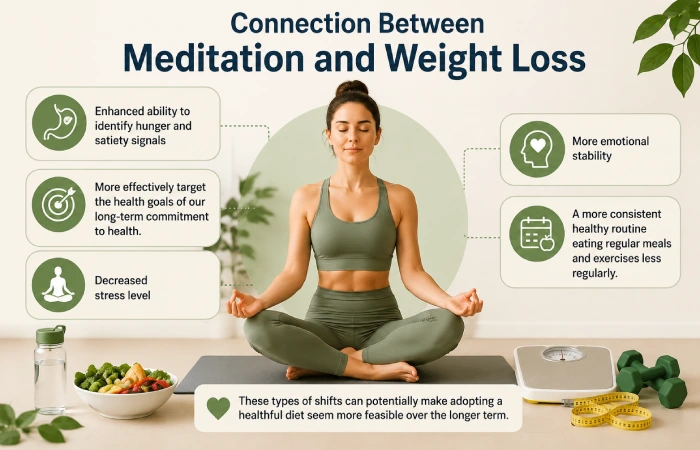
Most eatings are not due to hunger. Anxieties, stress, boredom and tiredness can lead to overeating. Meditation soothes the mind and pauses to react on such feelings.
Potential benefits include:
- Enhanced ability to identify hunger and satiety signals
- More effectively target the health goals of our long-term commitment to health.
- Decreased stress level
- More emotional stability
- A more consistent healthy routine eating regular meals and exercises less regularly.
These types of shifts can potentially make adopting a healthful diet seem more feasible over the longer term.
How Mindful Eating Supports Weight Loss
What‘s most rewarding with mindful eating is getting to train yourself to be present during eating instead of eating mindlessly.
Try these simple habits:
- Read the article (within limits) and practice visualizing what you have read.
- Chew each bite slowly.
- Pay attention to the flavors, textures and aromas.
- Stop when you feel satisfied and not so hungry that you are busting at the seams.
- Check: are you hungry? Or upset?
Mindful eating doesn‘t mean complete food restriction. Alternatively, it just promotes a more thoughtful attitude towards food.
Meditation Helps Reduce Emotional Eating
A craving is often confused with real feelings of hunger. An idea to help reduce emotional eating is to try and meditate on a regular basis so you will get into the habit of spotting emotional triggers before you reach for food.
Common emotional eating triggers include:
Stresswork: This often correlates with a life event which measures the extent to which an individual perceived the event as a stresser.
- Anxiety
- Loneliness
- Boredom
- Sadness
- Poor sleep.
As these emotions come out, even a 3-minute meditation session may be effective in breaking up typical patterns of automatic eating and promoting some adaptation response.
Best Types of Meditation for Weight Loss
Different meditation techniques offer unique benefits. Consider trying one or more of the following:
| Meditation Type | Benefits |
| Mindfulness Meditation | Develops awareness of one‘s thoughts, feelings and eating behavior |
| Guided Meditation | Good for beginning users. Give clear radio by tone and voice. |
| Body Scan Meditation | Assists in releasing stress and enhances mindfulness of the body |
| Breathing Meditation | The nervous system is relaxed and you become less stressed. |
| Loving-Kindness Meditation | It increases Self-Compassion and decreases Food Guilt |
The most effective treatment is the one that you are able to do regularly.
A Simple 10-Minute Meditation Routine
If you‘re new to meditation, start with this easy routine:
Minute 1–2: Settle In
Get into a comfortable place and close your eyes. Pay attention to your breathing.
Minute 3–5: Observe Your Thoughts
Observe your thoughts without judgment. If your mind begins to drift, softly bring it back to your breathing.
Minute 6–8: Check In With Your Body
Become aware of physical sensations, such as hunger, constriction, or feelings of heaviness. Simply be aware, don‘t react.
Minute 9–10: Set an Intention
Choose a simple goal such as:
- Today I will eat conscientiously.
- “I will tune into my body‘s hunger signals.”
- “I will make decisions about my life that benefit my health.”
It is recommended to practice this routine every day to help develop better habit.
Building Long-Term Wellness Habits

Successful weight management is about consistency, not perfection. Meditation aids multiple wellness practices that aid in sustained health:
- Sleep quality.
- Was less stressed everyday
- Enhanced focus
- More self-motivation More thoughtful food selections
- More emotionally stable
- Met performance, looking through and performing – Here you go.
Is Meditation Sufficient by Itself?
Is meditation effective? No. Meditation is most effective when incorporated into a healthy lifestyle.
- For sustainable weight loss, combine meditation with:
- A healthy, balanced diet that is rich in nutrients
- Regular physical activity:
- Weightlifting and aerobic exercise
- Good sleep
- Sufficient fluid intake
- Consistent stress coping
Imagine that meditation is a facility to supporting Healthy behaviors rather than as an isolated weight-loss solution.
Tips for Getting Started
If you‘re just beginning:
- Begin with 5–10 minutes each day.
- An effective and successful way to do this is to practise at the same time every day so that it becomes habitual and much easier.
- Sit in a chair in a quiet, comfortable room.
- Concentrate on accomplishments over flawless.
- If you want a little more guidance or support, consider trying a guided meditation app.
Changes are more likely to happen when those small changes are incorporated into a daily routine; daily life is where real change occurs.
Frequently Asked Questions
Meditation burns very little calories.
Its main benefit is promoting healthful behaviors, reducing stress and providing more mindful eating.
How do I meditate to lose weight?
Two or five minutes a day can be a good beginning for the average novice. As the task becomes easier they may find that there is some benefit in lengthening it to fifteen or twenty minutes.
Dividing the abdominal department with two horizontal lines, your stomach is the section between the two lines.
Can meditation help flatten that part?
Having 2 separate horizontal lines in the middle of your abdomen; Look in the mirror and see if the midsection section (between the middle and bottom horizontal line) is fat 1.
It is important to note that meditation will not directly reduce a person‘s stomach fat. But by reducing persistent stress levels and improving habits it could be a helpful component to an overall fat reducing lifestyle when coupled with good dietary and exercise choices.
Most effective meditation for weight loss?
Mindfulness meditation is another area of research which focuses on increasing awareness of the sensations of hunger and fullness, emotions and eating behaviors.
Conclusion
Meditation for weight reduction is an integral part of a holistic weight management plan as it addresses the psychological and emotional factors behind eating. With regular practice of mindful eating, overcoming emotional eating, maintaining mindful eating and achieving healthy sustainable wellness habits, meditation can be of great benefit to weight control.
Although meditation isn‘t a shortcut, combined with healthy balance eating, appropriate exercise and a steady practice of self-care can help you make your weight-loss goal a mindful, enjoyable, and sustainable experience.