
 Sameena Fatima
Health & Wellness Content Writer
in
Sameena Fatima writes reader-focused
health and wellness content for
HealthBloomWeb, covering fitness,
nutrition, healthy lifestyle and
everyday wellness topics.
Sameena Fatima
Health & Wellness Content Writer
in
Sameena Fatima writes reader-focused
health and wellness content for
HealthBloomWeb, covering fitness,
nutrition, healthy lifestyle and
everyday wellness topics.
 Mirza Ibrahim Ali Khan
Editorial & Content Reviewer
in
Mirza Ibrahim Ali Khan contributes to
HealthBloomWeb's editorial review process,
with a focus on content structure,
readability, search intent and overall
editorial quality.
Mirza Ibrahim Ali Khan
Editorial & Content Reviewer
in
Mirza Ibrahim Ali Khan contributes to
HealthBloomWeb's editorial review process,
with a focus on content structure,
readability, search intent and overall
editorial quality.
 Reyansh Sethi
Medical Reviewer
in
Reyansh Sethi contributes to the medical
review process at HealthBloomWeb, focusing
on clarity, responsible health context and
reader-friendly presentation of health
information.
Reyansh Sethi
Medical Reviewer
in
Reyansh Sethi contributes to the medical
review process at HealthBloomWeb, focusing
on clarity, responsible health context and
reader-friendly presentation of health
information.
Answer to your question : Mindfulness meditation is simply defined as being present without judging. Practicing mindfulness meditation may improve stress, decrease brain areas associated with self, increase emotional reactivity and promote the healthiest possible response to life’s day to day situations.
Why This Resource?
The mindfulness information this guide is derived from comes from mindfulness research studies published prior to 2026, the leading mindfulness programs, peer-reviewed psychology, and medical journals. While meditation is considered to have numerous benefits for many, it is not designed as a treatment that will replace clinical health and medical intervention.
This Article is the Part of Meditation
How to Use Mindful Meditation to Improve Your Focus and reduce stress?
Mindfulness Meditation The most popular form of mindfulness meditation Mindfulness Meditation It is a meditation for attention that teaches you how to notice your thoughts, emotions, sensations and awareness of yourself without your reaction to these immediate changes. The purpose is to stop your thoughts, but instead to pay attention to them and come back again – that’s usually how you focus your breath again.
Unlike other types of meditation, which often involves chanting or visualization, mindfulness meditation is simply the practice of paying attention. Its aim is not to empty your mind, but rather to pay closer attention to what you’re experiencing right now. Mindfulness meditation is a very popular approach to meditation that is widely practiced, well-studied and taught in schools, hospitals and companies.
Since the practice of meditation mindfulness can be started up easily and the activity can also be carried into the daily activity of one, this is the most advisable and highly-regarded way of meditating to have tried by the learners. The use of mindfulness may be done whenever the one seeks for a peaceful time for reflection, thus reducing the stress the person experiences. Besides this, the user of mindfulness can achieve an elevated mental concentration and be able to have better sleeping conditions as well as clarity for a person’s life’s goals.
How is Mindfulness Meditation Different?
You and I may have been confusing these two terms, but Mindfulness and Meditation are not quite the same. The state of mindfulness Meditation
| Mindfulness | Meditation |
| Meditation refers to a way of being in touch with the present | A type of practice that consists in training the mind |
| May be cultivated throughout the day or any time during everyday routines | Generally carried out during a dedicated meditation session |
| Practices such as walking | Mindfulness meditation, mindful eating meditation |
| mindfulness of breathing may take several seconds | Minutes May range from 5 to 30 minutes and longer |
mindfulness meditation is the meditation on mindfulness, the attempt to foster mindfulness through meditation practice.
How Does Mindfulness Meditation Work?
The mechanics of mindfulness meditation depend on training our attention. We flit between past and future, anxiety and anticipation, internal concerns and external distractions all the time; each time that you gently guide your mind’s wandering back to an object of attention (like the breath, for example) you’re cultivating qualities like:
- Sustained attention
- Emotional awareness
- Self-regulation
- Cognitive flexibility
- Stress resilience
Such repeated moments of clarity can, over time, enable people to be less likely to act reflexively when faced with obstacles. The researchers think these adjustments may be enabled by the brain’s capacity for change through plasticity – that is, the ability to reshape neural circuits with regular practice.
What is Going On In the Brain During mindfulness Meditation?
The studies Brain scans have found that the effects of regular mindfulness can affect several areas of the brain related to:
Attention Decision Making Emotional regulation Learning Self Awareness Studies of brain changes due to regular mindfulness have found trends in the following:
• Better function in the parts of the brain responsible for attention and the ability to decide
• better control over how you react to stimuli,
• reduced sensitivity to irritations
• more insight into what you are thinking, and whether or not these thoughts are going to be overwhelming Remember
all studies show a general trend that occurs in research groups, and may not be applicable to an individual depending on sleep, health, diet, and overall life and practicing habits.
2026 Research Snapshot
The popularity of mindfulness meditation continues to grow as researchers explore its role in supporting mental and physical well-being.
Comparison Table: What Recent Research Suggests
| Research Area | What the Studies Commonly Say | The Takeaway For Practical Use |
| Stress Management | Studies frequently note a correlation between regular mindfulness practice and a lower subjective level of stress. Consistent, regular mindfulness | Even as little as 10-15 minutes per day may assist with stress management. |
| Attention and focus | Participants typically demonstrate enhanced capacity for prolonged attention after only a few weeks of consistent mindfulness practice. | Can be particularly useful for students or those in professional fields needing enhanced concentration. |
| Emotional Health | Health Clients demonstrate a higher capacity for being present with emotion without automatically reacting. | Can contribute to enhanced emotional resiliency over time. |
| Sleep Health | Mindfulness practiced in the evening has often been found to be correlated with improved relaxation prior to sleep. | Could be a helpful adjunct to established sleep habits. |
| Workplace well-being | There is growing awareness in organizations about the role mindfulness can play in employee wellness initiatives. | Incorporating brief mindfulness sessions during the day could improve focus for workers. |
Who Can Benefits Mindfulness Meditation?
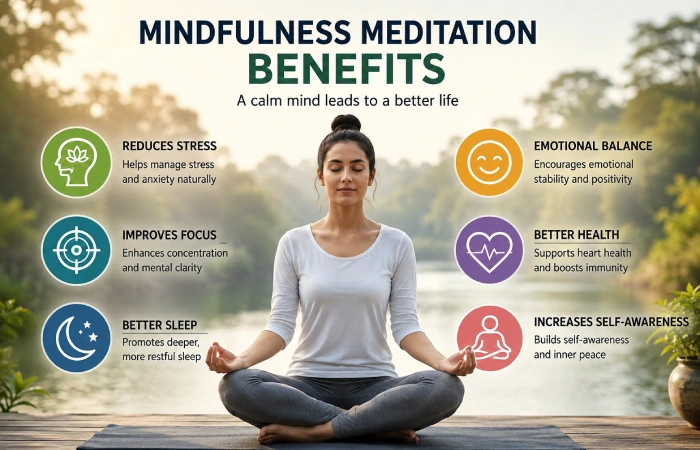
One of the nice things about Mindfulness Meditation is how accessible it is – no equipment necessary and you do not need to belong to any belief system to practice!
You can use mindfulness meditation to help manage:
- Stress during the day
- Developing greater concentration
- The balance of your professional and personal lives
- Deeper emotional insight
- Developing healthy sleeping habits
- Growing on an individual basis
As beginners first explore meditation they are often overwhelmed at the notion that your mind wanders every where else. This happens to even the most experienced meditator as well and the act of bring your focus back to your current experience reinforces mindfulness.
Beginner Meditation Techniques and Mind Tip
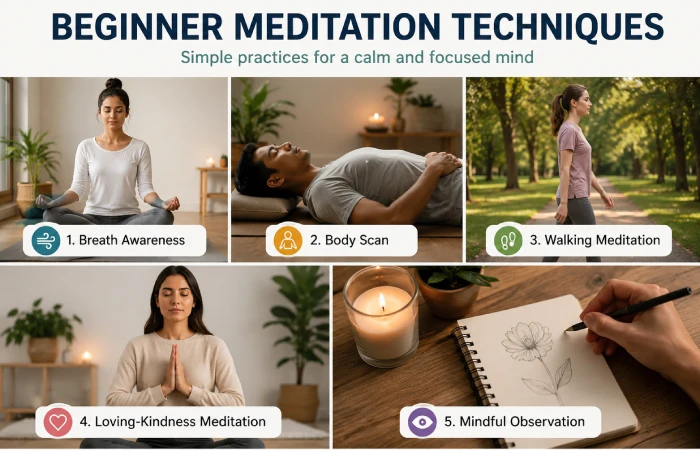
The practice is working If your mind is off in another thought every few seconds,
You are in a perfect place. Mind wandering is actually key to this practice; this is how you practice exercising your awareness. When you notice you have strayed from your anchor of choice.
kindly guide your attention back. Five minutes each day, perfectly imperfect, creates the consistency required.
AI Overview Summary
Mindfulness meditation, in its essence, is as easy as paying attention to the present moment in non-judgmental ways. While research on this technique as of 2026 indicate that a daily mindfulness practice could promote relaxation, concentration, healthy sleep patterns, and emotional well-being, you can begin as slowly as a few minutes each day practicing the art of focusing your breath.