

 Sameena Fatima
Health & Wellness Content Writer
in
Sameena Fatima writes reader-focused
health and wellness content for
HealthBloomWeb, covering fitness,
nutrition, healthy lifestyle and
everyday wellness topics.
 Mirza Ibrahim Ali Khan
Editorial & Content Reviewer
in
Mirza Ibrahim Ali Khan contributes to
HealthBloomWeb's editorial review process,
with a focus on content structure,
readability, search intent and overall
editorial quality.
 Reyansh Sethi
Medical Reviewer
in
Reyansh Sethi contributes to the medical
review process at HealthBloomWeb, focusing
on clarity, responsible health context and
reader-friendly presentation of health
information.
Work-life balance, in the most basic sense, involves maintaining the equilibrium between our work and our lives that prevents one from siphoning off the other’s resources excessively, or vice versa. While there’s a fair bit of complexity behind the phrase, fundamentally, balance simply means sustaining the healthy tension that exists between two related spheres.
Most of us, thankfully, will not need to work a single, standard hour every day. We all are subject to the ups and downs of life. Some weeks are dedicated to work.
Others to family, to our health, or to other obligations.
Balance does not mean exacts, but proportional; namely, ensuring that the mass of one does not slowly and steadily destroy the mass of the other.
How “Work-LIFE Balance” Is Defined
Work-life balance definitions may vary, but they all come back to a consistent goal: To be able to accomplish your work in a way that you have the time and energy (and good health-mentally and physically) to relax and enjoy your loved ones, recreation, and yourself. Psychologists have used the amount of time spent on different roles or occupations as a measure of balance, while others have described the presence of role conflict or resource enhancement, and still others use an everyday working definition, “a situation in which the demands of work and personal life do not conflict with one another and a person feels like the combination is sustainable over time.”
Distinctions These current concepts of work-life balance can be distinguished from related terms such as work-life integration, which allows for more overlap and relies on a sustainable, ongoing flow, and work-life harmony, where the parts are mutually supporting.
Their use is not mutually exclusive, and some people incorporate elements of the various ideas into their approach to work and life depending on the phase of life they are in and the demands of their job. People are very different, and their work-life arrangements will vary over time and by circumstance.
Why Work-Life Balance Matters
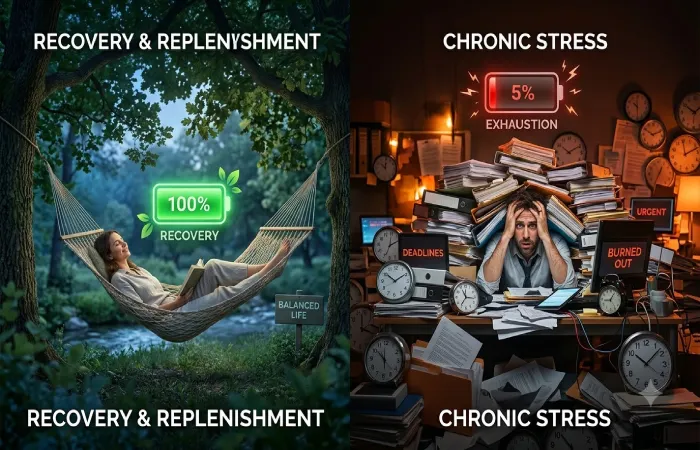
Balance can be demonstrated in the areas of health, performance, relationships and longevity. Chronic imbalance increases stress and decreases the time available for recovery. The body and mind require periods of reduced demand to repair, process experiences and replenish energy.
When those periods get short or non-existent, dis-ease will result.
Sleep quality often suffers. Reactivity can increase. Tension, headache and digestive complaints can become frequent. In the longer term, ongoing elevated demand without sufficient recovery has been associated with an increased risk of a number of health problems.
Mental health is particularly susceptible to imbalance. Ongoing excessive demand can lead to burnout, a combination of emotional exhaustion, distancing and reduced sense of accomplishment. Low mood and anxiety can become chronic when individuals lack control over the choices and demands they face each day.
How performance is impacted on is a counterintuitive result. Extended hours don’t necessarily equate to better output. Once a person has been awake and performing at high capacity for a period of time, fatigue begins to erode performance, increase mistakes and slow decision-making.
Exhausted people tend to do less than their capabilities, even when present for additional hours.
Companies that promote healthy balance are likely to enjoy more engaged and stable employee performance with lower retention costs.
Work life balance can and does impact relationships too. Constant inability to focus or provide support can show up in disruption to life partners, family members and friends. Over time this erodes one of the supports that will help in managing stress.
A practical career factor for many employees has been the value placed on work/life balance when choosing jobs.
Even if it impacts negatively on compensation, the level of importance over the last decade has increased, even to the point of competing with pay.
The Power of a Better Balance
The Power of a Better Balance Improvements tend to show up in multiple dimensions of life all at once: Enhanced mental sharpness and emotional stability. People report decreased daily stress, greater resilience to setbacks, and improved awareness of others around them. The risks of burnout are lessened when recovery is routine rather than sporadic.
Better health.
Longer and more sound sleep, more moderate physical activity, and lower levels of chronic stress all translate into better blood pressure, lower disease risks, and more energy. Greater productivity. While productivity might decline during big changes, in the longer term, people who are rested and less fried are more focused, make fewer errors, and persevere longer, and the majority of shorter work-hour studies find work output to be sustained or even improved. Stronger relationships.
More presence and emotional connection from day to day mean more incremental investment, which often makes more difference than sporadic big expressions of affection.
Increased career sustainability. Avoiding chronic overload helps professionals preserve their effectiveness over the long haul rather than burning out, taking early retirement or other extensive measures, or leaving critical roles prematurely. Organizations benefit from less absenteeism and presenteeism, and more retention of their most productive people.
Common Signs That Balance Is Slipping

The common signs that are clues we are losing balance. It is rarely one event. We often get the clues in the form of small warnings signs that we can learn to spot. Fatigue that is not relieved by weekends or even worse, continued on the weekend can be a strong clue that you are off kilter as our physical indicators show us.
Not feeling refreshed after the weekend and others giving you subtle clues that you are not yourself is another early marker that you are out of alignment as we can see when we study the minds of others.
Not being able to “relax” or “switch off”. Thinking about work on your days off. Sensing you are not fully present. Thinking about work as the alarm goes off in the morning and you keep checking your email. Noticing you are wrapped up in work even when you are with others. Headaches, muscle tension, digestion issues, getting sick more often, rising blood pressure.
Mental: feeling more irritable, impatient, anxious especially leading into your workweek, diminished levels of motivation, increasing frustration and dissatisfaction with your work.
Relationships: missed appointments, disrupted conversations, naming off tasks or when they feel checked out with you. Producing more hours at work does not translate into better results. Career and work motivation and quality goes downhill. Still putting in 40 hours or more per week but the output and results diminishes. Taking fewer holidays, avoiding breaks, relying on caffeine, drugs and alcohol to push through the day, feeling guilty for not working. Think about this…these are all signs. And provide us with a powerful break to hit the reset button.
How Imbalance Builds Up
A variety of familiar factors lead to imbalance.
Connectivity makes it possible to work just about whenever. The very tools that offer this flexibility can also eliminate natural settling periods.
Workplaces that reinforce non-stop availability or equate presence with engagement or performance create a need to be ‘on.’ Heavy workload and low influence lead to stress and longer working hours. Poor prioritization and interruptions aggravate this situation.
Personal considerations also interfere. Caregiving, financial stress, perfectionism, and boundary challenges can stand in the way of reclaiming recovery time.
Life transitions – a new job, promotion, a child, parent needs, a health condition – often upset prior arrangements and require intentional planning.
Balance-Boosting Practical Tips
When you incorporate more specific boundaries, more optimal recovery practices, intentional workload flow, and structural changes whenever possible, positive change happens. First, a reality check. Log a typical week.
Log where real time and real energy are being spent.
Identify where the real root issues are and which recovery strategies are most impactful. Identify where specific boundaries might actually be feasible. This could be a dedicated end time for work-related correspondence, guaranteed time blocks for fitness or family, or guidelines around work device use. Transparency around boundaries might be appropriate, but be aware how it can be taken –don’t apologize or invite criticism. Consistency beats perfection.
Consistently protecting recovery.
Sleep, movement, and strategic time off is work. Include this in your schedule like you would a work obligation. Restorative breaks throughout the day help you stay energized and focused for the great length of your day.
Adjust workload intentionally.
Know priorities. Build in systematic day-to-day, weekly, and monthly movement breaks and work within the limits of the strongest functioning times of your day. Choose peak hours for your most demanding tasks. If at all possible cut down on meetings and related interruptions.
Put effective workplace flexibility practices in place.
Think through what options may be available to you for earlier or later start times, remote or hybrid work, or a group condensed work schedule that minimizes workplace presence and travel time.
Use your flexibility to set boundaries and restore rather than ‘save time’ to work longer hours. Create low-burden habits that can be repeated. An end-of work tradition at home or in another transition space, regular physical activity timing, breathing and mindfulness techniques throughout the day, and clear home-boundary guidelines significantly cut mental energy drain and create precious time and mental real estate.
Advocate at work for practical changes.
It’s remarkable how cooperative employers and coworkers can be when requests are detailed rather than whining. Define team boundaries for response times, scheduled ‘meeting free’ time, and respecting time off.
Different Approaches for Different Situations
For those with children in early education, predictability on school hours and backup plans for disruptions can be an enormous help. Some flexibility in start/end times or ability to work remotely on some assignments can make all the difference.
If you’re in an intense or client or service role, more boundaries on evenings and weekends may be necessary so the default doesn’t become availability.
Remote workers can have more effective separation if the workplace and time commitment is intentionally confined, rather than the default to home extended by the chaos of work.
If you are caring for aging parents or others, you may need compressed schedules or days off for appointments and support.
Different points in your career will also give you a different perspective. If you’re new to your career it can be intensive. When you are more established, you can focus on sustainability. The key is intention, not drift.
Country and cultural context
The expectations and supports can be very different. A country may have more legal restrictions on hours of work, longer paid leave, and a cultural norm that sees having time off as normal. Or a country may value the long working hours, or leave individual workers less support. However, the experience of an individual differs dramatically in any country.
Measuring Progress
Monitoring Progress Improvement is rarely a straight line. Frequent markers are consistency of energy, the ability to switch off, reduction of stress symptoms, availability in the personal life and less drain from the job. Regular reviews–monthly or quarterly– can arrest the drift before it has been allowed to get out of control.
A Realistic Perspective
A Practical Reality Not every day will be perfect. There will be stressful days, unanticipated days and disrupting events. The more productive, and more realistic, goal is to find a pattern of life that can be sustained over months and years: enough time to recharge most of the time, clear boundaries so work doesn’t take up everything, and the flexibility to do “real life” without needing to be in crisis mode all the time.
Work-life balance isn’t a luxury, and it isn’t an indication of how high your ambition is; it’s a practical necessity for your long-term health, your overall performance, and your life feeling meaningful outside of work.
The actual meaning of the phrase is that you’ve arranged your life so work is always there, but never everything; the rest of life gets some attention too. The specifics of what that looks like varies from person to person.