
 Sameena Fatima
Health & Wellness Content Writer
in
Sameena Fatima writes reader-focused
health and wellness content for
HealthBloomWeb, covering fitness,
nutrition, healthy lifestyle and
everyday wellness topics.
Sameena Fatima
Health & Wellness Content Writer
in
Sameena Fatima writes reader-focused
health and wellness content for
HealthBloomWeb, covering fitness,
nutrition, healthy lifestyle and
everyday wellness topics.
 Mirza Ibrahim Ali Khan
Editorial & Content Reviewer
in
Mirza Ibrahim Ali Khan contributes to
HealthBloomWeb's editorial review process,
with a focus on content structure,
readability, search intent and overall
editorial quality.
Mirza Ibrahim Ali Khan
Editorial & Content Reviewer
in
Mirza Ibrahim Ali Khan contributes to
HealthBloomWeb's editorial review process,
with a focus on content structure,
readability, search intent and overall
editorial quality.
 Reyansh Sethi
Medical Reviewer
in
Reyansh Sethi contributes to the medical
review process at HealthBloomWeb, focusing
on clarity, responsible health context and
reader-friendly presentation of health
information.
Reyansh Sethi
Medical Reviewer
in
Reyansh Sethi contributes to the medical
review process at HealthBloomWeb, focusing
on clarity, responsible health context and
reader-friendly presentation of health
information.
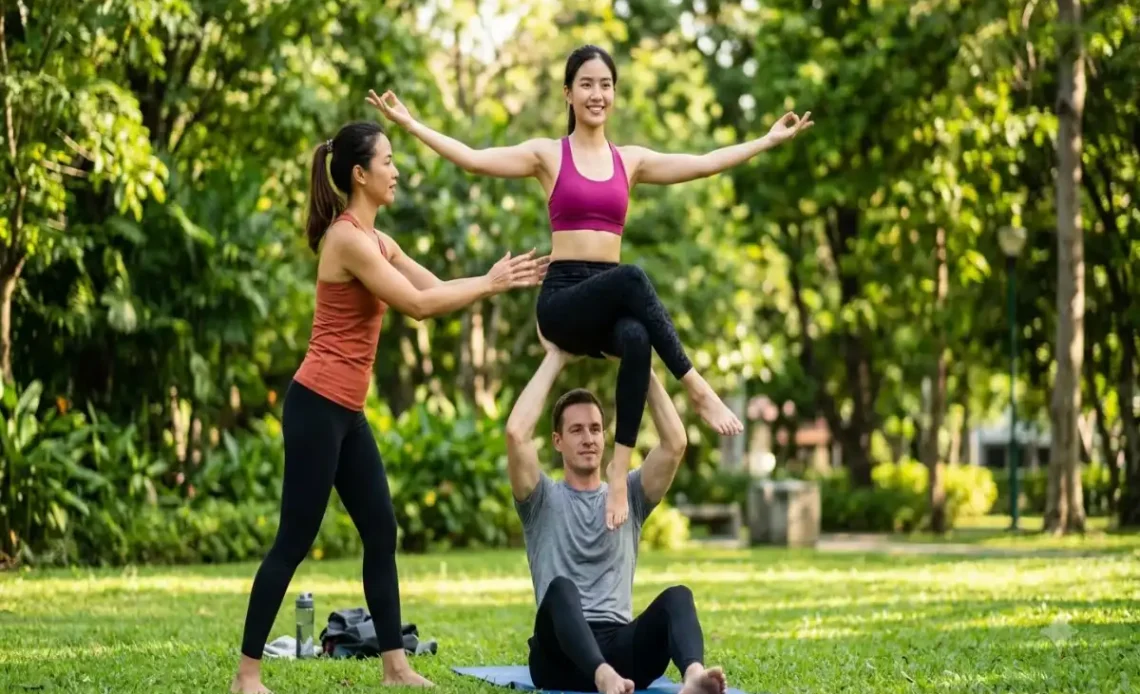
Acro yoga for three people looks impressive from the outside. One person lies on the ground, another balances above, and a third watches closely so no one gets hurt. That is the basic picture of 3 person acro yoga poses, also called acro yoga for three, beginner trio acro yoga, three person acro poses, acro yoga group poses, or safe acro yoga for beginners.
The word “acro” comes from acrobatics, but the beginner version stays close to the ground and moves slowly. You are not expected to throw anyone into the air on day one. You learn how weight is shared, how to stack bones instead of relying only on muscle, and how to talk clearly while you move. The third person—the spotter—is not optional for beginners. Their job is to keep everyone safe.
This guide focuses on the safest entry points. The language stays plain. The poses are broken into clear roles so anyone can follow. You will find practical safety rules, role explanations, step-by-step shapes that work for most groups, comparison tables, and a short sequence you can try once the group feels ready. The material is deliberately different from the earlier guides on easy grounded poses and standing balance work.
The Three Roles That Make Everything Work
Every safe acro session uses three clear jobs.
Base
The person who stays on the ground and supports the weight. Most often the base lies on their back. Strong legs, steady arms, and a calm mind help. Size does not matter as much as alignment. A smaller base can support a larger flyer when the bones stack correctly.
Flyer
The person who is lifted or balanced. The flyer needs core strength, the ability to stay still, and the willingness to trust. Lighter flyers are easier at the start, but anyone can learn the role with good technique.
Spotter
The person who stands beside the pair and watches everything. The spotter’s only job is safety. They keep hands ready near the flyer’s hips or shoulders, give verbal cues, and help lower someone if balance is lost. For beginners the spotter is essential. Skipping this role is the most common way people get hurt.
Rotate the roles often. Everyone learns more by trying each job.
Non-Negotiable Safety Rules for Beginner Trio Acro
Acro yoga carries more risk than regular yoga because of height and shared weight. These habits lower that risk sharply.
- Warm up wrists, shoulders, hips, and core for at least 10–12 minutes.
- Practice on a thick mat or with crash pads underneath.
- Agree on clear words before you start: “Ready,” “Flying,” “Down,” “Stop.”
- Never attempt a new shape without a dedicated spotter.
- Base keeps legs strong and aligned over the hips. Flyer keeps the body long and engaged.
- Exit every pose slowly. Most falls happen on the way out.
- Stop at any sharp pain or dizziness.
- Build one pose until the group can do it cleanly ten times before moving on.
- If anyone is pregnant, recovering from injury, or has uncontrolled high blood pressure, skip elevated work.
These rules are not optional. They are what keep the practice fun instead of scary.
Beginner-Friendly Three-Person Acro Poses
Start low and slow. The poses below keep most of the work close to the ground or with full spotting.
1. Front Plank (also called Front Bird or Phalanx) with Spotter
This is the classic first flying pose.
How to do it
Base lies on the back, knees bent, feet flat. Flyer stands at the base’s feet, facing the base’s head. Base places the balls of the feet on the flyer’s hip bones (the bony points at the front of the pelvis). Both partners hold each other’s wrists or hands. Base slowly straightens the legs until the flyer is lifted into a horizontal plank position, body long from head to heels. Spotter stands at the flyer’s side with hands ready near the hips or shoulders. Hold for 3–5 breaths, then lower slowly.
Why it works
It teaches the basic weight-sharing and bone-stacking that every other pose builds on.
Modifications
Keep the base’s knees more bent so the flyer stays lower. Flyer can keep one foot lightly touching the ground at first.
2. Plank on Plank (Three-Person Version)
A strength builder that stays relatively low.
How to do it
One person (base) holds a strong plank on the mat. Second person places hands on the floor and feet on the base’s shoulder blades or lower back, forming a second plank on top. Third person acts as spotter, ready to support the top person’s hips or help if the stack tips. Keep cores tight and hips level. Hold for a few breaths, then carefully reverse the entry.
Safety note
Do not place full weight on the lower back. The top person uses the hands and feet for support and keeps most of their own weight.
3. Two-Person Whale Pose with Spotter
A gentle backbend for the flyer and a strength challenge for the base.
How to do it
Base lies on the back and lifts the legs to about 90 degrees. Flyer stands near the base’s head, facing away. Base holds the flyer’s ankles. Flyer leans back while the base places the feet under the flyer’s shoulders or upper back. The flyer’s body arches gently. Spotter stands at the side, hands ready to support the flyer’s torso or hips. Hold briefly, then reverse slowly.
Benefits
Opens the flyer’s chest and teaches the base how to support with the legs.
4. Throne Pose (Seated Version) with Spotter
One of the most stable beginner shapes.
How to do it
Base sits cross-legged or in a stable seated position. Flyer stands behind the base, facing the same direction, and sits lightly onto the base’s thighs or supported hands. Base can place feet on the flyer’s inner thighs for extra support in some variations. Spotter stands close, ready to help the flyer stand up again. Keep the hold short at first.
Why beginners like it
The flyer stays relatively upright and close to the ground, which feels less intimidating.
5. Modified Downward Dog Pyramid (Light Contact Only)
A gentle introduction to stacking without full weight.
How to do it
Person A comes into Downward-Facing Dog. Person B places hands on the floor and rests only the toes or balls of the feet lightly on A’s lower back or hips—no full body weight. Person C acts as dedicated spotter and can also offer light hand support. Everyone keeps knees soft and communicates constantly. Hold for a few breaths, then rest.
Important
This is not a full load-bearing pyramid. Keep contact light until the group has solid experience.
Comparison Table: Beginner Acro Poses for Three
| Pose | Height Level | Main Skill Taught | Spotter Role | Good First Choice For |
| Front Plank / Bird | Low-medium | Weight sharing, bone stack | Essential | Most groups |
| Plank on Plank | Low | Core & arm strength | Essential | Strength building |
| Whale with Spotter | Medium | Backbend & leg support | Essential | Trust building |
| Throne | Very low | Seated balance | Helpful | Nervous beginners |
| Modified Dog Pyramid | Low | Light stacking awareness | Essential | Transition practice |
Short Safe Practice Flow for a Trio (15–20 Minutes)
- Full warm-up of wrists, shoulders, hips, and core (10 min).
- Practice the “ready / flying / down” words while standing.
- Front Plank with full spotting – 2 or 3 short holds, switch roles.
- Throne Pose – 1 or 2 short holds, switch roles.
- Plank on Plank or modified Whale – only if the group feels solid.
- Rest in a shared Child’s Pose or seated circle and talk about what felt steady or shaky.
Keep the total flying time short. Quality and safety matter more than duration.
Common Mistakes and How to Fix Them
- Skipping the spotter – Never do this as beginners.
- Rushing the lift – Move slower than you think you need to.
- Soft or bent base legs – Stack the bones. Muscle alone tires quickly.
- Flyer collapsing or tensing – Keep the body long and the core gently engaged.
- Poor communication – Talk before, during, and after every attempt.
- Trying advanced shapes too soon – Master the basics first.
Progressing Without Getting Hurt
Once the group can do Front Plank cleanly with a spotter many times, you can explore longer holds or small variations. Keep the same spotter system. Add new shapes only when everyone feels confident. Many groups stay happily at the beginner level for months because the connection and trust are already rewarding.
Final Thoughts
Three-person acro yoga is less about looking impressive and more about learning to support and be supported. The base learns to be steady. The flyer learns to trust. The spotter learns to watch carefully. When the three roles work together the practice feels playful and surprisingly calm.
Start with Front Plank and a reliable spotter. Keep the holds short, the talking constant, and the mats thick. Rotate roles so no one stays in the same job the whole time. Over weeks the group will move with more ease and less fear.
Find two people you trust, clear a safe space, and try the first low lift. Stay close to the ground, stay honest about how it feels, and the rest of the flying will come when the foundation is solid.