
 Sameena Fatima
Health & Wellness Content Writer
in
Sameena Fatima writes reader-focused
health and wellness content for
HealthBloomWeb, covering fitness,
nutrition, healthy lifestyle and
everyday wellness topics.
Sameena Fatima
Health & Wellness Content Writer
in
Sameena Fatima writes reader-focused
health and wellness content for
HealthBloomWeb, covering fitness,
nutrition, healthy lifestyle and
everyday wellness topics.
 Mirza Ibrahim Ali Khan
Editorial & Content Reviewer
in
Mirza Ibrahim Ali Khan contributes to
HealthBloomWeb's editorial review process,
with a focus on content structure,
readability, search intent and overall
editorial quality.
Mirza Ibrahim Ali Khan
Editorial & Content Reviewer
in
Mirza Ibrahim Ali Khan contributes to
HealthBloomWeb's editorial review process,
with a focus on content structure,
readability, search intent and overall
editorial quality.
 Reyansh Sethi
Medical Reviewer
in
Reyansh Sethi contributes to the medical
review process at HealthBloomWeb, focusing
on clarity, responsible health context and
reader-friendly presentation of health
information.
Reyansh Sethi
Medical Reviewer
in
Reyansh Sethi contributes to the medical
review process at HealthBloomWeb, focusing
on clarity, responsible health context and
reader-friendly presentation of health
information.
If you’ve ever rolled out a mat with two friends or family members and wondered how to move together without turning it into a complicated circus act, you’re in the right place. Easy yoga poses for 3 people—also called beginner 3 person yoga poses, simple trio yoga poses, three person yoga for beginners, easy group yoga poses, or beginner partner yoga for three—are exactly what they sound like: gentle, grounded shapes that three people can share. No flips, no heavy lifts, no need for years of practice. Just clear communication, steady breathing, and a willingness to support each other.
These poses work for complete beginners, mixed-ability groups, friends who want a fun activity, or families looking for something different from screen time. They build connection as much as they stretch the body. You don’t need expensive gear, a fancy studio, or perfect flexibility. A few mats, some open floor space, and three people who can talk to each other is enough.
This guide walks you through everything step by step. You’ll get practical pose instructions, safety rules that actually matter, simple warm-ups, modifications for different bodies, comparison tables, country-level context on how yoga is practiced around the world, and a ready-to-use short sequence. The tone stays straightforward so anyone can follow along.
Why Try Three-Person Yoga as a Beginner?
Solo yoga is great for quiet focus. Two-person partner yoga adds support and trust. Three people creates a small team. The extra person changes the feeling of every pose. You share balance, offer gentle resistance, and notice each other’s breathing. Many people find it more motivating than practicing alone because someone is right there with you.
Physical benefits include better balance, stronger core stabilizers, improved posture, and safer stretching. When one person helps another hold a position, the stretch often feels deeper without forcing it. Mental benefits show up as reduced stress and sharper focus—coordinating with two other people keeps you present. Social benefits are the ones people talk about most: clearer communication, more patience, and stronger trust.
Research on group movement and partner practices points to increased feelings of connection. Synchronized breathing and supportive touch can lower stress hormones and support bonding. Group physical activity has been linked to rises in oxytocin in some studies, the hormone associated with trust and closeness. You don’t need a lab to feel it—after a few shared poses most groups simply feel more at ease with each other.
These beginner poses stay low to the ground or keep at least one foot planted. That keeps risk low while still giving you the fun of working as a trio.
How Yoga Looks Around the World (Country Snapshot)
Yoga is practiced differently depending on where you are. Looking at participation helps put trio practice in context. Numbers vary by survey year and method, but recent data paints a clear picture.
| Country / Region | Approximate Practitioners | Share of Population (approx.) | Notes on Style & Trends |
| India | 50–70 million (some estimates higher) | 4–6% or more in some surveys | Traditional roots strong; government promotion; mix of classical and modern classes |
| United States | 36–42 million | ~10–11% | Large commercial scene; many studio styles; strong focus on fitness + mental health |
| China | 30–40 million | 2–3% | Fast urban growth; hybrid approaches |
| South Korea | High female participation | Women ~43%, men ~7% | Popular among women for stress and body awareness |
| Spain | Solid female participation | Women ~31% | Growing studio culture |
| United Kingdom | 2–5 million | 3–7% | Mature market, strong studio presence |
| Germany | ~3–4 million | ~4–5% | Health-oriented; some insurance links to yoga therapy |
| Australia | 2–3 million | 8–11% | High per-capita rates; outdoor practice common |
| France | ~10 million (ever tried) | Higher reported interest | Steady growth in recent years |
| Brazil | 5–8 million | 2–3% | Fitness-oriented group classes popular |
Sources include Yoga Alliance global surveys, Statista consumer insights, national health reports, and market analyses from 2024–2026. Women still make up the majority of practitioners in most countries, though male participation has risen. Stress relief and mental health rank high as reasons people start. Group and partner formats are growing because they feel social and less intimidating for newcomers.
In places like India, family or community practice is more natural. In the US, Australia, and parts of Europe, people often seek classes or home sessions with friends. Easy three-person poses fit both settings.
Safety First: Rules That Keep Everyone Comfortable
Three people mean more moving parts. Safety is simple if you treat it as a shared responsibility.
- Warm up for 8–12 minutes before any trio pose. Cold muscles and stiff joints lead to strain.
- Practice on non-slip mats or a soft, even surface. Grass works outdoors if it is dry and free of holes.
- Talk before every movement. Agree on clear words: “Ready,” “Going in,” “Hold,” “Coming down,” or “Stop.”
- Never force a stretch. The least flexible person sets the depth.
- Keep weight shared and supported. Avoid putting pressure on the neck or lower back.
- Assign roles loosely at first: one person can be the “spotter” who watches alignment even in easy poses.
- If anyone has recent injury, high blood pressure, pregnancy, or dizziness, skip weight-bearing or balance work and choose seated options.
- Exit slowly. Most wobbles happen when people rush out of a pose.
- Stop at any sharp pain. Discomfort from a stretch is different from pain that signals stop.
These rules turn potential awkwardness into smooth teamwork. Beginners who follow them rarely have problems.
Simple Warm-Up Sequence for Three (8–10 Minutes)
Do this together before the main poses. Face the center or stand side by side.
- Standing breath sync – Stand in a loose triangle, feet hip-width. Soften knees. Raise arms on inhale, lower on exhale. Do 6–8 rounds while looking at each other or at a shared point.
- Shoulder rolls and arm circles – Circle shoulders back 8 times, then forward. Reach arms out and make big circles together.
- Cat-Cow on all fours – Move spines together: inhale drop the belly and look up, exhale round the back. 8–10 rounds.
- Seated side stretch – Sit cross-legged in a triangle. Reach one arm up and lean gently to the side. Hold 3 breaths each side. Hold hands if you want extra support.
- Gentle forward fold with bent knees – Stand, fold from the hips with soft knees, and let arms hang or rest on thighs. Bounce lightly if it feels good. 5 breaths.
This warms the spine, shoulders, hips, and hamstrings—the areas most used in beginner trio poses.
Easy Beginner Yoga Poses for 3 People
Here are the most accessible shapes. Each includes clear steps, what it works, common mistakes, and modifications. Hold most poses for 5–8 slow breaths. Breathe through the nose if possible.
1. Group Mountain Pose (Tadasana Trio)
This is the simplest starting point. It builds posture awareness and teaches the group to breathe as one.
How to do it
Stand in a triangle facing inward, or side by side in a short line. Feet hip-width or a little wider. Soften the knees. Lengthen the spine as if a string is lifting the crown of the head. Either rest arms by the sides or lightly hold hands or rest a hand on a neighbor’s shoulder. Root through all four corners of the feet. Breathe together for 5–10 cycles.
Benefits
Improves posture, grounds the group, creates a shared rhythm.
Modifications
If balance feels shaky, stand closer and link elbows. If someone has lower-back sensitivity, keep a slight bend in the knees.
Common mistake
Locking the knees or holding the breath. Soften and keep breathing.
2. Triple Child’s Pose Circle
One of the most relaxing shapes. Perfect for cool-down or when the group needs a reset.
How to do it
Kneel in a triangle facing the center. Bring big toes together or leave a little space. Sit back toward the heels. Fold the torso forward, arms reaching toward the center or resting by the sides. Foreheads can rest on the mat or on stacked hands. Breathe slowly. After a few breaths, try reaching one arm toward a partner for a gentle shoulder stretch, then switch.
Benefits
Releases the lower back and hips, calms the nervous system, creates a shared quiet space.
Modifications
Place a folded blanket under the knees or between the calves and thighs. If the head doesn’t reach the floor, stack fists or use a block. Keep knees wider if hips feel tight.
3. Three-Person Seated Forward Fold (or Seated Triangle Stretch)
A classic beginner stretch that works better with partners because the hand connection encourages everyone to stay long in the spine.
How to do it
Sit in a triangle with legs extended toward the center so the feet nearly meet or touch. Sit tall on the sit bones. Hold hands or wrists with the people on either side. Inhale and lengthen the spine. Exhale and hinge forward from the hips together, keeping the chest open. Go only as far as the tightest hamstring allows. Hold 5–8 breaths, then rise on an inhale.
Benefits
Stretches hamstrings and lower back, builds trust through shared effort, improves coordination.
Modifications
Bend the knees generously. Sit on a folded blanket to tilt the pelvis forward. If reaching hands is hard, hold a strap or scarf between you.
Comparison note
Solo seated forward fold often rounds the back. With three people the mutual pull keeps the spine longer for most beginners.
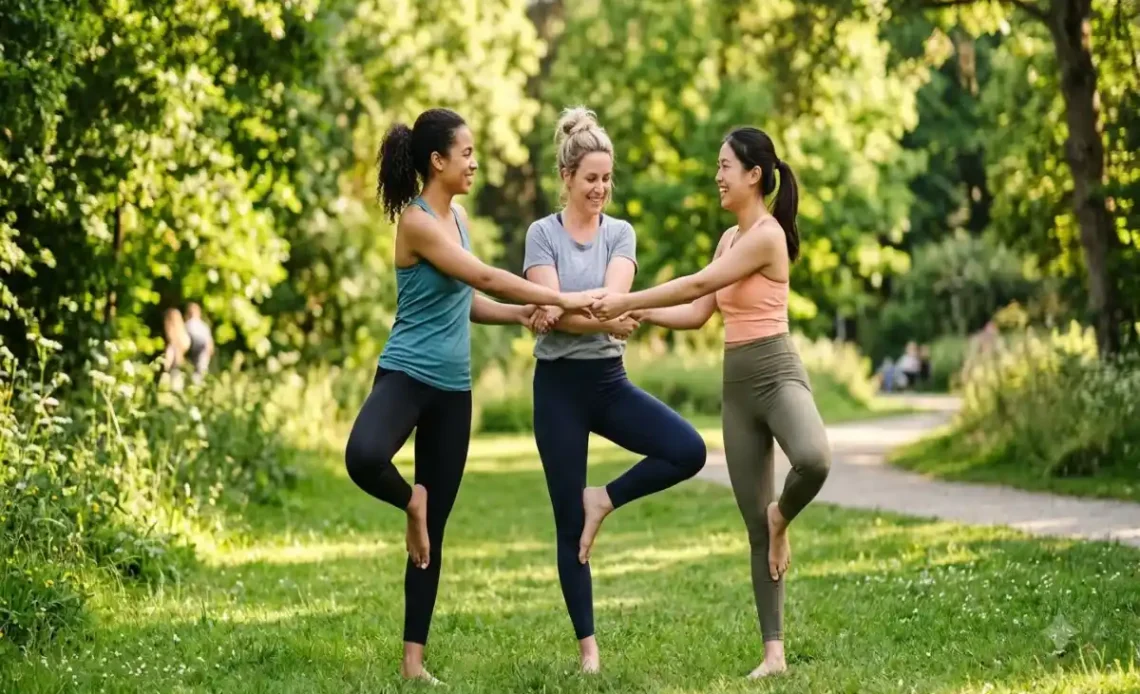
4. Three-Way Tree Pose (Vrikshasana Trio)
Balance becomes easier when you have two other people to lean on lightly.
How to do it
Stand in a tight triangle or short line facing inward. Shift weight onto the outer leg (the one farther from the center). Place the sole of the inner foot on the calf or inner thigh of the standing leg—never directly on the knee. Lightly hold hands or rest a hand on a neighbor’s shoulder or waist. Gaze at a shared point or soft focus. Breathe steadily for 5–8 breaths, then switch sides.
Benefits
Strengthens legs and ankles, improves focus, builds confidence through mutual support.
Modifications
Keep the toes of the lifted foot on the floor like a kickstand. Stand closer together. Use a wall behind the group if needed.
Tip
Talk the whole time. “I’m shifting weight now” prevents surprises.
5. Seated Circle Twist
Gentle spinal mobility with built-in resistance from the group.
How to do it
Sit cross-legged in a triangle, backs roughly facing the center or slightly angled. Sit tall. On an inhale lengthen the spine. On an exhale twist to the right, placing the right hand on the left knee of the person next to you (or on your own knee if reach is limited). The left hand can rest behind you for support. Hold 4–5 breaths, then switch sides.
Benefits
Increases spinal mobility, eases upper-back tension, teaches cooperative resistance.
Modifications
Sit on a blanket. Keep the twist very small. Hold your own knee instead of a partner’s if contact feels uncomfortable.
6. Modified Triple Downward Dog (Beginner Version)
This is the gateway to more connected shapes without stacking full weight.
How to do it (safe beginner version)
Person A comes into a regular Downward-Facing Dog (hands and feet on the floor, hips high, knees soft if needed). Person B places hands on the floor a short distance in front or beside A and comes into their own Down Dog, optionally resting one foot lightly on A’s lower back or calf for light contact only. Person C stays as a spotter, watching alignment and ready to support, or mirrors the shape beside the others without adding weight. Everyone keeps knees soft and cores gently engaged. Hold 5 breaths, then rest in Child’s Pose.
Benefits
Stretches the back of the body, strengthens shoulders and arms, introduces weight-sharing ideas safely.
Important safety note
Do not place full body weight on another person’s lower back. Keep contact light or skip the foot placement entirely for true beginners. Always communicate pressure levels.
7. Group Breath Circle (or Back-to-Back Breathing Variation)
More of a connection practice than a stretch, but powerful for beginners.
How to do it
Sit cross-legged in a tight circle so knees almost touch. Place one hand on your own belly and the other lightly on a neighbor’s upper back or shoulder. Close the eyes or soften the gaze. Breathe slowly together for 1–2 minutes, noticing the rise and fall. Or sit back-to-back in pairs with the third person joining by placing a hand on one of the backs.
Benefits
Synchronizes breathing, lowers stress, builds quiet awareness of the group.
Comparison Table: Beginner Trio Poses at a Glance
| Pose | Main Focus | Difficulty (1–5) | Best For | Key Modification |
| Group Mountain | Posture & breath | 1 | Starting any session | Soften knees, link elbows |
| Triple Child’s Pose Circle | Relaxation & hips | 1 | Cool-down or reset | Blanket under knees |
| Seated Forward Fold | Hamstrings & trust | 2 | Flexibility practice | Bend knees, use strap |
| Three-Way Tree | Balance & legs | 2–3 | Confidence building | Toes on floor, use wall |
| Seated Circle Twist | Spine mobility | 2 | Desk workers & tension | Small range, sit on blanket |
| Modified Triple Down Dog | Shoulders & back body | 2–3 | Strength introduction | Light contact only, spotter |
| Group Breath Circle | Connection & calm | 1 | Any time, any ability | Eyes open if preferred |
Building a Simple 20–25 Minute Trio Practice
- Warm-up (8–10 min) as described earlier.
- Group Mountain – 1 minute.
- Seated Forward Fold – 1–2 minutes total (both sides if doing side variations).
- Three-Way Tree – 1 minute each side.
- Seated Circle Twist – 1 minute each side.
- Modified Triple Down Dog or Triple Child’s Pose – 1–2 minutes.
- Group Breath Circle or Triple Child’s Pose for final rest – 2–3 minutes.
Rest between poses. Drink water. Talk about what felt good or wobbly. The conversation is part of the practice.
Common Challenges and Practical Fixes
- Different flexibility levels – Always work to the tightest person’s range. Use props (blankets, blocks, straps) freely.
- Uneven strength – Keep most poses grounded. Save any stacking for later when everyone feels solid.
- Laughing and falling – Normal and useful. It releases tension. Just get up slowly and try again.
- Shyness about touch – Start with poses that use only hand holds or no contact at all. Consent is ongoing—check in every time.
- Space limits – Many of these poses work in a living room. Push furniture aside and use shorter stances.
Progressing Without Rushing
After a few sessions of the poses above, you can add light variations: longer holds, slower transitions, or one person gently assisting another’s stretch while the third spots. Avoid advanced acro or full weight-bearing pyramids until the group has solid communication, strength, and trust. Many people stay happily at the beginner level for months because the connection itself is rewarding.
Frequently Asked Questions
Are easy yoga poses for 3 people safe for complete beginners?
Yes, when you stick to grounded shapes, warm up, and communicate. The poses listed here keep risk low.
How often should we practice?
Two or three times a week is plenty for most groups. Even once a week builds the habit and the friendship.
Do we need the same fitness level?
No. Modifications make the practice inclusive. The least flexible or strongest person simply adjusts the depth or role.
Can kids join?
Many of these shapes work well with children when kept playful and short. Adult supervision and lighter holds are important.
What if someone has an injury?
Choose only seated or fully supported poses and skip anything that loads the injured area. When in doubt, ask a doctor or experienced teacher.
Is special clothing required?
Comfortable clothes that let you move and that won’t slip are enough. Bare feet or non-slip socks help with balance.
Final Thoughts
Easy yoga poses for 3 beginners turn a regular stretch session into shared time that strengthens bodies and relationships at the same time. You don’t need perfection. You need three people willing to breathe together, talk honestly, and support each other. Start with Mountain Pose and Child’s Pose Circle. Add the seated fold and the tree when you feel ready. Keep the rules simple: warm up, communicate, never force, and exit slowly.
Over weeks you’ll notice better balance, easier conversations, and a quiet sense that the three of you can count on each other—on the mat and off it. That is the real gift of beginner partner yoga for three.
Grab two people you trust, clear a little floor space, and try the first pose today. The rest will follow naturally.