
 Sameena Fatima
Health & Wellness Content Writer
in
Sameena Fatima writes reader-focused
health and wellness content for
HealthBloomWeb, covering fitness,
nutrition, healthy lifestyle and
everyday wellness topics.
Sameena Fatima
Health & Wellness Content Writer
in
Sameena Fatima writes reader-focused
health and wellness content for
HealthBloomWeb, covering fitness,
nutrition, healthy lifestyle and
everyday wellness topics.
 Mirza Ibrahim Ali Khan
Editorial & Content Reviewer
in
Mirza Ibrahim Ali Khan contributes to
HealthBloomWeb's editorial review process,
with a focus on content structure,
readability, search intent and overall
editorial quality.
Mirza Ibrahim Ali Khan
Editorial & Content Reviewer
in
Mirza Ibrahim Ali Khan contributes to
HealthBloomWeb's editorial review process,
with a focus on content structure,
readability, search intent and overall
editorial quality.
 Reyansh Sethi
Medical Reviewer
in
Reyansh Sethi contributes to the medical
review process at HealthBloomWeb, focusing
on clarity, responsible health context and
reader-friendly presentation of health
information.
Reyansh Sethi
Medical Reviewer
in
Reyansh Sethi contributes to the medical
review process at HealthBloomWeb, focusing
on clarity, responsible health context and
reader-friendly presentation of health
information.
Three-person yoga is more fun than solo practice and more connected than most partner work. It is also easier to get wrong if you skip the basics. 3 person yoga safety, warm up for acro yoga, group yoga safety tips, acro yoga spotting, beginner yoga warm up, and how to practise trio yoga safely all come down to the same things: clear communication, proper preparation, and knowing when to stop.
This guide focuses only on safety and warm-ups. It pulls together the practical rules that apply whether you are doing simple grounded shapes, standing balance work, light acro, family poses, or friend sessions. The language stays plain so anyone can follow it.
Why Safety Matters More with Three People
With one person the only body you control is your own. With three people, every movement affects the others. A small slip, a locked knee, or a moment of poor communication can turn a fun shape into a strain or a fall. Most problems are preventable. They happen when groups skip the warm-up, rush the entry, forget to assign a spotter, or ignore someone saying they feel unstable.
Good safety habits do not make the practice less fun. They make it sustainable. Groups that follow them keep practising for months instead of quitting after one awkward session.
Core Safety Rules for Any Trio Practice
These rules apply to every level and every style.
- Warm up for at least 8–12 minutes before any shared shapes. Cold joints and tight muscles increase the chance of strain.
- Talk before every new pose. Agree on simple words: “Ready,” “Going in,” “Hold,” “Coming down,” “Stop.”
- Never force a stretch or a lift. The least flexible or least confident person sets the depth and the pace.
- Keep weight shared and supported. Avoid pressure on the neck or lower back.
- Use non-slip mats or a soft, even surface. Clear the area of obstacles.
- Assign a spotter for any pose that involves elevation, stacking, or single-leg balance with contact. For beginners the spotter is not optional.
- Exit every pose slowly. Most wobbles and falls happen on the way out.
- Stop immediately at sharp pain, dizziness, or loss of control. Discomfort from a stretch is different from pain that signals danger.
- Rotate roles so no one stays in the hardest position the whole time.
- If anyone is pregnant, recovering from injury, has uncontrolled high blood pressure, or feels unwell, choose only grounded, low-risk shapes or skip the session.
These habits turn potential risk into manageable teamwork.
The Role of the Spotter
In any shape that leaves the ground or involves shared weight, one person should act as spotter.
What the spotter does
- Stands close to the person most likely to lose balance (usually the flyer or the person in the middle).
- Keeps hands ready near the hips, shoulders, or torso without touching unless needed.
- Watches alignment and gives calm verbal cues.
- Helps lower someone safely if the shape becomes unstable.
- Never looks away or gets distracted.
What the spotter does not do
- Push or pull people into deeper positions.
- Take their eyes off the group.
- Assume everything is fine because it looked steady for a few seconds.
For true beginners, keep a dedicated spotter until the group can perform the shape cleanly many times in a row. Even experienced groups benefit from a spotter when trying something new.
Essential Warm-Up for Three-Person Yoga (10–12 Minutes)
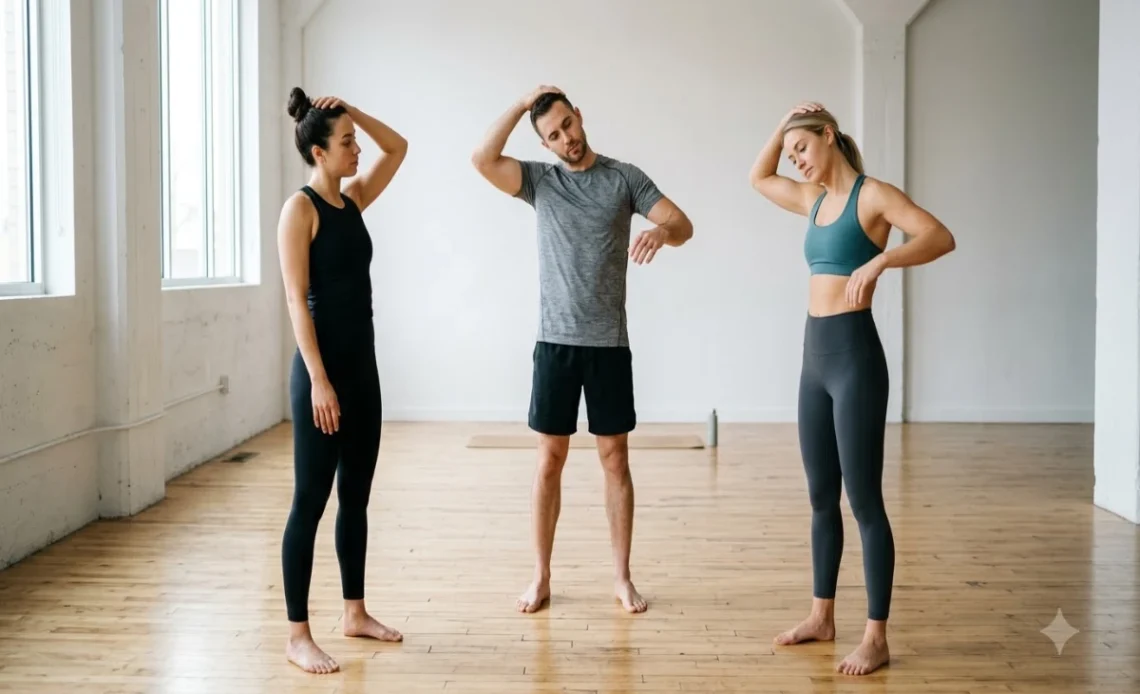
A good warm-up prepares the wrists, shoulders, spine, hips, ankles, and core—the areas most used in trio work. Do it together so the group starts breathing and moving in roughly the same rhythm.
- Standing Breath and Reach (1–2 min)
Stand in a loose triangle. Inhale and reach both arms up. Exhale and lower. Soften the knees. 6–8 rounds. Add gentle side leans if it feels good. - Shoulder and Arm Circles (1 min)
Circle the shoulders back, then forward. Reach the arms out and make bigger circles. Keep the movement slow and even. - Cat-Cow on All Fours (1–2 min)
Move the spine together: inhale drop the belly and look up, exhale round the back. 8–10 rounds. This wakes up the spine and teaches the group to move at a shared pace. - Wrist and Ankle Preparation (1–2 min)
On all fours, gently rock forward and back to warm the wrists. Sit and circle the ankles in both directions. Point and flex the feet. - Gentle Hip Openers and Hamstring Warm-Up (2 min)
From standing or seated, take soft forward folds with bent knees. Add gentle lunges or a low squat if the group feels ready. Keep everything light. - Core Activation (1–2 min)
Lie on the back and do a few slow knee-to-chest pulls or gentle dead-bug style movements. Or stay seated and take a few slow twists. The goal is light engagement, not fatigue. - Final Standing Check-In (1 min)
Return to Mountain Pose. Soften the knees, feel the feet, and take three shared breaths. Confirm that everyone feels ready.
This sequence works for grounded poses, balance work, light acro, and family sessions. For pure acro practice, spend a little extra time on wrists and shoulders.
Warm-Up Adjustments for Different Trio Styles
| Style of Practice | Extra Focus Areas | Suggested Addition |
| Easy grounded poses | Spine, hips, breath | Longer Cat-Cow and seated twists |
| Standing balance | Ankles, core, single-leg feel | Extra ankle circles and weight shifts |
| Light acro / flying | Wrists, shoulders, core | More wrist rocks and plank holds |
| Kids / family | Playful movement, short holds | Animal sounds, star jumps, games |
| Friends / social | Shared rhythm, communication | Linked arm reaches and group breath |
Common Risks and How to Reduce Them
Falls from balance or light elevation
Cause: Rushing the entry, locked knees, or no spotter.
Fix: Move slower, soften the standing leg, keep a dedicated spotter, and use a clear “down” signal.
Wrist or shoulder strain
Cause: Cold joints or poor alignment in weight-bearing shapes.
Fix: Thorough wrist and shoulder warm-up. Stack bones rather than relying only on muscle.
Lower-back discomfort
Cause: Collapsing the spine or placing weight incorrectly.
Fix: Keep the core gently engaged, avoid pressure on the lumbar area, and exit slowly.
Over-stretching
Cause: One person pulling another past their range.
Fix: The least flexible person always sets the limit. Use verbal check-ins.
Communication breakdown
Cause: Assuming everyone knows the plan.
Fix: Talk before every movement. Confirm readiness out loud.
Quick Safety Checklist Before You Start
- Space is clear and the surface is non-slip.
- Everyone has agreed on the words they will use.
- Warm-up is complete.
- Roles (including spotter) are clear for the first pose.
- No one is practising through sharp pain or dizziness.
- Mats or padding are in place if any elevation is planned.
- The group knows it is okay to stop at any moment.
Run through this list out loud the first few times. It becomes automatic quickly.
How to Practise Trio Yoga Safely Over Time
Start with fully grounded shapes and short holds. Add balance work only when the group can communicate smoothly. Introduce any elevation or stacking only after the basics feel solid and a spotter is always present. Keep sessions shorter rather than longer at the beginning. Quality of attention matters more than the number of poses.
Rotate who leads the warm-up and who acts as spotter. This builds shared responsibility and prevents one person from carrying the mental load.
If the group ever feels rushed, tired, or distracted, drop back to the simplest seated or standing shapes. The connection is more important than the difficulty level.
Final Thoughts
Safety and warm-ups are not the exciting part of three-person yoga, but they are what make the exciting parts possible. A few minutes of shared preparation and a handful of clear habits prevent most problems and let the group stay playful and confident.
Warm up thoroughly. Talk constantly. Spot when needed. Exit slowly. Respect every person’s limits. These practices turn three-person yoga from a risky experiment into a reliable way to move, connect, and support each other.
Use the warm-up sequence above before every session. Keep the safety checklist visible until it becomes second nature. When the foundation is steady, the rest of the practice—whether simple, balanced, playful, or lightly elevated—becomes much more enjoyable for everyone involved.