
 Sameena Fatima
Health & Wellness Content Writer
in
Sameena Fatima writes reader-focused
health and wellness content for
HealthBloomWeb, covering fitness,
nutrition, healthy lifestyle and
everyday wellness topics.
Sameena Fatima
Health & Wellness Content Writer
in
Sameena Fatima writes reader-focused
health and wellness content for
HealthBloomWeb, covering fitness,
nutrition, healthy lifestyle and
everyday wellness topics.
 Mirza Ibrahim Ali Khan
Editorial & Content Reviewer
in
Mirza Ibrahim Ali Khan contributes to
HealthBloomWeb's editorial review process,
with a focus on content structure,
readability, search intent and overall
editorial quality.
Mirza Ibrahim Ali Khan
Editorial & Content Reviewer
in
Mirza Ibrahim Ali Khan contributes to
HealthBloomWeb's editorial review process,
with a focus on content structure,
readability, search intent and overall
editorial quality.
 Reyansh Sethi
Medical Reviewer
in
Reyansh Sethi contributes to the medical
review process at HealthBloomWeb, focusing
on clarity, responsible health context and
reader-friendly presentation of health
information.
Reyansh Sethi
Medical Reviewer
in
Reyansh Sethi contributes to the medical
review process at HealthBloomWeb, focusing
on clarity, responsible health context and
reader-friendly presentation of health
information.
Core & Abs Training: Why It Matters More
The popularity of Core & Ab Training is likely to surge again in 2026 due to increasing awareness of what “a strong core actually involves”. Your core is not only a means of maintaining a tight midsection. Strong core muscles maintain correct posture, contribute to stability and balance, decrease back pain, enhance athletic performance, and stabilize virtually all body movements.
Whatever you goal – be it a leaner waistline, more toned abs, a stronger core, better posture, or improved performance in sports and activities – the correct core training program can help you achieve your desired outcomes long-term and in a safe and effective manner. Gone are the days of fad ab exercises that create short-lived gains. Today’s leading fitness professionals emphasize the need for core strengthening based on evidence-based, functional exercises designed to increase muscular endurance and reduce body fat.
This Article is a part of Weight loss
The Difference between “Core” and “Abs” For starters
Many people new to training assume the terms “core” and “abs” are identical.
Abs Muscles
Your abdominal muscles include:
- Rectus abdominis (“six-pack” muscles)
- Obliques
- Transverse abdominis muscles
These muscles mainly help with bending. They also help with twisting. They help to keep my torso stable.
Core Muscles
Your core includes:
- Abs
- Lower back muscles
- Pelvic floor
- Glutes
- Diaphragm
- Hip flexors
A strong core improves total-body movement and injury prevention.
Benefits of Core & Abs Training
- Better Posture
Strong core muscles help maintain spinal alignment and also reduce slouching.
- Reduced Lower Back Pain
The fitness professionals in 2026 now prioritize core stability exercises for back pain prevention.
- Improved Athletic Performance
Athletes use core training for:
- Faster sprinting
- Better jumping
- Stronger lifting
- Increased balance
- Enhanced Fat Burning
While abs workouts alone won’t melt belly fat, they increase muscle activation and improve workout efficiency.
For belly fat reduction – there are ways to speed up the process through dedicated cardio exercises and strength-training methods. Look through our thorough list of effective ab fat loss exercises
- Functional Everyday Strength
Simple daily activities like lifting groceries or climbing stairs become easier.
Best Core Strengthening Exercises for Beginners
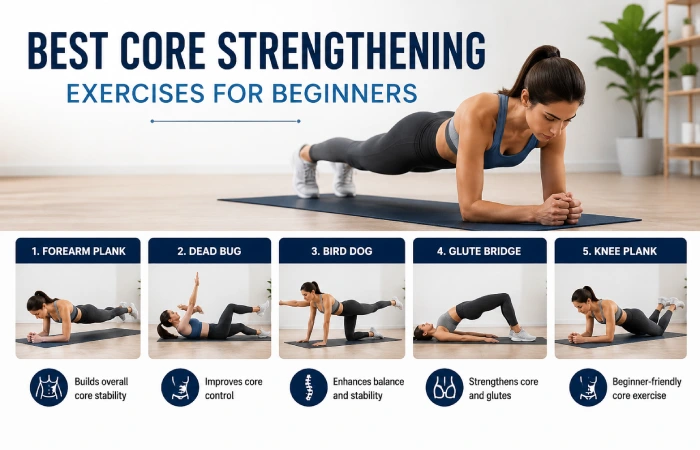
- Plank Exercises for Flat Stomach
Planks remain one of the best isometric exercises for total core activation.
How to Perform a Basic Plank
- Place forearms on the floor
- Keep elbows under shoulders
- Engage your abs
- Keep your body straight
- Hold for 20–60 seconds
Benefits
- Strengthens deep core muscles
- Improves posture
- Reduces spinal strain
Popular Plank Variations
| Exercise | Difficulty | Main Target |
| Forearm Plank | Beginner | Full core |
| Side Plank | Intermediate | Obliques |
| Plank Shoulder Taps | Intermediate | Stability |
| Plank Walkouts | Advanced | Core + shoulders |
Best Abs Workout at Home
The best abs workout, at home can be done with little equipment, which is one of the reasons why people like it so much.
Beginner Home Abs Circuit
| Exercise | Reps |
| Crunches | 15 |
| Leg Raises | 12 |
| Mountain Climbers | 20 |
| Plank | 30 seconds |
| Bicycle Crunches | 20 |
Repeat the circuit 3 times.
Why Home Abs Workouts Work
- Convenient
- No gym membership required
- Easy consistency
- Ideal for busy schedules
Crunch Variations for Core Strength
Crunches are effective when performed correctly and combined with other core exercises.
Standard Crunch
Targets upper abs.
Bicycle Crunch
Activates obliques and improves rotational strength.
Reverse Crunch
Focuses on lower abdominal activation.
Stability Ball Crunch
Improves muscle engagement and range of motion.
Crunch Comparison Table
| Crunch Type | Muscle Focus | Best For |
| Standard Crunch | Upper abs | Beginners |
| Reverse Crunch | Lower abs | Belly tightening |
| Bicycle Crunch | Obliques | Core rotation |
| Stability Ball Crunch | Full abs | Advanced training |
Lower Abs Workout Guide
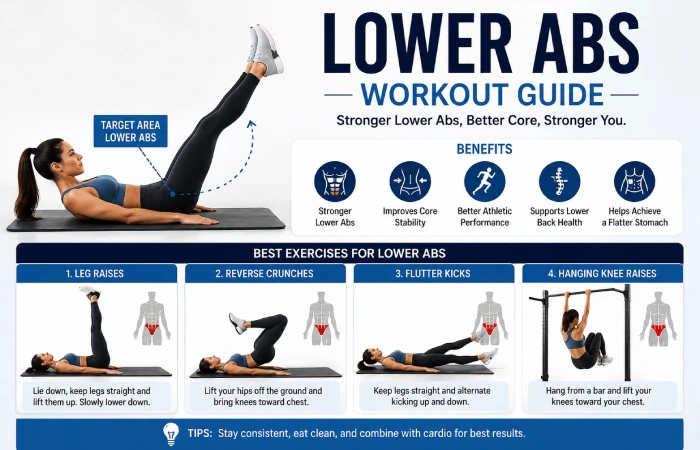
Lower abs are often the hardest area to strengthen because body fat naturally accumulates in the lower stomach region.
Best Lower Abs Exercises
Leg Raises
Excellent for lower abdominal activation.
Flutter Kicks
Improves endurance and hip stability.
Hanging Knee Raises
Advanced movement for deeper lower core engagement.
Dead Bug Exercise
Great for beginners and rehabilitation.
2026 Fitness Trend Data: Most Popular Core Exercises
| Exercise | Popularity Growth (2026) |
| Planks | +38% |
| Pilates Core Training | +44% |
| Standing Core Workouts | +31% |
| Resistance Band Abs Training | +27% |
| Functional Core Circuits | +41% |
Why These Trends Matter
Modern fitness programs now focus on sustainable movement instead of endless sit-ups.
Weekly Core & Abs Training Plan
Beginner Routine
| Day | Workout |
| Monday | Basic core workout |
| Tuesday | Light cardio |
| Wednesday | Plank-focused session |
| Thursday | Rest |
| Friday | Lower abs workout |
| Saturday | Full body + core |
| Sunday | Stretching & mobility |
Common Core Training Mistakes
- Training Abs Every Day
Muscles need recovery time.
- Ignoring Nutrition
Visible abs depend heavily on body fat percentage.
- Poor Form
Bad technique can strain the neck and lower back.
- Only Doing Crunches
Having a routine is really important because it delivers better results.
Nutrition Tips for Abs
We should eat more protein because protein is very good for our body and it supports muscle recovery and fat loss.
We must stay hydrated because hydration is very important and it improves our exercise performance.
We should reduce the amount of processed sugar we eat because excess sugar is not good for our body and it contributes to belly fat problems and storage.
We must prioritize sleep because poor sleep is not good, for our body and it increases hormones that are linked to weight gain.
Best Fitness Equipment for Core & Abs Training
| Equipment | Benefits | Best For |
| Yoga Mat | Comfort | Home workouts |
| Resistance Bands | Added resistance | Strength training |
| Stability Ball | Better muscle activation | Advanced core work |
| Ab Roller | Intense activation | Experienced users |
| Adjustable Dumbbells | Weighted core exercises | Progressive overload |
Women looking for beginner-friendly fitness routines can benefit from customized workout plans designed for different fitness levels. Explore our complete resource on women’s fitness and home workouts to support your health and body-shaping goals.
The best approach combines:
Regular hours of training, Appropriate nourishment, Progressive overload, Recovery
Weighted Matrix: The weighted matrix consisted of all eight factors that were rated from one to five. The weights were one-weakest, three-average, five-strongest. The eight factors with explanations are as follows
What are the costs and benefits of using the new exercise selection?
The costs of using the smart exercise selection are; The benefits of using the smart exercise selection are;
Starting a plank with beginner level exercises or more advanced lower abs exercises are a very effective way to strengthen your core. A stronger core enhances almost every feature of your fitness and wellness, as well as your life.
Begin with manageable goals, persevere, and concentrate on the big picture: building habits that will last an eternity.
Realistic Timeline for Seeing Results
| Goal | Average Timeline |
| Improved posture | 2–4 weeks |
| Stronger core | 4–6 weeks |
| Visible abs | 8–16 weeks |
| Reduced belly fat | Depends on diet + consistency |
Consistency matters more than intensity.
Frequently Asked Questions
What is the recommended frequency for core & abs training?
The majority of beginners should train the core 3–4 times a week.
Do abs workouts and burn belly fat?
While ab exercises will help you build muscles, it takes good nutrition and cardio to help you burn fat.
Are planks superior to crunches?
Both are beneficial. Planks develop stability while crunches focus on abdominal contraction.
What are the top beginner core exercises?
In addition to pushups, forearm planks and dead bugs are another set of beginner exercises.
What is the appropriate duration of a core workout?
15–30 min is sufficient for most people.
Final Thoughts
Core & Abs Training has since moved away from simply being about aesthetics. In 2026, personal trainers focus on functional strength, posture correction, injury avoidance and health maintenance.