
 Sameena Fatima
Health & Wellness Content Writer
in
Sameena Fatima writes reader-focused
health and wellness content for
HealthBloomWeb, covering fitness,
nutrition, healthy lifestyle and
everyday wellness topics.
Sameena Fatima
Health & Wellness Content Writer
in
Sameena Fatima writes reader-focused
health and wellness content for
HealthBloomWeb, covering fitness,
nutrition, healthy lifestyle and
everyday wellness topics.
 Mirza Ibrahim Ali Khan
Editorial & Content Reviewer
in
Mirza Ibrahim Ali Khan contributes to
HealthBloomWeb's editorial review process,
with a focus on content structure,
readability, search intent and overall
editorial quality.
Mirza Ibrahim Ali Khan
Editorial & Content Reviewer
in
Mirza Ibrahim Ali Khan contributes to
HealthBloomWeb's editorial review process,
with a focus on content structure,
readability, search intent and overall
editorial quality.
 Reyansh Sethi
Medical Reviewer
in
Reyansh Sethi contributes to the medical
review process at HealthBloomWeb, focusing
on clarity, responsible health context and
reader-friendly presentation of health
information.
Reyansh Sethi
Medical Reviewer
in
Reyansh Sethi contributes to the medical
review process at HealthBloomWeb, focusing
on clarity, responsible health context and
reader-friendly presentation of health
information.
Introduction
Stressed? Work. Family. Studies. Notifications on your phone.
In this fast-paced world, nearly all of us know the unpleasant feeling of being stressed, worried and overwhelmed.
This Article is the Part of Mindfulness
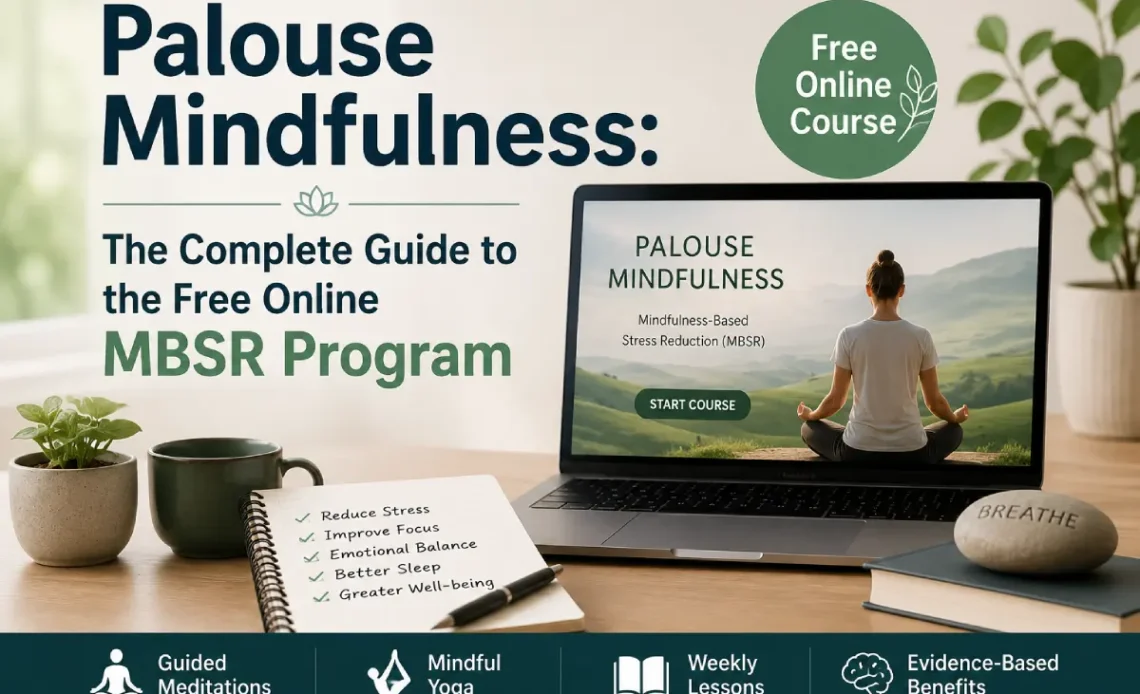
If you found this post after Google searching for “Palouse Mindfulness,” you are probably like us. You are tired of feeling the weight of the world on your shoulders and you’re looking for a free yet powerful way to practice mindfulness, better focus your attention and change bad habits into good habits-all without having to spend for a course. In truth, if you are reading this you are either trying the free, highly-esteemed online Palouse Mindfulness MBSR course, or you want to be aware what that “Paloouse Mindfulness MBSR” entails…Well. You’ve definitely stumbled upon a well-regarded free mindfulness program, because that is precisely what this site is all about.
Palouse Mindfulness offers the world’s first and finest of their kinds totally free, publicly-available online program in Mindfulness-Based Stress Reduction.
Palouse Mindfulness is designed so any individual who can have the attention-span to learn. If an individual want’s to try to train mindfulness without committing a thousand dollar course at their local university or in their hometown, this will work simply perfect for them; one particular will find this course useful for learning and applying Mindfulness for life – anything that this training can show people, that it’s a lot more powerful than any thing available on meditation iphone app programs today. Palouse Mindfulness not only covers meditation – but the neuroscience of why mindfulness actually works, mindful yoga and even offers useful strategies you can use throughout your daily life from managing your anxiety on the job to growing to better emotional resilience!
What Is Palouse Mindfulness?
The most flexible program, sliding scale Palouse Mindfulness, is free and offers the eight-week mindfulness-based program, MBSR. This treatment approach is specifically focused on a patient who has chronic pain, stress, and emotional challenges and employs meditation and a meditation training.
The structure of the course, however, is not like the ones used by relaxation or meditation apps, since it is following an eight-week MBSR class structure that takes one from brief mindfullness practices to longer classes that delve into the ideas of mindfulness through gentle movement, guided meditation, handouts and learning time.
Key Features at a Glance
| Feature | Details |
| Cost | Free |
| Learning Format | Self-paced online |
| Course Foundation | Mindfulness-Based Stress Reduction (MBSR) |
| Experience Level | Beginner to intermediate |
| Guided Meditations | Yes |
| Mindful Yoga | Yes |
| Weekly Lessons | Yes |
| Reflection Exercises | Yes |
| Flexible Schedule | Yes |
This combination of structured learning and flexibility makes the program appealing to people who want a deeper understanding of mindfulness than most mobile apps provide.
Why Is Palouse Mindfulness So Popular?
The mindfulness course structure is not like those used by relaxation or meditation apps, however, as it adheres to an eight-week MBSR class structure that guides learners from simple mindfulness exercises to longer sessions on the concepts presented through mindful movement, guided meditation, written practices, and educational lessons.
The Top 5 Reasons Palouse Mindfulness Has Become So Trendy With So Many Mindfulness Options Available Out there I noticed lots of mindfulness classes ask for quite a lot of money and require you to attend class sessions. Palouse Mindfulness removes barriers by offering in depth information at no course cost. This also includes its popularity.
Advantages:
1. On your schedule & Any Location
2. Grounded in An internationally Proven Framework of Mindfulness.
3. It’s not even essential to sit with the knowledge of Meditation.
4. It will accommodate an on the go professional and students schedules.
5. Combining Education And daily practice.
The emphasis isn’t to be able to practice perfect now but to practice with commitment so over time. And this seems to support lots of evidence that demonstrates the health benefits from Mindfulness will not show up for about 4 weeks (rather than after only few meditation practices). History of Palouse Mindfulness Before diving into the Palouse Mindfulness Mindfulness course material, you’ll need to know a little about the background and core principals of MBSR.
History and Background of the Program
The origin of MBSR The Mindfulness Based Stress Reduction (MBSR) curriculum was first developed in 1979 by researcher molecular biologist, Jon Kabat-Zinn at the University of Massachusetts Medical center, for the treatment of patients with chronic disease and stress. Kabat-Zinn’s aim was to devise a program that was a practical approach to apply mindful practice to people suffering from illness or stress with systematically train they would need to practice Mindfulness Mediation practice to relieve it.
Over the coming years, MBSR has developed into the most studied mindfulness-based intervention across the globe. Universites, hospitals and health systems around the country implemented the course as more and more research provided a greater understanding of MBSR’s capacity to improve mental health, increase stress management skills, and foster the overall quality of life.
The Palouse Mindfulness Online program was developed to provide wider access to this curriculum. Rather than relying on group classroom trainings, it provides the same benefits and teachings through self-paced, structured lessons, video instruction, and practice audio recordings, all delivered through the internet. Although the mode of delivery is unique to the traditional practice based classroom experience, the philosophy for education has the same grounding as it strives to provide the individual with tools to increase awareness of mind, emotions, and present day awareness.
Understanding Mindfulness-Based Stress Reduction (MBSR)
Learning about MBSR The MBSR is a mind body educational program on the development of mindfulness. It provides learners with ways of turning attention to your thought emotions and physical experience in an inquisitive, andnon-Judgmental fashion, thus facilitating one’s ability to responding rather than reacting to everyday stressors. How can the practice help?
Traditional MBSR programs generally follow an eight-week curriculum that combines:
- Guided meditation
- Body scan practice
- Mindful yoga
- Group discussions
- Daily home practice
- Reflection exercises
Palouse Mindfulness adapts these principles into a flexible online format, allowing learners to progress independently while maintaining the structured sequence of lessons.
Traditional MBSR vs. Palouse Mindfulness
| Feature | Traditional MBSR | Palouse Mindfulness |
| Cost | Usually paid | Free |
| Learning Format | Classroom-based | Online |
| Schedule | Fixed weekly sessions | Self-paced |
| Instructor Interaction | Live instructor | Independent learning |
| Daily Practice | Yes | Yes |
| Guided Meditation | Yes | Yes |
| Mindful Yoga | Yes | Yes |
| Global Accessibility | Limited | Worldwide |
For many learners, the self-paced format offers greater flexibility without sacrificing the structured progression that makes MBSR effective.
How to Get Started with Mindfulness
One of the most important points about mindfulness practice is that mindfulness will help to not necessarily do away with distress, difficult emotions and having a more positive outlook or outlook on life… mindfulness can help one to become more aware of experiences such that one can be more intentional and more clearly understand the cause of one’s suffering… some research and practice suggests that, through
Regular Practice:
- mindfulness might help with.
- Improved emotional awareness.
- better concentration.
- less perceived stress.
- better coping with stress during the hardest times.
- less volatile reactions to daily aggravations.
- increase your awareness of joy.
As stated in a prior topic, mindfulness as I described is an attempt at understanding. Mindfulness as I also describe is that it will takes on some time with practice to see true gains in most. Just like playing music or learning any other new skill it is likely to take consistent work.
How the Palouse Mindfulness Program Works
The Palouse Mindfulness program has such a solid foundation to it; in many respects this online, free, guided meditation training is unlike other programs on the market. Most meditation and mindfulness apps available for our devices ask you to participate in individual, one-off sessions on an everyday basis. The Palouse Mindfulness curriculum is quite the contrary in its learning objectives and has a solid structure that closely models that of the MBSR (Mindfulness-Based Stress Reduction) curriculum taught over a traditional 8-week period.
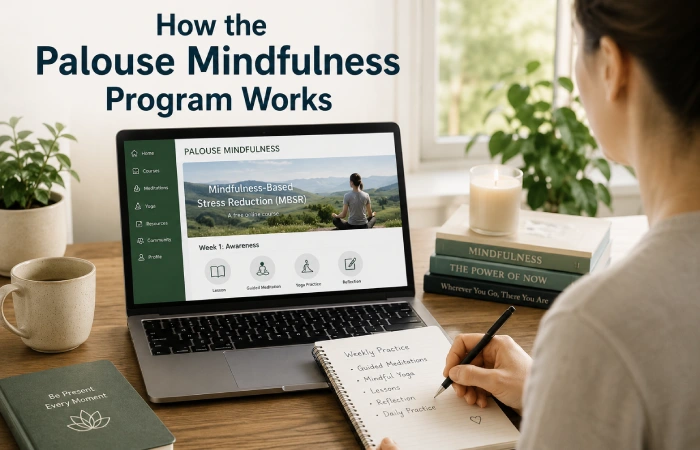
Rather than making you meditate every day from the start, you learn mindfulness practices in an easy to digest manner with education, guided sessions, and self-study.
Each new lesson builds upon the content previously provided. This allows new practitioners from going too far too fast.
Course Structure at a Glance
| Feature | Details |
| Course Format | Self-paced online |
| Duration | Approximately 8 weeks (recommended) |
| Daily Practice | 20–45 minutes |
| Guided Audio Meditations | Included |
| Mindful Yoga | Included |
| Educational Videos | Included |
| Weekly Reading | Included |
| Reflection Exercises | Included |
| Progress Tracking | Self-managed |
Unlike instructor-led classes, there are no strict deadlines. Learners can move faster or slower depending on their schedule, making the course accessible to working professionals, students, parents, and retirees.
What You Will learn Each Week
The programme is similar to the way that conventional MBSR does and teaches us new skills in order. There is no point in teaching everything at once and so you learn through practicing new awareness week by week:
Each week – Main Subject,
- Core Practice, Primary Goal; Week 1,
- Awareness & Autopilot, Body Scan meditation, becoming aware of the present-moment; Week 2,
- Perception & Attention, Sitting Meditation, developing sustained attention; Week 3,
- Mindful Movement, Gentle Yoga, connecting with the body; Week 4,
- Responding to stress, Breath Awareness meditation, identifying stress-reducing awareness; Week 5,
- Acceptance, Open Awareness Meditation, developing emotional resiliency; Week 6,
- Communication, Mindful Listening, enhancing relationships; Week 7,
- Integrating Mindfulness, Informal Daily Practice, bringing new awareness into everyday situations; Week 8,
Maintaining Practice, Personal Practice Plan, setting up for long term habits. This pattern of program allows the participants to be in the ‘normal’ pattern of development and leads on to, the application of the skill in daily life.
Daily Practice
Daily life Practice Day One to Five The good news is that meditation training sessions aren’t like going on some sort of self-retreat for two weeks.
Each day will ideally look something like this:
- A thirty minute, coached meditations 3x each day for this first five days,
- one shorter mindful breathing practice
- A day when one just breathes with no intervention (even if for two minutes),
- another day of conscious breathing as we are already doing now (where we notice the Breath and have some kind of intention).
Guided Meditation Practices Included
A major strength of Palouse Mindfulness is its variety of meditation techniques. Each practice develops different aspects of awareness and complements the others.
1. Body Scan Meditation
The Body Scan is often the first formal meditation introduced.
During this practice, attention moves slowly through different areas of the body while observing physical sensations without trying to change them.
Benefits
- Greater body awareness
- Early recognition of tension
- Improved relaxation
- Better connection between mind and body
Beginner Tip
Don’t worry if your mind wanders. Simply notice it and gently return your attention to the body.
2. Sitting Meditation
This classic mindfulness practice focuses on observing:
- Breathing
- Thoughts
- Emotions
- Sounds
- Physical sensations
Instead of trying to stop thinking, participants learn to notice thoughts without immediately reacting to them.
Many beginners discover that meditation isn’t about “emptying the mind” but about changing their relationship with thoughts.
3. Mindful Breathing
Breathing serves as a reliable anchor for attention.
Whenever distractions arise, gently returning awareness to the breath helps stabilize focus.
Even practicing mindful breathing for five minutes during a stressful day can help interrupt automatic reactions.
4. Walking Meditation
Mindfulness doesn’t require sitting still.
Walking meditation teaches awareness through slow, deliberate movement by paying attention to:
- Footsteps
- Balance
- Muscle movement
- Breathing
- Surrounding sounds
This practice is especially helpful for people who find seated meditation difficult.
5. Mindful Yoga
Mindful yoga differs from fitness-focused yoga classes.
The emphasis is not flexibility or athletic performance but paying close attention to bodily sensations while moving gently.
Participants learn to:
- Respect physical limits
- Move with awareness
- Notice tension
- Coordinate breathing with movement
Because movements can often be adapted, mindful yoga is accessible to people with varying fitness levels. Anyone with injuries or medical conditions should follow appropriate guidance from a qualified healthcare professional.
6. Informal Mindfulness
Formal meditation sessions are only one part of mindfulness training.
Palouse Mindfulness encourages bringing awareness into ordinary daily activities such as:
- Eating meals
- Washing dishes
- Drinking coffee
- Walking to work
- Waiting in line
- Having conversations
These everyday moments become opportunities to practice paying attention with curiosity rather than rushing through routines on autopilot.
Estimated Weekly Time Commitment
Many prospective learners ask whether they can realistically complete the course while managing work or family responsibilities.
The table below provides a general guideline.
| Activity | Approximate Time |
| Guided Meditation | 20–30 minutes daily |
| Reading & Videos | 60–90 minutes weekly |
| Reflection Exercises | 15–20 minutes weekly |
| Mindful Yoga | 20–40 minutes several times weekly |
| Informal Mindfulness | Throughout the day |
Even when life becomes busy, shorter sessions are often more beneficial than abandoning practice altogether.
Building a Sustainable Practice
One of the biggest reasons people stop meditating isn’t lack of interest—it’s unrealistic expectations.
Instead of aiming for perfect consistency, try building habits gradually.
Helpful Strategies
Practice at the same time each day.
Choose a quiet, comfortable location.
Turn off phone notifications.
Begin with shorter sessions if necessary.
Keep a mindfulness journal.
Celebrate consistency rather than duration.
These simple habits often make mindfulness easier to maintain over the long term.
Common Mistakes While Beginning
Almost everybody faces struggle for the initial few weeks!
Fortunately, those events happen for all! Most Popular Meditation Problems
| Mistake | Why It Happens | Better Approach |
| Try “cleaning the thoughts” | The assumption that the primary purpose of the 12th, 13th step for meditation is just to get your head to blank out : | Watch the thoughts without the desire to chase them away: You shouldn’t fight anything. |
| Wanting immediate effects | A premature hope | Treat mindfulness just as an activity you have to perform regularly instead of just on the bad days. |
| Skipped the tough classes | Anger | Be mindful again without harsh words you call to yourself. |
| Trying to “keep up” with others | You automatically do that | We progress in a different way – all your progression is individual. |
| You meditate just when you’re stressed | Wanting to save your feelings for when things get too bad | Do meditation routinely, not in response |
Recognizing these patterns early helps prevent unnecessary discouragement.
Realistic Expectations: When Do Results Come Around?
I have observed Mindfulness to be so deeply individual and that no specific timeframe exists;However, for quite a few, there was reported ‘slow and steady growth.’ Ultimately What’s important is… Please note that the above is purely an Educational diagram that illustrates the learning-curve; an expression for how we learn…It’s not A ‘HOW TO SUCCEED’ prescription!
Practical tips for gaining the most with Palouse Mindfulness:
- Designate an ‘attentive place for your practice.’ Example: The pillow tucked in the corner of your sofa.
- Commit to your chosen time daily
- Be willing to adopt a ‘ beginner mind,’ a state of curiosity.
- Practice reading week 1 prior to meditating week 1.
- Upon reflection of you personal experience, describe without analyzing and/or judging
- Recognize that your practice will flow easily on some days and more challenging on others.
Remember that mindfulness essentially entails… time and time again, turning the attention toward “here” and “now”.
The Benefits of Mindfulness Practice-What the Science Has to Say
Many of our students sign up for Palouse Mindfulness in large part because of the accumulating science. The role of E. MBSR has been rigorously examined in hospitals, workplaces, universities and community settings for the last 40 years. The science is exciting!
But it’s also crucial to understand what mindfulness is and isn’t all about.
The science shows us that consistent mindfulness practice may result in reduced perception of stress, better regulation of our emotions and attention, and general good well being. But mindfulness does not treat health conditions and should not be used to replace evidence based, clinical interventions.
Effects on body and brain: How Mindfulness Affects
The science behind why mindfulness is such a helpful practice: What’s the point of mindfulness? “Mindfulness is the idea that we are present with our experience – our thoughts, emotions, and our body – accepting that what is arising internally and externally right now,” explain the authors. This one act of paying conscious, accepting attention with curiosity to what arises right now-it may seem mundane, but can provide truly radical psychological (and some say, biological) shifts and improvements in multiple arenas once it’s practiced regularly.
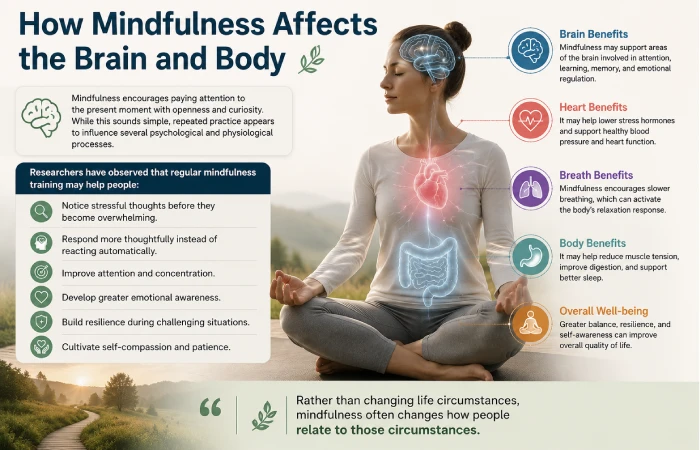
They believe that through mindfulness training, people learn to:
- Notice thoughts and images when they are still small and likely not yet the basis of a fully developed stress response
- respond to difficult, upsetting, and irritating events in a more skillful and less reactive way
- focus on tasks better, more accurately notice feelings when they arise
- Better tolerate stress. They go on to observe that mindfulness, ultimately
However, for the typical person who does mindfulness practice, the impact is likely to be in terms of changing their relationship to life rather than changing life itself.
Evidence-Based Benefits at a Glance
| Potential Benefit | Strong Strength of Research Evidence | Typical Timeframe Reported in Studies |
| Reduced perceived stress | Strong | 6–8 weeks |
| Improved emotional regulation | Strong | 6–8 weeks |
| Better attention and focus | Moderate to Strong | 4–8 weeks |
| Improved sleep quality | Moderate | Several weeks |
| Reduced anxiety symptoms | Moderate | Varies by individual |
| Increased self-awareness | Strong | Progressive with regular practice |
| Improved resilience | Moderate | Ongoing practice |
Evidence strength reflects the overall consistency of findings from systematic reviews and randomized studies, not guaranteed outcomes for every individual.
Mindfulness and Stress Management
Everyone experiences stressful situations throughout life, but this can have a negative effect on your emotional and physical well being if it becomes persistent.
Mindfulness can benefit you by allowing you to be more aware of early signals of stress, instead of getting into automated reaction. Let’s say you receive some upsetting news.
For example, imagine receiving a difficult email at work.
An automatic reaction might include:
- Racing thoughts
- Increased muscle tension
- Irritability
- Immediate emotional responses
A mindful reaction would entail pausing, observing this automatic tendency, taking a few deep breaths, then selecting a measured response, instead of an instinctive one.
The pause becomes more automated and easier with practice.
Ways in Which You Can Incorporate Mindfulness in your Life
Many participants report using mindfulness during:
- Busy workdays
- Family conflicts
- Academic pressure
- Long commutes
- Financial stress
- Public speaking
- Important meetings
Rather than eliminating stress, mindfulness often helps reduce the feeling of being overwhelmed by it.
Mindfulness and Anxiety
A commonly asked question about mindfulness is whether or not mindfulness can “cure anxiety”. For most people, it is not a straightforward “yes”. Research has shown that mindfulness-based programs (that help to focus on what you’re experiencing in the present moment) can be effective in lessening anxiety symptoms for some, particularly with regular and regular practice, and if necessary, alongside professional therapy.
Rather than automatically accepting thoughts as fact Mindfulness encourages us to pay attention to anxious thoughts but without immediately accepting them as real.
Instead of “ Something bad is going to happen” we pay attention to “I am noticing that my thoughts are anxious in this moment”. Mindfulness helps prevent people from becoming completely enveloped in their anxious thoughts but this technique of observation is not suitable for those in extreme anxiety or suffering from mental illness.
Emotional Regulation
One significant outcome of our mindfulness programs is training in emotional regulation. For us, an emotionally regulated person is not someone who does not feel or is not upset; rather, he or she is someone with the ability to put space between the emotional experience and one’s behavior in the form of a wise choice.
So, for instance: Without Mindfulness
Event Immediately I feel…..
I will automatically…..
By the time my emotions are out of control I’m having the next emotional explosion (again!) MindfulnessEvent Awareness I notice, “Hmmm… there’s that feeling of…” pause I consider: What do I really value?
What are my long-term goals?
How would I like to respond in a way that is consistent with these intentions?
Response (conscious, values-aligned choice)
Better Sleep Through Mindfulness
Difficulty sleeping is often linked to racing thoughts and persistent worry.
Mindfulness practices such as body scan meditation and mindful breathing may help some people relax before bedtime.
Many participants develop a calming evening routine that includes:
- Turning off digital devices
- Gentle stretching
- Slow breathing
- Guided meditation
- Gratitude journaling
While mindfulness is not a treatment for insomnia, research suggests it may support healthier sleep habits for some individuals.
Improved Focus and Concentration
Modern life is full of distractions.
Emails.
Notifications.
Social media.
Constant multitasking.
Mindfulness trains attention by repeatedly bringing focus back to the present moment.
This repeated practice may strengthen the ability to notice distractions and return attention to the task at hand.
Students, professionals, and creative workers often report improvements in:
- Sustained attention
- Task completion
- Listening skills
- Reading comprehension
- Decision-making
Mindfulness and Physical Well-Being
Mindfulness and Physical Well-Being
Although most literature on mindfulness relates to mental health, there has also been research into Mindfulness and physical health.
Some studies suggest mindfulness programs may help support:
Healthy stress responses
Chronic pain management
Blood pressure control (within the context of a general lifestyle management package)
Coping with illness
Healthier daily habits
Remember that mindfulness by itself does not replace medical treatment. It has the added benefit of working along side other good health practices such as exercise, good nutrition and sleep.
Comparing Before and After a Mindfulness Practice
| Daily situation | Habitual Automatic Reaction | Mindful Response |
| Lots of work at hand | Feel overwhelmed Identify | priority and focus on that |
| Traffic delays | Frustration | Notice breathing and surroundings |
| Family disagreement | Defensive reaction | Pause and listen carefully |
| Negative feedback | Feel like a victim in life of criticism | Reflect before responding |
| Busy schedule | Overwhelmed at an upcoming engagement | Choose one thing you care to get done next |
What Meditations Align to What Goals ?
| Meditation Technique | Primary Purpose | Helpful For |
| Body Scan | To promote bodily awareness | For when experiencing high levels of stress and muscle tension. |
| Sitting Meditation | focus on the mind | To assist in developing concentration or to help you control attention or to manage emotions. |
| Mindful Breathing | To promote awareness of the present moment | For the stresses and distractions of daily life. |
| Walking Meditation | awareness of the present moment | For restlessness. |
| Loving-Kindness Meditation | compassion to oneself and others | For improving interpersonal skills and a sense of well being. |
| Mindful Yoga | mind and body awareness | For flexibility and easing muscle tension. |
Why Consistency Matters More Than Duration
A common misconception is that longer meditation sessions automatically produce better results.
In reality, consistency often matters more than session length.
For many beginners:
- 10–20 minutes practiced regularly can be more sustainable than occasional hour-long sessions.
- Daily repetition helps build familiarity with mindfulness skills.
- Small improvements accumulate over time.
The goal isn’t to meditate perfectly—it’s to return to the practice consistently.
Myth vs. Reality
| Myth | Reality |
| Meditation stops all thoughts. | Thoughts continue; mindfulness changes how you relate to them. |
| You must sit cross-legged. | Any comfortable, stable posture can work. |
| Results appear immediately. | Benefits typically develop gradually with regular practice. |
| Being mindful means feeling present at all times | It involves observing with open attention each and every one of your sensations. |
| Missing even one day kills your progress. | The journey includes getting back to practicing the practice. “Is Palouse Mindfulness Right for You? “ |
Is Palouse Mindfulness Right for You?
The program may be a good fit if you:
- Want a structured introduction to mindfulness.
- I like learning at my own pace
- Enjoy practicing in addition to listening and reflecting on concepts.
- Want evidence based stress management tools.
- Able to practice what is taught each week for a duration of multiple weeks.
It may be less suitable if you’re looking for a quick solution or expect mindfulness to replace professional medical or psychological care.
Research Snapshot
Snapshot 2026. Although individual study findings differ, meta-analyses published over the last decade still confirm that MBSR and other related mindfulness programs can improve perceived stress and some dimensions of psychological well-being among numerous study participants. But the scientists suggest there is still a role for consistency in practice and patient characteristics to achieve positive outcomes. Until and throughout 2026, it appears mindfulness as an adjunctive, rather than standalone, approach continues to hold the most support for the treatment of many illnesses.