
 Sameena Fatima
Health & Wellness Content Writer
in
Sameena Fatima writes reader-focused
health and wellness content for
HealthBloomWeb, covering fitness,
nutrition, healthy lifestyle and
everyday wellness topics.
Sameena Fatima
Health & Wellness Content Writer
in
Sameena Fatima writes reader-focused
health and wellness content for
HealthBloomWeb, covering fitness,
nutrition, healthy lifestyle and
everyday wellness topics.
 Mirza Ibrahim Ali Khan
Editorial & Content Reviewer
in
Mirza Ibrahim Ali Khan contributes to
HealthBloomWeb's editorial review process,
with a focus on content structure,
readability, search intent and overall
editorial quality.
Mirza Ibrahim Ali Khan
Editorial & Content Reviewer
in
Mirza Ibrahim Ali Khan contributes to
HealthBloomWeb's editorial review process,
with a focus on content structure,
readability, search intent and overall
editorial quality.
 Reyansh Sethi
Medical Reviewer
in
Reyansh Sethi contributes to the medical
review process at HealthBloomWeb, focusing
on clarity, responsible health context and
reader-friendly presentation of health
information.
Reyansh Sethi
Medical Reviewer
in
Reyansh Sethi contributes to the medical
review process at HealthBloomWeb, focusing
on clarity, responsible health context and
reader-friendly presentation of health
information.
Mindfulness-Based Stress Reduction (MBSR)
Nowadays for the majority of individuals, life has grown to be intrinsically synonymous with stress from the workplace to loved ones, to funds and the endless digital sphere around us. But there is actually the very best mindfulness-based stress reduction programme you are going to encounter within a 3-7 days training that has been perfected more than decades of clinical exercise and scientific investigate to guide folks toward reacting more deliberately, reasonably and much more powerfully to the everyday challenges of daily life. This 8 week mindfulness course is just one particular with the very best-investigated strategies to naturally minimize strain, anxiety, constant discomfort as well as stress and anxiety of on a regular basis residing life without having quick repairs.
This Article is the Part of Mindfulness
MBSR not merely brings all the well being positive aspects of mindfulness instruction to folks, but it’s just as relevant whether you might be brand-new to mindfulness teaching, or are already engaged in a course and would like to embrace a whole new way to enhancing the entire top quality of daily life using scientific analysis proven approaches for handling stress.
Mindfulness-Based Stress Reduction (MBSR)
What Is It The eight week Mindfulness Based Stress Reduction program consists of training on how to focus attention nonjudgmentally on what is currently happening. We don‘t get rid of stress, we learn to respond to it more skillfully through a program called MBSR. As you learn and practice relaxation and mindfulness skills, you‘ll pay attention to preceding thoughts, feelings and physical sensations and to the body sensations that occur just prior to the states of overwhelm. In that moment you will have an opportunity to select how to respond, rather than how to respond low.
These days, MBSR is taught all over the world in hospitals, colleges, health spas, in organizations and in any medical setting. Healthcare professionals often recommend it along with conventional medication for stress-related problems because of its focus on acquiring useful tools which benefit health in the long-term.
Core Principles of MBSR
The program is built around several key ideas:
- Paying attention to the present moment.
- Observing thoughts without judging them.
- Accepting experiences rather than fighting them.
- Be responsive instead of responsive reacting
- Practicing the habit to be aware.
These principles are often cited in numerous new modern stress relief programs and therapies, mindfulness. The Story of the MBSR Mindfulness-Based Stress Reduction
The Story of MBSR Mindfulness-Based Stress
Reduction, developed in 1979 by molecular biologist Jon Kabat-Zinn at the University of Massachusetts Medical Center, was designed with one,
Simple but novel aim: bring mindfulness into contemporary medicine to assist people who suffer from chronic pain, disease and chronic stress.
He designed this program to enhance, not substitute for, medical treatment. Numerous research studies subsequently documented the effects of the MBSR on psychological and physiological health and led to a plethora of articles describing the influence of mindfulness on pain, stress and emotion.
Currently, MBSR is the progenitor for various subsequent evidence-based methods such as mindfulness programmes used in schools, workplace settings and by clinical psychologists.
How is MBSR Different from Standard Meditation?
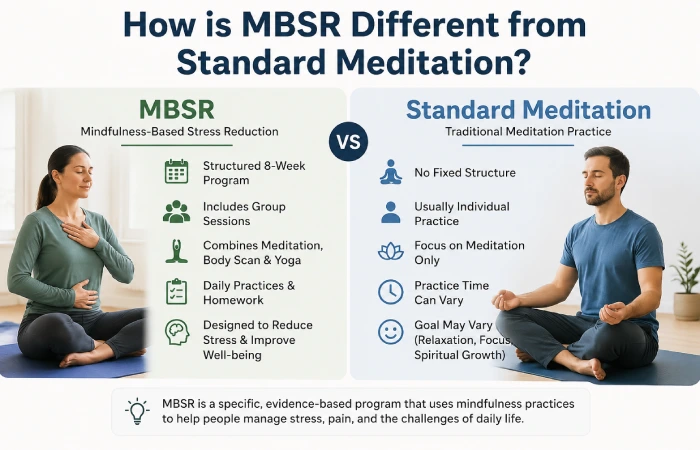
For most newcomers, MBSR can feel like another “meditation class”. It definitely incorporates meditation into its practice, but that only forms a portion of the MBSR experience.
| Feature | Mindfulness-Based Stress Reduction | General Meditation Practice |
| Structure | Guided 8-week curriculum | Open-ended, self-guided |
| Instructor Support | Yes | Optional |
| Scientific Foundation | Extensive clinical research | Depends on practice style |
| Body Scan Practice | Included | Optional |
| Gentle Mindful Movement | Included | Not always |
| Daily Homework | Structured | Usually self-paced |
| Group Learning | Common | Varies |
Since it has such a clear structure, the MBSR program leads you step-by-step so you don’t have to build a mindfulness practice from the ground up. How the 8-Week MBSR Program Helps You Download the free 20-Minute Body Scan Practice below to experience this yourself. You’ll be Guided.
The MBSR Program Structure. How the 8-Week MBSR Program Works
There may be some variation in the schedule depending on the instructor, but the general outline of most programs is:
Week 1: Understanding Mindfulness
Participants are informed about what mindfulness is and the purpose of attention, as well as the role of automaticity in generating stress.
Week 2: Knowledge of the body
All attention then moves to bodily sensation (body scan meditation, noticing breath).
Week 3: Observing thoughts and emotions
When participants become more aware of thoughts they do not necessarily take them for granted.
Week 4: Responding Instead of Reacting
Mindfulness techniques remind us to stop or pause between events that most cause stress and our emotional responses.
Week 5: Managing Stress More Effectively
The participants would practice them learn how to become aware of difficultexperiences and put more effectively, using mindfulness skills.
Week 6: Mindful Communication
The program also exposes to: ways of listening attentively, speaking deliberately, and enhancing relationships.
Week 7: Integrating Mindfulness Into Everyday Life
Now, we look at means of applying mindful awareness in the workplace, family situations, when shopping, eating, taking walks or simply going about one‘s daily life.
Week 8: Maintaining Long-Term Practice
Participants establish their own sustainable personal mindfulness practice as a result of completing the course.
What Happens in an MBSR Session?
Most of the weekly sessions range from two to three hours and include some kind of activity which is led in some way.
A typical session may include:
- Guided mindfulness meditation.
- Body scan meditation
- Gently mindful stretching or yoga.
- Group discussion
- Reflection tasks
- Planning Home practice2
Participants are also advised to practice daily for 30-45 minutes at home. It is more important to practice regularly than to be perfect, even if it is just 15 minutes, and to have mindfulness become a part of daily life.
Core Mindfulness Training Techniques Used in MBSR
Participants practice observing thoughts, emotions, and physical sensations with curiosity instead of judgment. Over time, this can strengthen emotional awareness and improve resilience during stressful situations.
Another reason that, despite having been around for so many years, the MBSR program is still so effective is with its branches of complementary practices.
1. Mindful Breathing
Conscious mindful breathing means really concentrating on every in breath and every out breath. If and when your mind drifts (which it will) you return to your awareness of this breath.
This brief exercise increases the students concentration and helps to stop us getting caught up in stressful thinking.
2. Body Scan Meditation
Body scan is when you direct your attention to various parts of your body in slow motion and you observe the sensation of each body part, without attempting to alter its quality.
Many newcomers only realize they‘ve been tense until they consciously stop and take note of how their bodies are.
3. Mindful Movement
Gentle stretching and yoga may help link awareness with movement and breathing. Movements are not made for their usefulness or for their ability to make us more athletic- rather they are held to notice what is happening.
4. Sitting Meditation
Participants rehearse exercising curious observation rather than judgment of thoughts, feelings and sensations. This practice potentially enhances emotional awareness and builds endurance in stressful contexts, as a result.
Comparison Table: MBSR vs Other Stress Reduction Techniques
Individuals are frequently questioning whether it is the best choice, in comparison to other widespread methods.
| Technique Best For Scientific Evidence Daily Time Needed Beginner Friendly |
| Mindfulness-Based Stress Reduction Long-term stress management Excellent 30–45 minutes Yes |
| Deep Breathing Exercises Immediate relaxation Strong 5–10 minutes Excellent |
| Progressive Muscle Relaxation Physical tension Strong 10–20 minutes Yes |
| Walking Exercise Mood improvement Excellent 20–30 minutes Excellent |
| Journaling Emotional awareness Moderate 10-15min Excellent |
| Yoga Stress and flexibility Strong 20–40 minutes Yes |
Rather than substituting these, MBSR will frequently enhance their practices by increasing long-term awareness and resilience.