
 Sameena Fatima
Health & Wellness Content Writer
in
Sameena Fatima writes reader-focused
health and wellness content for
HealthBloomWeb, covering fitness,
nutrition, healthy lifestyle and
everyday wellness topics.
Sameena Fatima
Health & Wellness Content Writer
in
Sameena Fatima writes reader-focused
health and wellness content for
HealthBloomWeb, covering fitness,
nutrition, healthy lifestyle and
everyday wellness topics.
 Mirza Ibrahim Ali Khan
Editorial & Content Reviewer
in
Mirza Ibrahim Ali Khan contributes to
HealthBloomWeb's editorial review process,
with a focus on content structure,
readability, search intent and overall
editorial quality.
Mirza Ibrahim Ali Khan
Editorial & Content Reviewer
in
Mirza Ibrahim Ali Khan contributes to
HealthBloomWeb's editorial review process,
with a focus on content structure,
readability, search intent and overall
editorial quality.
 Reyansh Sethi
Medical Reviewer
in
Reyansh Sethi contributes to the medical
review process at HealthBloomWeb, focusing
on clarity, responsible health context and
reader-friendly presentation of health
information.
Reyansh Sethi
Medical Reviewer
in
Reyansh Sethi contributes to the medical
review process at HealthBloomWeb, focusing
on clarity, responsible health context and
reader-friendly presentation of health
information.
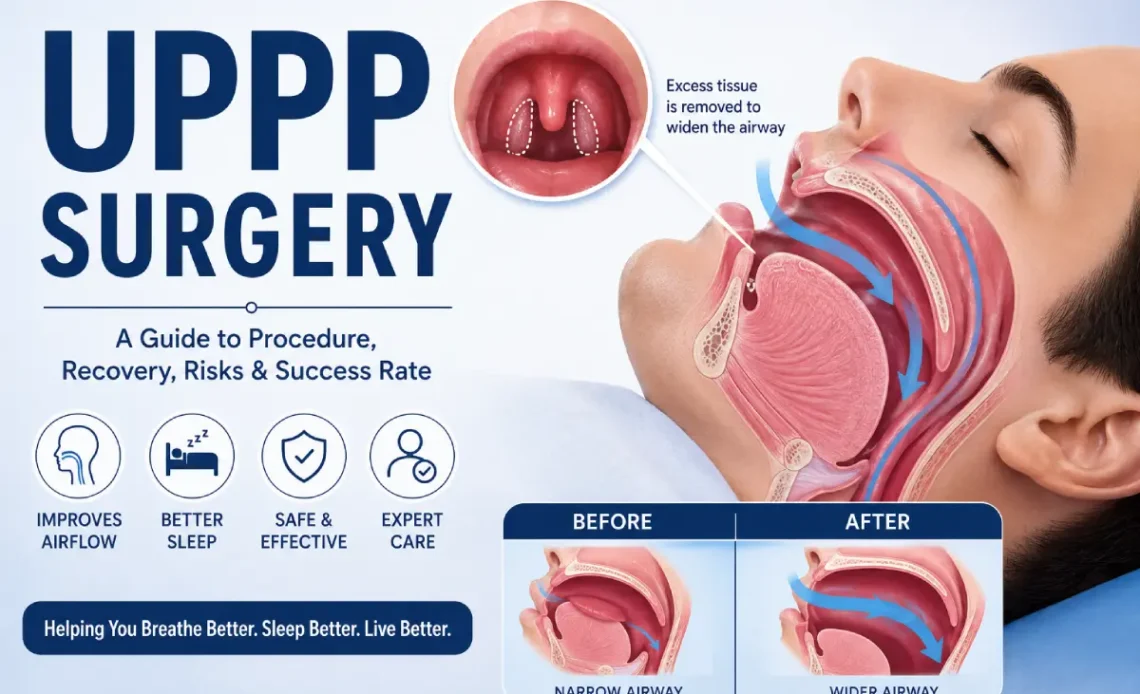
Obstructive Sleep Apnea’s Risks Extended Beyond the Night: Sleep apnea’s toll isn’t only on the night, it impacts your days by causing drowsiness, brain fog, snoring, and over time, can increase your risk of conditions like high blood pressure and heart disease. If the alternative (like CPAP) has either been ineffective or unbearable, UPPP surgery can be considered. What UPPP surgery Is: Also called a uvulopalatopharyngoplasty, UPPP is an airway surgery to cut or contour the back part of the throat to widen the opening and allow air to flow smoothly through your airways while you’re asleep.
This Article is the Part of Sleep Improvement
Although the surgery itself has been around for a long time, it only works in highly selected patients with sleep apnea surgery and isn’t applicable for every patient with OSA.
We will look at what is entailed in UPPP surgery, who makes a good candidate, how long recovery lasts, up-to-date statistics, and how it stacks up against other alternatives.
Medical disclaimer: this article is meant for informational purposes only, not as advice from a qualified ENT or sleep physician.
What Is UPPP Surgery?
UPPP Surgery The Problem Uvulopalatopharyngoplasty (UPPP) is surgery to widen your airway by removing or restructuring tissue in your throat. In some individuals, a loss of tone in the tissue around your airway causes the area to collapse while you sleep. When you can no longer breathe, your brain wakes up to reopen it, which results in pauses in your sleep, and decreases the oxygen in your bloodstream.
UPPP Surgery helps open this blockage by creating more space in your airway.
Removing or adjusting The soft tissue in your throat includes The uvula Part of your soft palate Excessive tissue in the sidewall of your throat (tonsil area) if it is large. CPAP Therapy It has one limitation Unlike CPAP, which is an active intervention and works only when you are wearing the device, UPPP alters the physical anatomy of the airway.
Which Conditions Does the UPPP Procedure Correct?
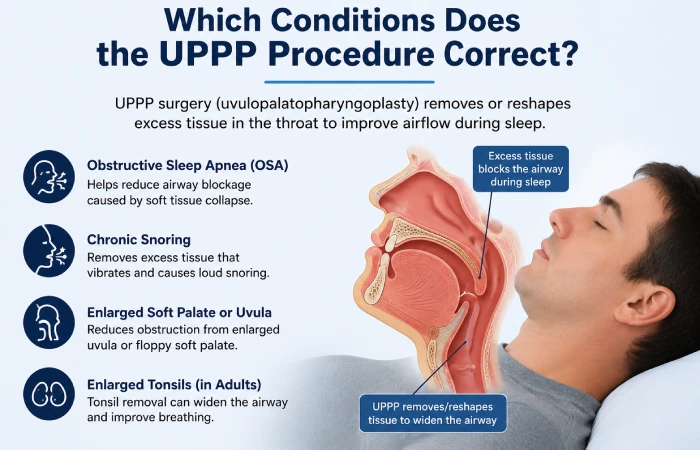
A commonly held misconception is that the UPPP treats snoring but UPPP surgery is actually used for the treatment of the OSA condition (sleep disorder).
Doctors may recommend it for:
- Moderate obstructive sleep apnea
- Severe obstructive sleep apnea
- Loud chronic snoring caused by soft palate obstruction
- Upper airway blockage confirmed during evaluation
- CPAP intolerance
It is not considered a treatment for central sleep apnea.
Who Is a Candidate For Surgery?
It isn’t all sleep apnea patients who benefit from the surgery.
Doctors evaluate several factors before recommending UPPP.
You may be a suitable candidate if you:
- Have confirmed obstructive sleep apnea through a sleep study
- Cannot tolerate CPAP therapy
- Have enlarged soft palate tissues blocking the airway
- Maintain a healthy or moderately elevated BMI
- Are healthy enough for general anesthesia
Patients with obesity-related airway collapse affecting multiple airway levels may require additional procedures rather than UPPP alone.
How Doctors Decide If You Need UPPP
Prior to surgery, specialist generally undertake a series of assessments.
Evaluation Why It Matters
What Sleep Study(Polysomnography) is Used ForTo determine the severity of OSA
Physical Examination Identifies airway obstruction
Flexible Nasal Endoscopy Examines throat anatomy
Drug-Induced Sleep Endoscopy (DISE) determines the site of airway collapse during sleep
Medical History Review Determines surgical suitability
There has been a movement towards the use of drug-induced sleep endoscopy (DISE) in to sleep centers because of its ability to help surgeons choose the appropriate patient for particular procedures.
How Is UPPP Surgery Performed?
Procedures UPPP is performed in the following manner:
UPPP performed typically inpatient, the procedure usually done in hospital, generally performed in general anesthesia, typically lasting from 60-120 minutes.
Although every case differs, the procedure generally follows these steps:
Step 1: General Anesthesia
The patient will be under general anesthesia before beginning the operation so there is no pain and to make the patients comfortable.
Step 2: Accessing the Airway
The surgeon dilates the mouth so that the oropharynx can be seen, with the mouth held open with retractors.
Step 3: Removing Excess Tissue
Depending on the patient‘s anatomy, the surgeon may remove or reshape:
Uvula
Soft palate tissue
Side throat tissue.
Increased tonsillas
To maximize airway patency and to preserve possible normal function.
Step 4: Reconstruction
Rather than removing tissue, extensive reconstruction and repositioning of the remaining tissue is carried out by many surgeons to stabilize the airway and decrease complications.
Step 5: Recovery Room
Patients are observed in the hospital for a number of hours prior to being discharged or admitted overnight for observation.
UPPP Surgery vs Other Sleep Apnea Treatments
UPPP Surgery versus Other Treatment Options for Sleep Apnea When considering treatment for sleep apnea, severity of sleep apnea, your airway’s unique characteristics, your health, and your personal preference are major factors.
| Treatment | Best For | Invasive | Typical Recovery | Long-Term Use |
| UPPP Surgery | Selected patients with soft palate obstruction | Yes | 2–6 weeks | Permanent anatomical change |
| CPAP Therapy | Mild to severe OSA | No | None | Nightly |
| Oral Appliance | Mild to moderate OSA | No | Few days | Nightly |
| Weight Loss | Overweight patients | No | Gradual | Ongoing lifestyle change |
| Inspire Therapy | Selected CPAP-intolerant patients | Minimally invasive | Several weeks | Implanted device |
Potential Benefits of UPPP Surgery
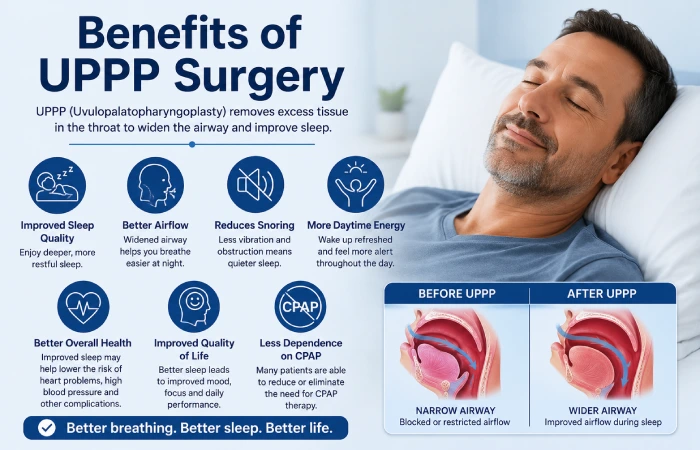
Patients who are carefully selected for UPPP may experience:
- Reduced airway obstruction during sleep
- Less loud snoring
- Improved breathing at night
- Better sleep quality
- Increased daytime energy
- Reduced sleep interruptions
- Improved quality of life
Foods to Eat After UPPP Surgery
After UPPP surgery the way you approach your eating and dining habits can significantly improve how you feel. Consuming particular food products may reduce discomfort as well as help your healing process. Recommended Foods
- Yogurt
- Applesauce
- Mashed potatoes
- Oatmeal
- Smooth soups
- Scrambled eggs
- Protein shakes
- Ice cream (in moderation)
- Smoothies (without seeds)
Foods to Avoid
- Spicy foods
- Hot beverages during the first few days
- Crunchy snacks
- Toast
- Chips
- Citrus juices if they cause irritation
- Alcohol
- Smoking or tobacco products
When you have the proper level of hydration it can really help to recover from an injury faster and more efficient. When your body is properly hydrated the amount of dehydration can be prevented. When you are properly hydrated your throat can also be kept moist.
Risks and Potential Complications
URPP like any other type of airway surgery carries risk. However, the risks associated are very rare so here is a summary in order for the patients to know:
Common Risks
- Temporary sore throat
- Difficulty swallowing
- Swelling
- Minor bleeding
- Voice changes
- Dry throat
- Bad breath during healing
Less Common Complications
- Infection
- Significant bleeding
- Airway narrowing
- Persistent nasal regurgitation when swallowing
- Scar tissue formation
- Continued obstructive sleep apnea despite surgery
Fortunately, with the skilled hand of an ENT surgeon and adherence to post-operative instructions, severe complications are uncommon.
What Is the UPPP Success Rate?
Often, patients will wonder if UPPP surgery really helps. The answer is, as it tends to be with most things in medicine: it depends on a few factors, such as: BMI Your underlying severity of OSA
- Severity of obstructive sleep apnea
- Body Mass Index (BMI)
- Location of airway obstruction
- Tonsil size
- Age
- Whether additional treatments are used
Current evidence suggests that UPPP is most successful in carefully selected patients with obstruction primarily at the soft palate. It is generally less effective when airway collapse occurs at multiple levels of the throat.
Factors That Improve Success
| Factor | Impact on Outcome |
| Healthy body weight | Higher success likelihood |
| Large tonsils | Better surgical results |
| Soft palate obstruction | Better response |
| Mild to moderate OSA | More favorable outcomes |
| Following postoperative care | Supports recovery and long-term results |
While surgery can effectively diminish snoring and promote better breathing, some patients may still need the use of CPAP therapy or other treatments following a recovery.
UPPP Surgery vs CPAP: Which Is Better?
Both treatments aim to improve airflow during sleep, but they work differently.
| Feature | UPPP Surgery | CPAP Therapy |
| Treatment Type | Surgical | Non-surgical |
| Improves Airway | Permanently reshapes tissue | Uses air pressure to keep airway open |
| Sleep Apnea Surgery Recovery | Yes | None |
| Daily Equipment | No | Yes |
| Best For | Selected surgical candidates | Most people with OSA |
| Long-Term Commitment | One procedure | Nightly use |
Cost of UPPP Surgery
The cost of uvulopalatopharyngoplasty varies depending on several factors, including:
- Country and region
- Hospital or surgical center
- Surgeon’s experience
- Insurance coverage
- Additional procedures performed at the same time
However, in the U.S. Cost can average $3,000 to over $10,000, not including insurance. Patients should consult their medical provider as well as their health insurance carrier to get specific estimates based on coverage.
Conclusion
UPPP Surgery for OSA. This surgery can be beneficial for carefully chosen candidates suffering from obstructive sleep apnea or snoring that occurs due to soft palatet issue obstructions. Surgeons remodel the soft tissue structure at the rear of the mouth and throat to help increase the airway opening and decrease the sleep interruptions.
While surgery might be indicated, it’s crucial to get a sleep medicine and an ENT physician evaluation before making any decisions.
Typically, other procedures are combined with lifestyle adjustments for the ultimate success of the treatment for OSA. Let your surgeon explain all the pluses and minuses of any OSA sleep surgery so you can achieve the expected benefits.