

 Sameena Fatima
Health & Wellness Content Writer
in
Sameena Fatima writes reader-focused
health and wellness content for
HealthBloomWeb, covering fitness,
nutrition, healthy lifestyle and
everyday wellness topics.
Sameena Fatima
Health & Wellness Content Writer
in
Sameena Fatima writes reader-focused
health and wellness content for
HealthBloomWeb, covering fitness,
nutrition, healthy lifestyle and
everyday wellness topics.
 Mirza Ibrahim Ali Khan
Editorial & Content Reviewer
in
Mirza Ibrahim Ali Khan contributes to
HealthBloomWeb's editorial review process,
with a focus on content structure,
readability, search intent and overall
editorial quality.
Mirza Ibrahim Ali Khan
Editorial & Content Reviewer
in
Mirza Ibrahim Ali Khan contributes to
HealthBloomWeb's editorial review process,
with a focus on content structure,
readability, search intent and overall
editorial quality.
 Reyansh Sethi
Medical Reviewer
in
Reyansh Sethi contributes to the medical
review process at HealthBloomWeb, focusing
on clarity, responsible health context and
reader-friendly presentation of health
information.
Reyansh Sethi
Medical Reviewer
in
Reyansh Sethi contributes to the medical
review process at HealthBloomWeb, focusing
on clarity, responsible health context and
reader-friendly presentation of health
information.
Your Ultimate guide If there’s one type of supplement that’s always over-marketed, that would be gut health supplements. Advertisements are bursting with millions of probiotics, numerous strains, digestives enzymes, prebiotics, and “advanced” gut formulas to confuse you, but you don’t need the highest CFU number, nor do you necessarily want a ridiculously long ingredient list in the perfect product. It will take your specific intention, reading the label carefully, evaluating the evidence around the ingredients, and buying from quality assurance standards.
This Article is the Part of Health Habits
What are GUT health supplements?
Gut health supplements are any products taken for gut health, such as supplements including probiotics, prebiotics, fiber, digestive enzymes, and/or combinations of the above. Probiotics are defined as live micro-organisms which, when administered in adequate amounts, confer a health benefit on the host. Prebiotics are defined as food ingredients which are selectively utilized by the host micro-organisms and benefit the host. Probiotic + Prebiotic supplements are often defined as Synbiotics.
Not every supplement is appropriate for everybody, let alone every product marketed as being for gut health.
Step back before you shop and determine your goal
First you must understand your specific intention behind getting a supplement. You may be trying to: Have general gut support to improve your gut health Eat more fiber Supporting gut microbes Managing infrequent digestion issues Restoring certain probiotics after stress, and/or, Improving bowel regulation The choice of the appropriate supplement depends upon the goal. Probiotic effectiveness particularly is so specific for the strains and conditions used, that a pill containing dozens of bacterial strains is often not very helpful.
If you’re experiencing ongoing abdominal pain, blood in your stool, unexplained weight loss, sever diarrhea, or any other chronic symptom that’s worrying you, first consult a health care professional rather than choosing an over the counter supplement.
Select the appropriate supplement type
A good starting point will be understanding what a particular type of supplement does, then choose. The supplement type What to search for Probiotics Specific strains and evident proof Prebiotics Ingredients listed and easily understood fiber or prebiotic content Synbiotics For combinations of pro- and pre-biotics, check its evidenced proof Fiber supplements What fiber is included and at what dosage.
The right choice should be based on how appropriate it is with relation to your intent-choosing a supplement only for its flashy packaging will lead you astray.
Digestive enzymes Specific enzymes used for specific uses Choosing your choice category early is critical, preventing you from buying based on appearance or advertisement alone.
3. The probiotic strains to seek
When you go to buy probiotics, just the word “probiotic” will not suffice, and what will tell a good product from a not-so-good one is the bacteria’s genus, species, and strain name written down on the back of the box. Different strains within species can perform and exhibit totally different functions and evidence has generally been obtained on individual strains. The ICMR-DBT Indian probiotics guidelines suggest considering identification, viability, quality control and labeling-therefore providing information about species, genus and strain for probiotics will give you more practical information than any other.
4. Probiotic CFU guide A.
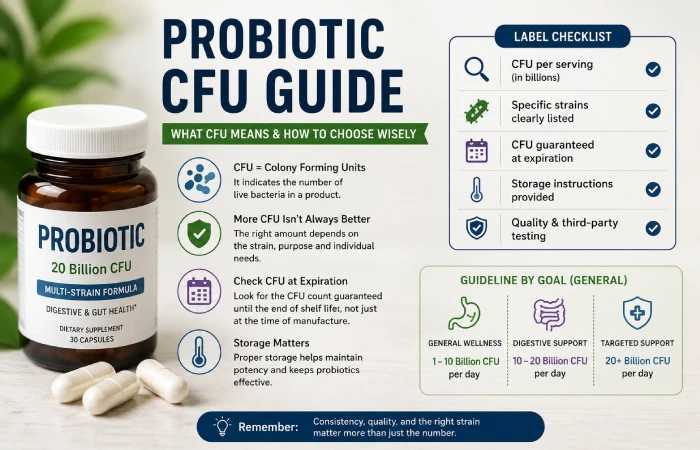
What is CFU and what to look for The CFU, number colony forming units, simply refers to the micro-organisms living within the product. The number one myth around probiotics and their usage is that any more CFUs will be better – it can’t be that far from the truth! Your 100 Billion CFU product does not automatically mean it is more effective than any 10 Billion CFU products; it really depends on the specific strains used, and their particular formulation.
NIH Office of Dietary supplements themselves states “There is no guarantee that products with higher CFU counts, higher numbers of strains, or more diverse ranges of species or strains will be more beneficial than products with more limited contents.” As a general guide when purchasing, it’s wise to take note of the CFU count, but in combination with: CFU per serving CFU count per capsule if different Specific strains accounting for CFU number Appropriate CFU guaranteed through the expiration date The recommended serving size you will be using.
5. Read the entire label
A good supplement label should allow you to answer the following few points:
- What are all the full ingredients?
- How much of each is being used per serving?
- What is the best serving size?
- What are specific strains involved if it is a probiotic?
- What is the quantity of CFUs if it is a probiotic?
- When is its expiration date?
- How should it be stored?
And manufacturer details for queries and information regarding their specific manufacturing and testing standards. Be very careful of proprietary blends where specific ingredient amounts are hidden from you. Just looking at a long ingredient list and concluding it’s an effective supplement may be wrong; more ingredients don’t necessarily mean more effectiveness.
Source from and look into quality supplements and quality testing.
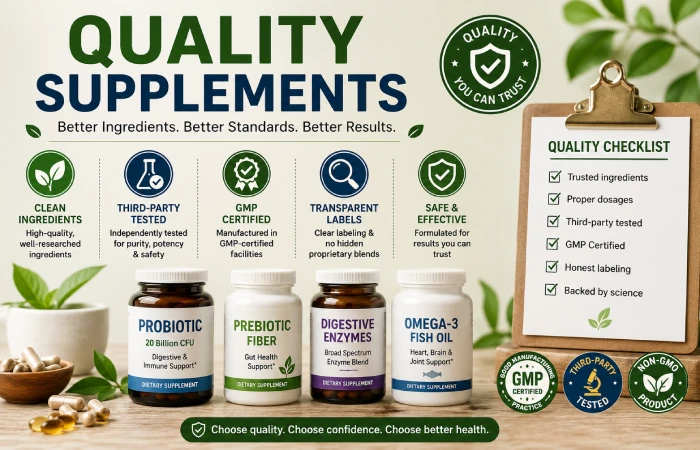
Quality is always paramount regardless of what brand of supplement you choose. You want an independent company that ensures its own quality standards are up to par and has evidence of this via, let’s say, quality control tests, and/or independent testing of the product, perhaps with third party certifiers like USP Verified and NSF for food supplements.
Ensure the company is transparent about these processes, from batch testing to storage standards.
As far as probiotics are concerned, storage standards are very important since some strains will quickly lose viability over time without proper refrigeration.
Don’t assume a higher CFU count will give greater effect.
Assumptions regarding probiotic purchasing which are incorrect: • 100 Billion CFU is always the answer. It isn’t necessarily better than 10 billion.
- More strains will always be better.
Still not necessarily, as we saw. • The highest cost is the highest quality supplement. Sometimes, the most expensive also means the most expensive.
- “Clinically proven” applies to each individual supplement. Again, still no. It needs to apply to the specific strains and purpose your are taking the supplement for.
Cost per serving comparison
It might be important, but let’s look beyond just the price of a bottle, especially where digestive supplements are concerned.
For example, say a bottle of pills from Product A costs 1,200 but contains 30 servings whereas Product B costs 900 but contains only 15 servings. The difference is 40 per serving versus 60 per serving of each supplement. Just because a bottle isn’t as costly doesn’t mean it’s more affordable in the long run.
Gut Health Supplement Buying Checklist
- What is the specific goal you want to have addressed?
- Are you using the correct supplement category?
- Are all the ingredients clearly labeled?
- For a probiotic supplement, are the specific bacterial species listed?
- Is the amount of CFUs clearly stated?
- Is potency guaranteed through the expiration date?
- Are storage conditions mentioned and applicable?
- Have you looked up quality assurance details about the product and manufacturer?
- Does it offer a credible health claim backed by scientific evidence?
- Is the cost per serving reasonable compared to the ingredients?
If you were able to answer all these questions before buying, you’ll have a much better likelihood of actually picking a beneficial product instead of picking a product based on its advertisements alone.
FAQ
Is a higher CFU probiotic better?
Generally no.
A higher CFU doesn’t necessarily translate into a greater health effect.
It highly depends on the specific strain, formulation, and indications. The dose required for any particular probiotic depends on specific strains of bacteria used, and may range quite a bit. It’s not unusual to see suggestions of anywhere from a billion to 100 billion CFU, and this might be because different strains require different amounts to prove they can have an effect.
How do I check the quality of my probiotic?
Check the packaging for specific strain names that identify the bacteria up to strain, amount of viable CFUs, expiry date and storage requirements. It’s also important to choose an ethically sourced brand or a third-party tested product.
Should I get a probiotic with a lot of strains in it?
No, not necessarily. You just need the strains that will have an effect. Again, the same logic applies as in all other cases of a multitude of strains; the choice needs to be specific to what you want to remedy.
Are third party tested supplements better?
A third party tested supplement indicates that the supplement itself and/or its product line may have undergone separate, impartial tests.
This provides a level of assurance regarding what’s on the label. However, no test proves that a certain product will necessarily render the results that it promises.
Final Thoughts Your goal is your starting point.
The category you buy belongs to, the ingredients present, probiotic strain details and CFU count will be critical elements of your investigation of any supplement. Read the full label and buy what is storage-appropriate and has the required expiration date. Lastly, but equally vital; quality control standards and the evidence backed by scientific studies behind whatever products you are buying.
Don’t let the massive number or the high CFU number fool you.