

 Sameena Fatima
Health & Wellness Content Writer
in
Sameena Fatima writes reader-focused
health and wellness content for
HealthBloomWeb, covering fitness,
nutrition, healthy lifestyle and
everyday wellness topics.
Sameena Fatima
Health & Wellness Content Writer
in
Sameena Fatima writes reader-focused
health and wellness content for
HealthBloomWeb, covering fitness,
nutrition, healthy lifestyle and
everyday wellness topics.
 Mirza Ibrahim Ali Khan
Editorial & Content Reviewer
in
Mirza Ibrahim Ali Khan contributes to
HealthBloomWeb's editorial review process,
with a focus on content structure,
readability, search intent and overall
editorial quality.
Mirza Ibrahim Ali Khan
Editorial & Content Reviewer
in
Mirza Ibrahim Ali Khan contributes to
HealthBloomWeb's editorial review process,
with a focus on content structure,
readability, search intent and overall
editorial quality.
 Reyansh Sethi
Medical Reviewer
in
Reyansh Sethi contributes to the medical
review process at HealthBloomWeb, focusing
on clarity, responsible health context and
reader-friendly presentation of health
information.
Reyansh Sethi
Medical Reviewer
in
Reyansh Sethi contributes to the medical
review process at HealthBloomWeb, focusing
on clarity, responsible health context and
reader-friendly presentation of health
information.
Muscular Strength and Muscular Endurance
Muscular strength (MS) and muscular endurance (ME) are two fundamental facets of physical fitness that enhance everyday functioning, athletic performance, and lifelong health. Both are important to your performance whether you’re at the grocery store, on the stairs, or in the gym working out. Knowing how each is different and what type of training is best suited to each will allow you to develop a comprehensive fitness program.
This Article is the Part of Cardio Fitness
Muscular Strength
Muscular strength is the greatest amount of force a muscle or muscle group can generate in a single maximal effort. It is your capacity to lift, push, or pull a very heavy weight.
Health and strength training is mainly aimed at fast twitch muscle fibers which are responsible for contracting rapidly while producing large amounts of high force.
Examples of Muscular Strength
- Deadlifting with a significant weight on the barbell
- Completing a 1RM (one repetition maximum) bench
- Moving furniture
- Elevating a fully packed and carried suitcase
As you create your own programs, you will find that strength training programs aid in developing muscle hypertrophy, high bone density, sturdy joints, and enhanced form.
Healthy Muscular Endurance

Muscular endurance is the ability of a muscle to undergo repeated contractions or maintain an activity for a lengthy time.
However, endurance is not so much lifting the heaviest weight as you can, but rather doing the most weights for the longest time.
Examples of Muscle Endurance
- Handing off multiple push-ups
- Maintaining a plank for a prolonged period of time
- Long time cycling (at least 30 min)
- Based on performance in swimming laps
- Bodyweight Squats for a large number of repetitions
Provides benefits for general activity as well as improving endurance sports.
Muscular Strength vs. Muscular Endurance
| Feature | Muscular Strength | Muscular Endurance |
| Goal | Maximum force | Sustained muscle activity |
| Weight Used | Heavy | Light to moderate |
| Repetitions | 1–6 reps | 12–20+ reps |
| Rest Between Sets | 2–5 minutes | 30–90 seconds |
| Primary Muscle Fibers | Fast-twitch (Type II) | Slow-twitch (Type I) |
| Best For | Power and lifting | Stamina and prolonged activity |
Both have their qualities and can make you more well rounded in terms of your level of fitness.
Benefits of Building Muscular Strength and Muscular Endurance
Training them together has a lot of health and performance benefits.
Benefits of Muscular Strength
- Enhances lean muscle mass
- Aids in maintaining healthy bones
- Enhances posture and equilibrium
- Improves athletic performance
- Simplifies all moving and lifting tasks lifting carrying pushing pulling for you.
- Improves metabolism
Benefits of Muscle Endurance
- Related to muscle fatigue
- Enhances cardiovascular fitness
- Helps you work out for a longer duration
- Improves functional movement
- Decreases the chance of developing overuse injuries
- Enhances general endurance
Together they provide a comprehensive workout which is well rounded and promotes health in the long term.
Best Strength Training and Resistance Exercises
Resistance training involves work against an external resistance. To be considered effective resistance exercise muscles must:
Exercises for Muscular Strength
- Barbell Squats.
- Deadlifts.
- Bench Press.
- Overhead Press.
- Pull-UPS.
- Weighted Lunges.
For strength development:
- Resistance.
- repetitions.
- 3 5 sets.
- Long recovery period.
Exercises for Muscle Endurance
- Push-up
- Bodyweight Squats
- Walking Lunges
- Planks.
- Resistance Band Rows
- Step-Ups.
For endurance training:
Light to moderate resistance is best. If the person with back pain loads the body – head, arms, trunk, specifically the shoulder girdle as seen in the “X” above,– low back pain is more likely to persist.
- Resistance.
- 12–20 repetitions
- 2–4 sets 4 Repeat
- Brief rest periods (with very limited rest interval lengths)
These weight training methods can work on various components of muscular fitness.
Progressive Overload: The Key to Improvement
No matter what your goals are, you‘re going to need some form of progressive overload to keep progressing. This means steadily increasing the stress you put on your muscles as you get stronger.
You can progressively overload your muscles by:
- Adding weight to the box
- Performing extra repetitions.
- Increasing the number of sets used to perform an exercise.
- Reducing movement variability
- Shortening rest time between exercises
- Bumping up the number of practices held in a week to between 10 and 20 times.
- Small, gradual increases in workload
maintain the muscles’ ability to adapt to the new workload without injury
Why Functional Strength Matters
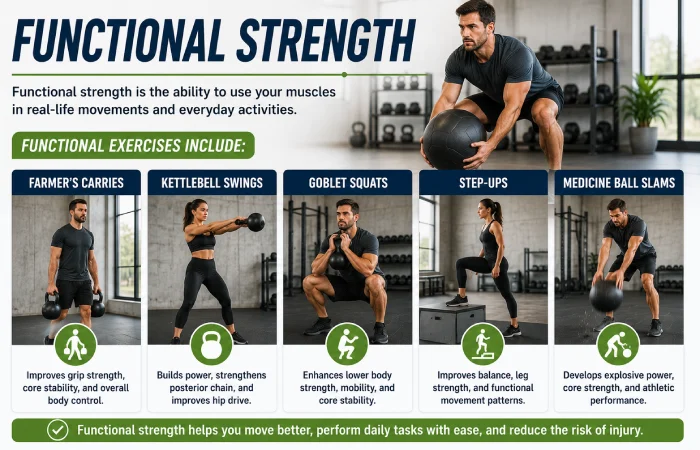
Developing practical strength involves practicing the movements that your muscles will regularly need to do.
Functional exercises include:
- Farmer‘s Carries
- Kettlebell Swings
- Goblet Squats
- Tables to Step-Ups
- Medicine Ball Slams
These types of exercises are great for improving coordination and the stability and mobility of several muscles at the same time.
Muscle Conditioning Tips
Muscle conditioning is achieved through combining strength, endurance, flexibility and maintaining systems in recovery.
For the best results:
- Train 2–4 days a week
- Start each session with a warm up Focus on correct exercise technique Eat enough protein.
- Drink plenty of fluids (water)
- Should sleep for 7–9 hours per night
- Allow yourself to recover in between the hard sessions
The key is consistency, not its vigour. Consistency means doing things regularly.
Can you train both simultaneously?
Yes. It is common for individuals to do both strength and endurance work within the same weekly program.
A balanced weekly plan might include:
- Monday: Heavy strength training (shoulders, back and biceps)
- Wednesday: the endurance circuit of muscles.
- Friday: Exercises with resistances for the whole body
- Weekend: Walks, cycles, and or mobility work
This method excels at increasing general fitness and also at preventing training imbalances.
Common Training Mistakes
Avoid these common errors:
- Skipping warm-ups
- Using deficient form in lifting.
- Training with very heavy weights.
- Only doing workout/training plans while ignoring recovery days.
- Not applying enough progressive overload (perhaps with the wrong exercises).
- Not paying attention to a diet, and not drinking water/having good hydration levels
Over the course of a career, a single correction can improve each of those measures and reduce the risk of injury.
Conclusion
Both muscular strength and muscular endurance play key roles in creating a healthier, stronger body. Increased muscular strength provides the ability to create the greatest possible force for lifts or exercises, while muscle endurance offers the ability to activate that muscle and perform the activity for an extended period. Participate in strength training, resistance exercises, weight training, progressive overload, functional strength, and muscle conditioning to develop a comprehensive program that results in a healthy, more efficient, more balanced body.
If you want to lift heavier weights, improve your stamina or just get overall fit, training muscular strength and muscular endurance will give you long term physical benefits and health benefits.
Frequently Asked Questions
Is muscular power identical to muscular endurance?
No. This would be considered muscular strength as opposed to muscular endurance. Muscular endurance is the ability of a muscle group to perform repeated contractions against a resistance for an extended period of time.
What is the number that uses more calories?
Muscular endurance exercises tend to have a higher caloric burn rate during the program due to a higher repetition range and longer activity duration, in contrast to strength training which creates more muscle.
How many days should I do strength training?
The majority of adults find the need to perform strength work at least 2-3 times a week and provide enough rest time in-between.