
 Sameena Fatima
Health & Wellness Content Writer
in
Sameena Fatima writes reader-focused
health and wellness content for
HealthBloomWeb, covering fitness,
nutrition, healthy lifestyle and
everyday wellness topics.
Sameena Fatima
Health & Wellness Content Writer
in
Sameena Fatima writes reader-focused
health and wellness content for
HealthBloomWeb, covering fitness,
nutrition, healthy lifestyle and
everyday wellness topics.
 Mirza Ibrahim Ali Khan
Editorial & Content Reviewer
in
Mirza Ibrahim Ali Khan contributes to
HealthBloomWeb's editorial review process,
with a focus on content structure,
readability, search intent and overall
editorial quality.
Mirza Ibrahim Ali Khan
Editorial & Content Reviewer
in
Mirza Ibrahim Ali Khan contributes to
HealthBloomWeb's editorial review process,
with a focus on content structure,
readability, search intent and overall
editorial quality.
 Reyansh Sethi
Medical Reviewer
in
Reyansh Sethi contributes to the medical
review process at HealthBloomWeb, focusing
on clarity, responsible health context and
reader-friendly presentation of health
information.
Reyansh Sethi
Medical Reviewer
in
Reyansh Sethi contributes to the medical
review process at HealthBloomWeb, focusing
on clarity, responsible health context and
reader-friendly presentation of health
information.
Obstructive sleep apnea (OSA) impacts millions of adults across the globe. If you have sleep apnea, you might have asked yourself, “Is surgery a permanent cure?” Sleep apnea surgery success rate varies, depending on the type of surgery, your severity of sleep apnea, and your airway anatomy. However, it is important to note that surgery can greatly reduce the number of breathing breaks and improve sleep, but it is not a permanent cure for everyone.
This Article is the Part of Sleep Improvement
Surgery is an option where CPAP cannot be used or specific airway obstructions are present where a more permanent solution is sought. It is important to have knowledge of the benefits and side effects of surgery and success and selection rates before deciding to proceed.
In the following, you will discover how effective various surgeries to treat sleep apnea are, factors that influence their success and how they compare against other treatments.
What Is a Successful Sleep Apnea Surgery?
The first huge misconception is that success equals a complete cure. Success of surgery in clinical studies is seldom described in this way.
Most clinical studies consider surgery successful when it:
- Decreases AHI by at least 50%
- Shortening the snoring episodes, thus decreasing the number of apnea/hypopnea events in a given hour to 20 or less
- Reduces symptoms such as loud snoring, daytime fatigue and poor sleep quality
This indicates that even after surgery the patient can have mild sleep apnea but notice a major decrease in their symptoms and quality of life.
Sleep specialists today also look at other measures including blood oxygen levels, blood pressure improvements, and quality of life reported by patients instead of solely the AHI scores.
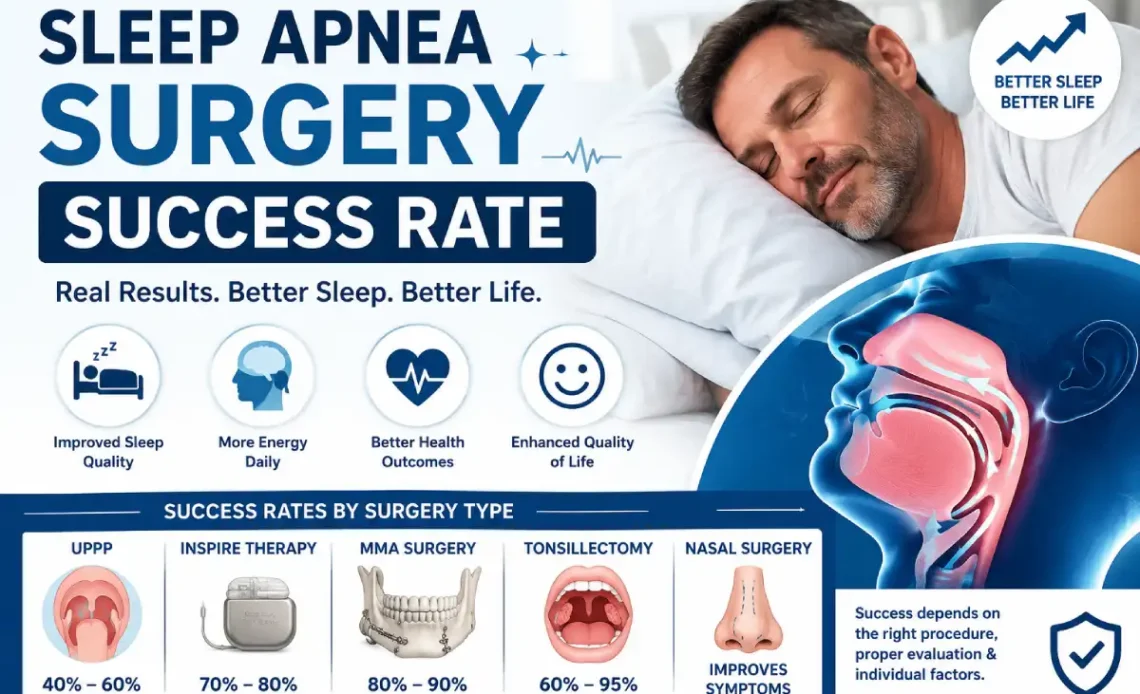
Sleep Apnea Surgery Success Rates by Procedure
Different surgeries work on different parts of the airway and therefore can have widely varying results.
| Surgery Type | Typical Success Rate* | Best For | Recovery Time |
| Uvulopalatopharyngoplasty (UPPP) | 40–60% | Soft palate obstruction | 2–4 weeks |
| Inspire Therapy | 70–80% | Adults who are intolerant to C-PAP and meet eligibility | 2–6 weeks |
| Maxillomandibular Advancement (MMA) | 80–90% | Severe OSA with jaw related airway narrowing | 6–12 weeks |
| Tonsillectomy (selected adults) | 60–95% | Enlarged tonsils leading to obstruction of the airway | 2–3 weeks |
| Nasal Surgery Only | May improve breathing, (rarely cure OSA)- | Nasal obstruction | 1–3 weeks |
Factors that influence the effectiveness of sleep apnea surgery
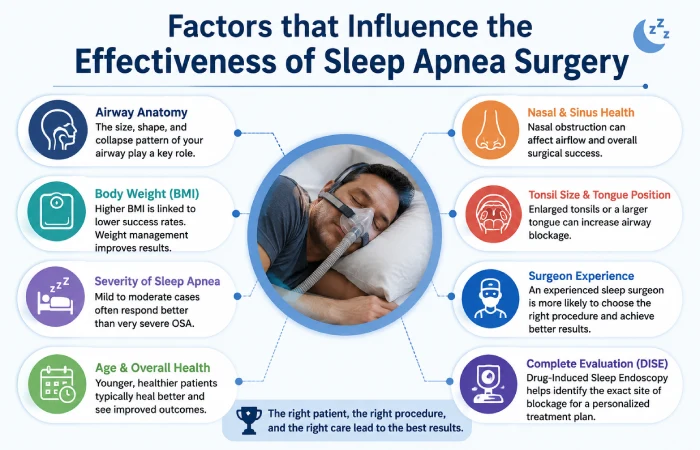
More than simply the choice of surgery itself, there is more to assessing whether or not sleep apnea surgery is going to be successful and one of the best indicators of success is the careful selection of patients.
1. Severity of Sleep Apnea
Generally, better outcomes are obtained in patients with mild to moderate OSA than those with very severe disease, although more aggressive surgeries such as MMA can have high success rates in severe OSA.
2. Body Weight (BMI)
A higher BMI is can result in a lower surgical success rate. This is because of the remaining fatty tissue around the airway that can still cause disruption.
Having maintained a healthy weight before and after surgery may improve long-term outcome.
3. Airway Anatomy
Every person‘s airway is unique. Some patients have:
- big tonsils
- A long soft palate
- A receding lower jaw
- Obstruction of the base of the tongue
- congestion in the nose
Sleep specialists may perform a Drug-Induced Sleep Endoscopy (DISE) to observe where the airway is collapsing prior to recommending surgery. This is a personalized assessment that can help determine what the most suitable technique would be.
4. Age and Overall Health
Less healthy and/or younger patients tend to have better outcomes as they tend to have a faster recovery. Chronic medical conditions, smoking, and poor healing will all impair a positive long-term outcome.
5. Surgeon Experience
Sleep apnea surgery is a technique that requires expertise. It would be most advantageous to have a surgeon experienced in airway procedures.
A good sleep surgeon and a careful preoperative workup are the best way to optimize the chances of success.
Long-Term Outcomes After Sleep Apnea Surgery
Most patients show significant improvement within weeks of surgery, but the proven long term results are equally important. Achieved treatment can result in:
- Decreased snoring
- To sleep better.
- Better on it during the day.
- Improved concentration
- Improved blood oxygen levels while sleeping
- Enhanced quality of life,
- Decreased utilization of CPAP in some patients. Back to the table
This is not to say, however, that at this point in time surgery is a definitive cure. Obesity, the aging process and changing airway anatomy can all contribute to a resumption of sleep apnea symptoms over time. Regular follow-up and repeat sleep studies where indicated can detect this requiring retreatment if necessary.
Would You Be a Good Candidate for Sleep Apnea Surgery.
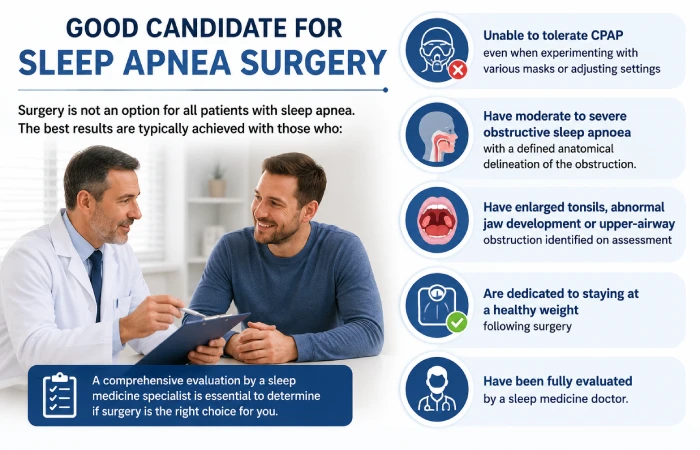
Candidate for sleep apnea surgery is not an option for all patients with sleep apnea. The best results are typically achieved with those who:
- Unable to tolerate CPAP even when experimenting with various masks or adjusting settings
- Have moderate to severe obstructive sleep apnoea with a defined anatomical delineation of the obstruction.
- Have enlarged tonsils, abnormal jaw development or upper-airway obstruction identified on assessment
- Are dedicated to staying at a healthy weight following surgery
- Have been fully evaluated by a sleep medicine doctor.
Additional tests such as a sleep study and Drug-Induced Sleep Endoscopy (DISE) may be suggested by your doctor to decide which operation would be best for you.
Tips to Improve Long-Term Results
- Keep your body at a healthy weight.
- Do not smoke or drink large quantities of alcohol.
- Attend all follow-up appointments.
- Can also be repeated if the symptoms reoccur.
- Follow through with your healthcare provider and make changes in your lifestyle.
However, these procedures may also be used to improve the rate of apnea improvement, thereby prolonging the effects of surgery.
Frequently Asked Questions
What is the success rate of sleep apnea surgery?
The success rate depends on the procedure and patient groups. Most usual PPPs will have moderate success while Maxillomandibular Advancement (MMA), Inspire Therapy will probably have even higher success rate when performed on selected group of patients.
Can it recur?
Yes. Weight gain, aging, and anatomical alterations can cause recurrent obstructive sleep apnea. Continued follow-up with a sleep center is necessary.
What is the most successful sleep apnea operation?
Maxillomandibular Advancement (MMA) has the best success rates of all the procedures for appropriate patients at all levels of the airway because it expands the upper, middle and lower airway.
Can the operation cure the patient of sleep apnea?
Not necessarily. While the majority of patients will show improvement, some may have mild sleep apnea following surgery, or require further intervention such as CPAP and/or oral appliance.
Is surgery better than CPAP?
CPAP still remains the first-line treatment for many adults because of its effectiveness. Surgery can be an alternative if CPAP is not tolerated or there is an anatomical obstruction that can be corrected.
Conclusion
The success rate of alternatives to sleep apnea surgery will vary greatly according to the procedure selected for the appropriate patient. There is no procedure that will cure everyone but some patients can have a reduction in the number of breaks in their breathing, sleep better and have more energy during the daytime. Anatomy of the airway, weight, general health and surgeon experience all influence the results.
If surgery risk is being considered, speak with a competent sleep medicine specialist who will be able to assess what treatment options are most suitable for your individual case. Having a treatment plan tailored to individual needs will give you the best chance at a permanent cure to your obstructive sleep apnea.