

 Sameena Fatima
Health & Wellness Content Writer
in
Sameena Fatima writes reader-focused
health and wellness content for
HealthBloomWeb, covering fitness,
nutrition, healthy lifestyle and
everyday wellness topics.
Sameena Fatima
Health & Wellness Content Writer
in
Sameena Fatima writes reader-focused
health and wellness content for
HealthBloomWeb, covering fitness,
nutrition, healthy lifestyle and
everyday wellness topics.
 Mirza Ibrahim Ali Khan
Editorial & Content Reviewer
in
Mirza Ibrahim Ali Khan contributes to
HealthBloomWeb's editorial review process,
with a focus on content structure,
readability, search intent and overall
editorial quality.
Mirza Ibrahim Ali Khan
Editorial & Content Reviewer
in
Mirza Ibrahim Ali Khan contributes to
HealthBloomWeb's editorial review process,
with a focus on content structure,
readability, search intent and overall
editorial quality.
 Reyansh Sethi
Medical Reviewer
in
Reyansh Sethi contributes to the medical
review process at HealthBloomWeb, focusing
on clarity, responsible health context and
reader-friendly presentation of health
information.
Reyansh Sethi
Medical Reviewer
in
Reyansh Sethi contributes to the medical
review process at HealthBloomWeb, focusing
on clarity, responsible health context and
reader-friendly presentation of health
information.
It’s still 2026, nutritionists are still stating that nutrition is so much more than losing or gaining weight. Food impacts our energy levels, immune system, psychological state, ability to sleep well, respond to stressors and susceptibility to various chronic diseases. Nutrition, a healthy life style and a healthy long term outlook are very closely associated. There are many fads in the world today, fast diets and overloading our systems with many of the high protein themes, but our health is dependent on proper nutrition, a regular exercise regime and a large amount of rest.
In 2026 nutrition professionals are still saying nutrition is about much more than weight control; what we eat effects our energy levels, immunity, our mental well being, sleep patterns, ability to cope with stresses and risks of many chronic diseases. Combined with a healthy life style nutrition will improve quality of life enormously, including healthy aging.
This Article is a Part of Anxiety Relief
WhyNutrition and healthy lifestyle matter
Health is not about one plate or one hour workout; It’s a regular practice that leads you where your body wants to go.
Nutrition is a key in providing the necessary vitamins, minerals, protein, fats and carbohydrates for:
- Energy production
- Brain function
- Hormone regulation
- Immune health
- Tissue repair
- Mental wellness
Our daily habits, like sleeping and exercising and if we drink water all work together with the food we eat to help us feel our best.
These habits and the food we eat are connected they help us feel good.
We should think about our lifestyle and food to feel our best.
The food we eat and our lifestyle habits are important.
They help us feel good when we sleep well exercise, drink water and eat right.
We need to take care of ourselves by getting sleep being active drinking water and not getting too stressed out. This is what helps us have overall health. Lifestyle habits and nutrition are very important, for our health.
Health Benefits of a Healthy Lifestyle
| Health Area | Benefits |
| Brain Health | Improved memory and focus |
| Mental Wellness | Better stress basics resilience |
| Heart Health | Reduced cardiovascular risk |
| Immune Function | Stronger defenses against illness |
| Sleep Quality | Better recovery and energy |
| Weight Management | Sustainable healthy weight |
| Longevity | Lower chronic disease risk |
2026 Wellness Trends Comparison
| Lifestyle Factor | Impact on Overall Health Comparison |
| Balanced Nutrition | Very High |
| Quality Sleep | Very High |
| Regular Exercise | Very High |
| Stress Management | High |
| Hydration | Moderate to High |
| Social Connections | High |
Important Point: The research indicates consistently that those who maintain nutrition with exercise and sleep do not look a lot different in the long run than those that only maintain nutrition.
Foods That Reduce Stress Naturally
Stress is something that we all have to deal with. It is a part of life.. When we have stress all the time it is not good for us. This kind of stress can make our body produce cortisol. The stress and cortisol can then hurt our health and our mental health. Stress, like this is a problem because it does not go away. Ongoing stress and chronic stress can really affect our health and our mental health in bad ways.
Thankfully, some foods include the nutrients necessary to aid the system of the body‘s stress response.
Best Foods That Help Reduce Stress
Food can help control stress.
Here are some foods that can help.
- *Salmon fish is rich in Omega-3 Oily Acids. They help with mood balance. Salmon has lots of these acids.
- Salmon is a food for this.
- * Avocados have Healthy Fats and Potassium that help our nervous system work properly.
- Avocados are a choice.
- * Spinach has Magnesium that helps us relax.
- Spinach is an option for relaxation.
- * Blueberries have Antioxidants that reduce stress.
- Blueberries are very good for this.
- * Pumpkin Seeds have Magnesium and Zinc that help with balance.
- Pumpkin Seeds are a food for emotional balance.
- * Greek Yogurt has Probiotics that help our gut and brain connect.
- Greek Yogurt is a choice for this.
- * Dark Chocolate has Flavonoids that can improve our mood.
- Dark Chocolate is a treat that can help with stress.
These foods are all good, for reducing stress. Eating these foods can really help with stress.
Why These Foods Help
Several nutrients, as well as enzymes play an role in the creation of neurotransmitters such as serotonin as well as dopamine, which influences brain sectors responsible for your mood, worry management abilities and your sensations. And also, it’s possible that foods with a lot of magnesium could boost the capability of the physical body to tolerate worry, causing a rest that is even more reliable and restorative.
Cortisol Triggering Foods
On the other hand, there are some foods which can induce relaxation, and others that can stimulate cortisol production if these foods are overeaten.
Cortisol is commonly termed the “stress hormone” of the body, and although it is essential to our survival, high levels of extended cortisol production may give rise to:
- Sleep disturbances
- Weight gain
- Increased anxiety
- Fatigue
- Poor recovery
Common Cortisol Triggering Foods
| Food Category | Potential Effect |
| Sugary Drinks | Rapid blood sugar spikes |
| Refined Carbohydrates | Energy crashes |
| Excess Caffeine | Increased cortisol production |
| Ultra-Processed Foods | Higher inflammation |
| Excess Alcohol | Poor sleep quality |
| Energy Drinks | Overstimulation of stress response |
Signs Your Diet May Be Affecting Stress Levels
- Frequent energy crashes
- Increased irritability
- Difficulty concentrating
- Sleep problems
- Persistent cravings
Reducing processed foods while increasing whole-food nutrition can help support healthier cortisol regulation.
Best Herbal Teas for Relaxation
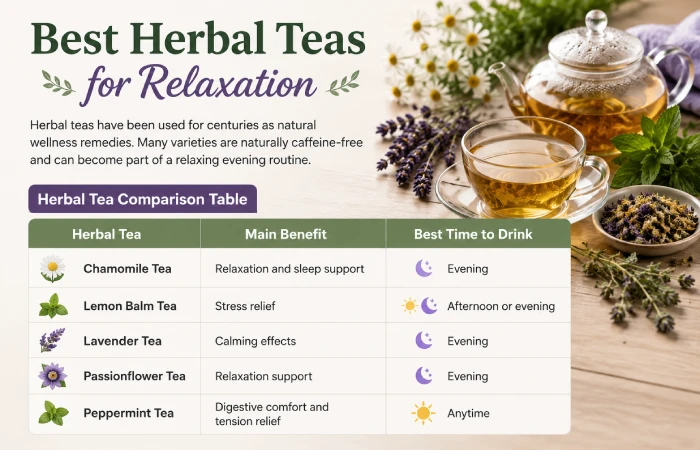
Calming Chamomile; If you need to de-stress, a warm cup of chamomile tea might be your solution. Chamomile teas help promote a feeling of peace and relaxation, and naturally does not contain any caffeine. “A cup of chamomile tea will make the stress in my shoulders release,” an anonymous commenter on an internet forum for anxiety remedies once shared.
Herbal Tea Comparison Table
| Herbal Tea | Main Benefit | Best Time to Drink |
| Chamomile Tea | Relaxation and sleep support | Evening |
| Lemon Balm Tea | Stress relief | Afternoon or evening |
| Lavender Tea | Calming effects | Evening |
| Passionflower Tea | Relaxation support | Evening |
| Peppermint Tea | Digestive comfort and tension relief | Anytime |
Herbal Teas And Relaxation
When you drink a herbal tea it can support like a signal to your body that it is time to calm down. If you also have sleep habits herbal teas can really help you relax without needing to use things that will keep you awake or too much caffeine.
Living A Healthy Life For Your Mind
Being mental well is not about dealing with stress. It is about making a life that helps you be strong when things get tough think and be happy.
Food is important, for your brain because it needs a supply of good things to work right.
Key Things For Good Mental Health
There are some habits that can really help with health.
- Balanced Nutrition is good for health because it helps our body make the chemicals it needs to feel good.
- Exercise is great because it can make us feel better and help us deal with times.
- Quality Sleep is very important for controlling our emotions.
- Social Connection is good for our well-being.
- Mindfulness Practices can really help us manage stress.
- Hydration is important for our brain to work properly.
- People who study this stuff are still learning about how the food we eat and the health of our stomach affects our health.
- Eating a lot of fiber foods that are fermented fruits and vegetables can help keep our stomach and the things that live in it healthy.
- This can really help us feel better and think clearly and that is what Mental Wellness is all about so Mental Wellness is very important.
- Mental Wellness is the key to a life and things, like Balanced Nutrition and Exercise can really help with Mental Wellness.
Daily Habits to Reduce Anxiety
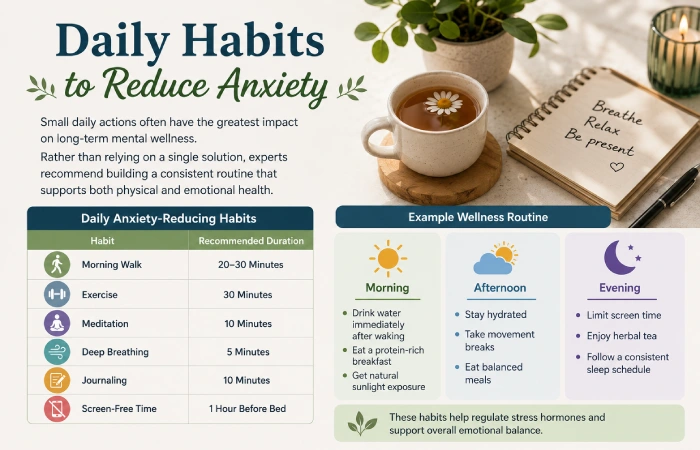
Small daily actions often have the greatest impact on long-term mental wellness.
Rather than relying on a single solution, experts recommend building a consistent routine that supports both physical and emotional health.
Product Comparison: Wellness Tools for a Healthy Lifestyle
| Product Type | Benefits | Best For |
| Magnesium Supplement | Relaxation support | Stress management |
| Omega-3 Supplement | Brain health support | Mental wellness |
| Herbal Tea Blend | Relaxation | Evening routine |
| Fitness Tracker | Activity monitoring | Lifestyle improvement |
| Meditation App | Mindfulness practice | Stress reduction |
Frequently Asked Questions
In what way is mental health disripted by the effect of nutrition?
Nutritional source – Providing food sources of nutrients to allow for neurotransmitters production, hormones to be produced and for the brain to to function properly.
What daily activities make you less anxious?
Healthy and frequent exercise, eating a healthy diet, sleeping well, meditation, and stress reduction can all contribute to mental health.
Which food reduces naturally stress levels?
Eating foods which are rich in magnesium, omega 3s, antioxidants and probiotics can have a normal stress level.
Which food will trigger Cortisol levels increase?
Processed foods, sweet drinks, over consumption of caffeine, refined carb diets.
Which herb tea is the best to relive the stress?
Chamomile tea has been very well researched as a sleep enhancer.
Conclusion
A fantastic nutritional & healthy lifestyle foundation impacts whatever health and fitness is- the number of reps you have, your capacity to get through the most emotional day of the week, your ability to be perceptive and prescient the coming health issues decades down the road. You won’t find a magic food or a magic exercise; you’ll find millions of small healthy choices.
In conjunction with your cortisol management you can integrate a sustainable health Lifestyle in the form of choosing nutrient-dense food, avoiding cortisol producing food, drinking soothing herbal teas, incorporating self care into your everyday. The most powerful health plan is not to do something perfect; it is to be consistent. I believe it is the small changes that we do every day that add up to the most benefit over time.