
 Sameena Fatima
Health & Wellness Content Writer
in
Sameena Fatima writes reader-focused
health and wellness content for
HealthBloomWeb, covering fitness,
nutrition, healthy lifestyle and
everyday wellness topics.
Sameena Fatima
Health & Wellness Content Writer
in
Sameena Fatima writes reader-focused
health and wellness content for
HealthBloomWeb, covering fitness,
nutrition, healthy lifestyle and
everyday wellness topics.
 Mirza Ibrahim Ali Khan
Editorial & Content Reviewer
in
Mirza Ibrahim Ali Khan contributes to
HealthBloomWeb's editorial review process,
with a focus on content structure,
readability, search intent and overall
editorial quality.
Mirza Ibrahim Ali Khan
Editorial & Content Reviewer
in
Mirza Ibrahim Ali Khan contributes to
HealthBloomWeb's editorial review process,
with a focus on content structure,
readability, search intent and overall
editorial quality.
 Reyansh Sethi
Medical Reviewer
in
Reyansh Sethi contributes to the medical
review process at HealthBloomWeb, focusing
on clarity, responsible health context and
reader-friendly presentation of health
information.
Reyansh Sethi
Medical Reviewer
in
Reyansh Sethi contributes to the medical
review process at HealthBloomWeb, focusing
on clarity, responsible health context and
reader-friendly presentation of health
information.
Introduction
The health related components of fitness are at the core of a healthy active lifestyle. Whatever your ultimate aim whether it‘s shed a few pounds, get stronger, train your stamina, avoid chronic disease or stay active into old age knowing what these five fitness components are will set you on the path to developing a well rounded training regime with enduring benefits.
These are not passing fads in fitness, but the essential aspects of physical activity identified by internationally recognized organizations and institutions including; the WHO, the American College of Sports Medicine (ACSM) and the Centers for Disease Control and Prevention (CDC). They give an easily understandable practical guide to improving our heart, muscles, mobility and general fitness.
This Article is the Part of Cardio Fitness
In this comprehensive 2026 guide, you‘ll learn:
- What the five health related components of fitness are
- Significance of each component:
- How to evaluate your present level of fitness
- The most suitable exercises for all the component for beginners
- Common errors to watch out for
- How to design a weekly workout plan that is balanced
- How these factors compare with skill related fitness
No matter if you are new to fitness or an experienced athlete, this article offers information supported by research and practical tips you can use today.
Key Takeaways
| Topic | Key Point |
| Number of Components | Five |
| Primary Goal | Improve general health and or physical performance |
| Suitable For | Novice through high level of fitness Applicants |
| Recommended Activity | Moderate aerobic activity for a minimum of 150 minutes/ week, with additional muscle-strengthening activities |
| Main Benefits | Healthier hearts, Musclier bodies, Greater flexibility, Increased tissue health, decreased risk of disease |
Since the research was looking specifically at the experience of women in Texas, the respondents were asked to identify where they were from. Out of the ten respondents, nine indicated their state of residence as Texas. One of the respondents listed her home state as Texas but was living elsewhere during the time of the research.
What Are the Health-Related Components of Fitness
Health-related fitness describes the physical attributes that are related to health and the performance of one‘s daily tasks in an efficient manner. These also focus on long-term health benefits such as disease prevention and mobility rather than solely athletic performance.
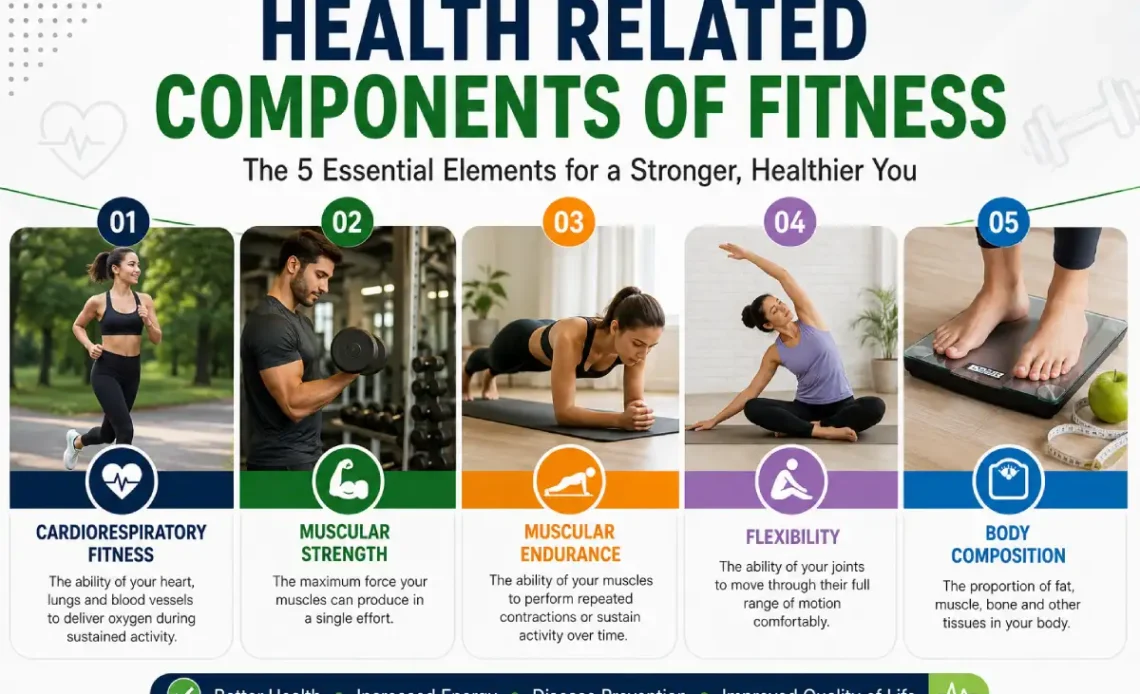
The five health related components of fitness are:
- Cardiorespiratory Fitness
- Muscular Strength
- Muscular Endurance
- Flexibility
- Body Composition
Each having their own functions, and working hand in hand:
Why These Components Matter
Think of walking up a flight of stairs without being out of breath, shopping without your arms aching, working at a computer without slouching and playing outside without tiring. What you want to be able to do is not reliant on one element of fitness but is made up from more than one.
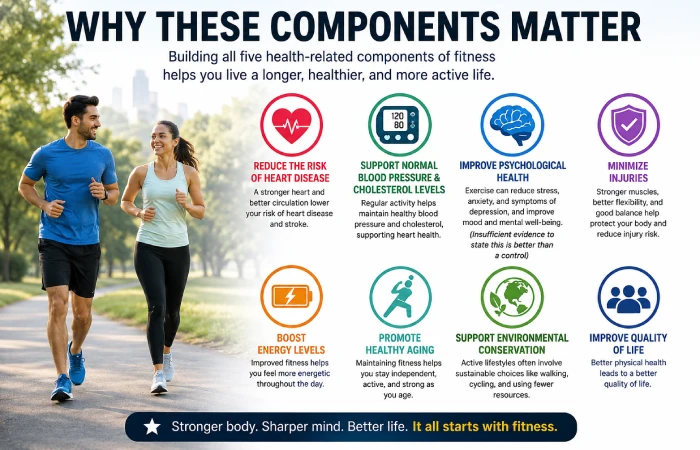
Improving these components can help:
- Reduce the risk of heart disease
- Support normal blood pressure and blood cholesterol levels
- Improve psychological health (Insufficient evidence to state this is better than a control)
- Minimize injuries;
- boost energy levels
- Promote healthy aging
- Support environmental conservation and improve quality of life
Health-Related Fitness vs. Physical Activity
A lot of individuals confuse the terms “physical activity” and “fitness” as one in the same. However, they are not:
| Physical Activity | Health-Related Fitness |
| Any motions that require energy to be consumed. | Any physical properties that can be measured. |
| Walking, working in the garden, general household cleaning | Endurance, strength, flexibility, body composition. |
| Can be occasional | Requires regular training |
| Improves health | Indicates how well your body is functioning. |
Engaging in regular physical activity is essential, yet improvement in each of the five health-related components of fitness enhances long-term benefits.
Why Health Related Components of Fitness Matter in 2026
Today most people are not as active as they used to be. Desert jobs, computers, watching television and a general lack of movement throughout the day have resulted in a very sedentary lifestyle for most. With this comes the importance of balanced fitness gaining even more significance.
Current public health recommendations continue to emphasize:
- Between the hours of 12 pm and 1 am, with subsequent aerobic activity.
- Taking part in strength training sessions on two days a week
- Exercising flexibility and mobility
- Decreased sitting time (i.e., prolonged sedentary behavior)
- Achieving and then maintaining a healthy body composition by eating well and engaging in physical activity
Addressing all five aspects ensures protection from the typical health problems related to inactivity.
Overview of the Five Health Related Components of Fitness
| Component | Primary Purpose | Example Activities | Common Assessment |
| Cardiorespiratory Fitness | Heart and lung efficiency | Walking, running, cycling, swimming | VO₂ Max, 1-mile walk test |
| Muscular Strength | Maximum force possible | Weightlifting, resistance bands | 1RM, grip strength |
| Muscular Endurance | Sustained muscle activity | Planks, push-ups, cycling | Push-up test, plank hold |
| Flexibility | Joint range of movement | Stretching, yoga | Sit-and-reach test |
| Body Composition | Healthy balance of fat and lean tissue | Nutrition and exercise | Body fat percentage, waist circumference, DEXA |
Benefits of Developing All Five Components
Working on one aspect of fitness may have some benefits, but working on all health components of fitness will offer the most health benefits.
| Fitness Component | Key Health Benefit |
| Cardiorespiratory Fitness | Improved cardiovascular and respiratory function |
| Muscular Strength | Ability to perform more basic movements more easily and less injury prone. |
| Muscular Endurance | Strength for work and play |
| Flexibility | More mobile, improves the posture |
| Body Composition | Lower chance of obesity-related illnesses |
Component 1: Cardiorespiratory Fitness
What Is Cardiorespiratory Fitness
Cardiorespiratory fitness is the term cardio-fitness, or aerobically fit, and can easily substitute that. Cardiovascular fitness, or aerobic fitness, which also go by cardiovascular strength endurance or oxygen consumption capacity, or it’s just how your heart’s ability or lungs to push or to take, blood as you do these endurance type activity and carry sufficient amounts of or oxygen for the body to be doing its exercise. What this amounts to essentially the condition of one’s fitness how long can you continuously use one of those types of exercise.
People with good cardiorespiratory fitness typically experience:
- Reduced tiredness in everyday life
- Shortened recovery time between bouts of exercise
- Seems to have improved stamina
- Better general health
Why Cardiorespiratory Fitness Is Important
A healthy cardiovascular system can aid the function of nearly all organs in the body. The heart muscle can be strengthened by aerobic workout, while circulation can be improved which can lead to a normalized blood pressure.
Benefits include:
- Decrease in risk of cardiovascular disease
- Decongested airways resulting in increased access of oxygen to the alveoli.
- Improved endurance
- higher rate of calorie expenditure;
- Improved sadness and helplessness: Better overall mood.
- Improved sleep quality;
- Cure for Depression There is proof that preventing depression improves cognitive function in patients with Alzheimer’ preclinical Alzheimer. There is enhanced cognitive performance in elder patients with Alzheimer‘s disease who are given estrogen replacement therapy.
Signs of Good Cardiorespiratory Fitness
You may have good aerobic fitness if you can:
- Walks quickly but without losing breath
- Climb up a few flights of stairs comfortably
- recover more rapidly from training
- Keep intensity at a moderate level, exercising for 30–60minutes
Best Exercises for Improving Cardiorespiratory Fitness
Mixing activity types is easier for new exercisers because they can begin with the default lower impact type.
| Exercise | Difficulty | Benefits |
| Brisk Walking | Beginner | Heart health, weight management |
| Cycling | Beginner | Low-impact endurance |
| Swimming | Beginner–Intermediate | Full-body cardiovascular workout |
| Jogging | Intermediate | Builds endurance |
| Rowing | Intermediate | Strength and cardio combined |
| Dancing | Beginner | Fun aerobic exercise |
| Hiking | Beginner–Intermediate | Improves stamina and leg strength |
Beginner Workout Example
| Day | Activity | Duration |
| Monday | Brisk Walking | 30 minutes |
| Wednesday | Cycling | 30 minutes |
| Friday | Swimming | 30 minutes |
| Saturday | Nature Walk | 45 minutes |
This timetable offers a reasonable and well-rounded initial approach to enhancing cardiovascular health.
How Cardiorespiratory Fitness Is Measured
The following methods are used by fitness professionals to measure aerobic capacity.
| Assessment | Purpose |
| VO₂ Max Test | Test of maximum oxygen consumption. |
| Cooper 12-Minute Run | Used to estimate aerobic capacity |
| One-Mile Walk Test | Suitable for beginners |
| Step Test | This exam is used to determine the recovery heart rate. |
| Treadmill Stress Test | Test Clinical assessment |
These tests determine whether a session is hard or easy for an individual and guides the intensity of training sessions.
Common Mistakes
Countless rookies derail the speed of their game by simply making mistakes that can easily be foreseen and corrected.
Avoid:
- Working out with excessive intensity even if only the first couple of weeks. We should understand that though we can handle it to a certain extent, it doesn’t mean that we should do it. For example, “one incredibly difficult training session today may place you right off training altogether”.
- Not warming up before the event. These are very important for helping to prepare the muscles for any work they are about to carry out. This will also allow any niggling injuries to become apparent before the main event.
- The temptation not to include recovery days, e.g. training every day1
- Only doing cardio and not incorporating serious strength training
- Irregularity of ones workout routine
Better to be consistent than a so-called ‘strong finish’ where you train hard and then rest…
Practical Tips for Beginners
- Sit comfortably, and build up to longer periods gradually.
- Moderate intensity level that allows you to talk while walking but not sing.
- Wear appropriate shoes.
- Drink plenty of fluids before, during and after exercise.
- Keep a record of your motivation and progress with a journal or on your phone, for example with a smartwatch.
- Include a mixture of aerobic activity, muscular strength and flexibility exercises.
Component 2: Muscular Strength
What Is Muscular Strength?
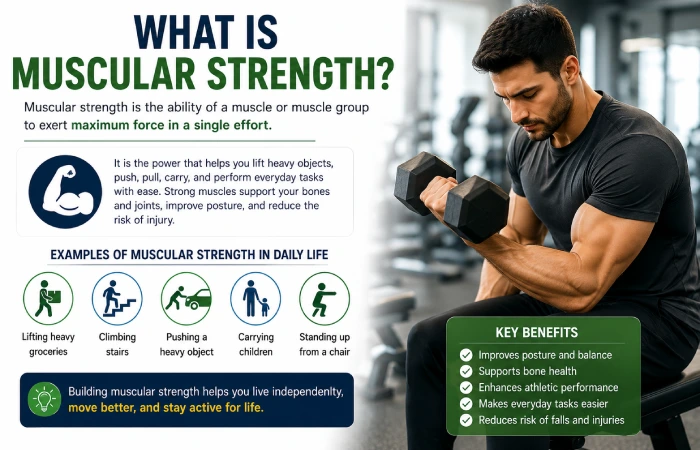
Definition of Muscular Strength: the maximum amount of force you can apply when you contract a muscle. Muscular strength is the ability to exert force immediately against a resistance.
Muscular strength It is the maximal force exerted by a muscle or muscle groups. It measures the maximum force or tension a muscle or a muscle group can produce. Individuals can improve their capacity to carry out their daily life routines such as: lifting heavy object, carrying groceries, climbing stairs, and remaining straight while. Strengthening muscle mass is able to reduce stress on the joint, improve stability as well as the odds of suffering physical. Strong muscles are thus one key aspect to heath-related exercise. Not Just sports conditioning
In the next part of this guide, we’ll explore muscular strength in depth, including:
- How muscles develop strength
- The most effective couple strength exercises, which are suitable for newcomers.
- Just put it in simple terms: progressive overload
- Effective and safe resistance training methods
- Frequently encountered errors in writing the shorthand
- Sample measurement systems that use: 1RM maximum weight a person can lift. Grip strength holds an object with a varying grip using a dynamometer.
- In what way is muscular strength different from muscular endurance
Muscular Strength
Muscular strength (also known as strength) refers to how much force a muscle or muscle group can exert in one effort. Any action of moving a heavy box, a bag on your back or doing a squat in the gym involves muscular strength.
While a lot of people think of bodybuilding when they hear the words “strength training”, building muscular strength is needed by all including new exercisers, seniors and just about everybody who wants to stay healthy and independent.
Why Muscular Strength Is Important
Having an increased level of muscularity isn’t just for show. Muscles can help to keep the joints stable, keep posture correct, and minimize risk of injury while engaged in everyday activities.
Key Benefits
- Builds strong bones by promoting higher bone density. Simplifies mundane activities.
- Enhances posture and balance
- Improves your athletic conditioning.
- Lowers the occurrence of falls and potential injuries
- Aids digestion, prevents constipation and
- Enhances metabolism in conjunction with lean muscle mass.
- Enhances the body’s responsiveness to insulin and regularizes blood sugar levels
Best Exercises for Building Muscular Strength
Principles should be learned first for both beginners and more advanced students.
| Exercise | Primary Muscles | Equipment Needed | Beginner Friendly |
| Bodyweight Squats | Legs, Glutes | No | Right |
| Push-ups | Chest, Shoulders, Triceps | No | Right |
| Dumbbell Bench Press | Chest | Dumbbells | Right |
| Deadlifts | Back, Legs | Barbell | Intermediate |
| Overhead Press | Shoulders | Dumbbells/Barbell | Right |
| Lunges | Legs | No/Dumbbells | Right |
| Resistance Band Rows | Back | Resistance Band | Right |
Progressive Overload Explained
Progressive overload is one of the most effective ways you can overcome a plateau with strength. Overloading your muscles
You can do this by:
- As the finger is screwed inward, the weight of 5.75kg ‘increases’.
- To do more repetitions
- Adding one more set
- Limitation of sleep intervals
- Enhancing exercise technique and/or form, which is essential for good technique.
- Training two or three times a week at first.
Small, steady wins the race than failing to lift heavy weights early in.
How Muscular Strength Is Measured
There are several established tests that are used to measure muscular strength.
| Test | Measures | Suitable For |
| One-Repetition Maximum (1RM) | Maximum lifting ability | Intermediate & Advanced |
| Hand Grip Dynamometer | Grip strength | All Fitness Levels |
| Leg Press Test | Lower-body strength | Gym Settings |
| Isometric Mid-Thigh Pull | Force Production | Sports Performance |
As beginners, seeing the quantitative effects of training over time can be just as meaningful as formal testing.
Common Mistakes
Avoid these common errors:
- Starting with more weight than their havers think they can handle.
- Lifting too hard too early (intense training, heavy weights).
- Not warming up: To prepare properly for the training sessions or matches. Preparing the body is the most important element to achieve the best possible performance or avoid injury.
- Lifting objects awkwardly or for a long duration.
- Never taking enough time off to recover from the hard sessions.
- Doing the same exercise for the same group of muscles daily
- Poor diets/ Meal skipped
Component 3: Muscular Endurance
What Is Muscular Endurance?
Muscular endurance refers to ability of muscles or group of muscles to repeat contraction or contract constantly with a force over some time. While muscular endurance is rather referring to the ability of the muscular system to do repetitive sustained contraction or holding a muscle contraction for a prolonged period. It also translates in other words as the ability to resist an increase amount of repetitions or an extended amount of contractions without getting fatigue.
For example:
- A plank to support the Holding a plank task.
- Doing several push-ups
- Cycling daily miles, so they attained higher levels of Fitness.
- Swimming laps of the pool at a moderate pace.
- Walking, for hours on end
Why Muscular Endurance Matters
Exercising with good muscular endurance will enable you to do activities for longer without too much fatigue.
Benefits include:
- Positional awareness- of posture
- More strength.
- Enhanced sporting performance…
- Simplified routine business activities, such as communicating easily with everyone, to meet our customers’ requirements
- Decreased levels of muscle fatigue
- Increase the muscle strength-to-mass ratio.
Best Exercises for Muscular Endurance
| Exercise | Difficulty | Benefits |
| Push-ups | Beginner | Upper-body endurance |
| Plank | Beginner | Core stability |
| Bodyweight Squats | Beginner | Leg endurance |
| Cycling | Beginner | Lower-body stamina |
| Swimming | Beginner | Full-body endurance |
| Jump Rope | Intermediate | Cardiovascular & muscular endurance |
| Circuit Training | Intermediate | Whole-body conditioning |
Muscular Strength vs. Muscular Endurance
Many beginners confuse these two parts.
| Muscular Strength | Muscular Endurance |
| Maximum force | Endurance/throughput |
| Heavy weights | Light to moderate resistance |
| Lower repetitions | Higher repetitions |
| Builds power | Builds stamina |
| Example: Deadlift | Example: Plank |
Both are equally important, and are complementary in a balanced fitness routine.
Assessment Methods
Professionals commonly assess muscular endurance using:
| Test | Component Measured |
| Push-up Test | Upper-body endurance |
| Sit-up Test | Core endurance |
| Plank Hold | Core stability |
| Wall Sit | Lower-body endurance |
Tips to Improve Muscular Endurance
- Enhance repetitions progressively – repeatedly to improve the technique, once you are satisfied 2 to 3 stepings of the technique (lacking repetitions) can be used.
- Nutrition and hydration eat appropriately before and during your workout for manageable and effective energy sources.
- Decrease rest periods (gradually increase from 2 min up to 20 min 2 min at a time)
- Instill/excuse Persistent Attendance/ Consistent Exercise Frequency. This involves allowing only 1 or 2 excused absences in the first 9 months of exercise or establishing 3 or more days per week as the expectation.
- Ensure correct breathing.
- Have some combination of strength exercises and endurance training.
Component 4: Flexibility
What Do You Mean by Flexibility?
Flexibility is movement available to joints. It’s how easily joints of the human body to moved freely.
Benefits of Having A Proper Range Of Motion It improves ease of movement, posture, and stiffness.
Most may assume that flexibility training for yogis or athletes. But, all fitness levels can benefit from gaining proper range of motion.
Benefits of Good Flexibility
Improved flexibility can:
- Muscle relaxation in the neck and shoulders to decrease muscle spasm
- Enhance posture
- Improving motion
- Lower injury risk)
- Enhance athletic performance
- Decrease ache in the lower back
- Increase knowledge of the benefits of lifestyle changes for maintaining healthy aging
Types of Stretching
| Type | Best Time | Example |
| Dynamic Stretching | Before Exercise | Leg Swings |
| Static Stretching | After Exercise | Hamstring Stretch |
| Active Stretching | Mobility Training | Standing Quad Stretch |
| PNF Stretching | Advanced Flexibility | Assisted Hamstring Stretch |
Best Flexibility Exercises
| Exercise | Target Area |
| Hamstring Stretch | Back of Legs |
| Cat-Cow Stretch | Spine |
| Child’s Pose | Lower Back |
| Hip Flexor Stretch | Hips |
| Chest Stretch | Upper Body |
| Shoulder Stretch | Shoulders |
| Cobra Stretch | Abdomen & Spine |
Flexibility Assessment
The most common assessments include:
| Test | Measures |
| Sit-and-Reach Test | Hamstring & Lower Back Flexibility |
| Shoulder Flexibility Test | Shoulder Mobility |
| Functional Movement Screen | Overall Mobility |
Common Flexibility Mistakes
Avoid:
- Stretching muscles that are cold
- Bouncing in the middle of the stretches
- Experiencing a feeling of suffocation (holding your breath)
- Tightening areas which are already painful eg tightness of the low back tightness.
- Not giving mobility exercises she was placed on a 1-week plan, where she was simply told to “do mobility exercises every day.” Though I knew they were beneficial, I didn‘t want to overwhelm her with too many.
Note: I discovered during Tom‘s initial session that mobility exercises can be contraindicated before any corrective exercises. stretch should be tension, not pain.
Component 5: Body Composition
What Is Body Composition?
Body composition, simply stated, is the distribution of muscle, fat, bone and other tissue that constitutes your body.
When considered alone, body composition is a better indicator of your general health than body weight.
Two are of similar weight but very different health status due to their body fat percentage and muscle mass.
Why Body Composition Matters
It is also important to know that healthy body composition is a good way of decreasing a risk of many forms of chronic illness and maintaining physical performance.
Benefits include:
- Those who are in a better state of metabolic health intermittent fasting appears to improve certain markers of health,
- Reduced risk for cardiac problems. This is a basis in accordance with the three followings:
- Enhanced mobility
- in athletic and recreational activities.
- More energy.
- Two most important factors for Healthier aging
Body Composition vs. BMI
Is commonly used, but not ideal:.
| BMI | Body Composition |
| Uses height & weight | Measures fat & lean mass |
| Quick screening tool | More accurate health indicator |
| Cannot distinguish muscle from fat | Differentiates tissues |
| Less precise for athletes | Better for fitness assessment |
Methods of Measuring Body Composition
| Method | Accuracy | Accessibility |
| BMI | Low | Very High |
| Waist Circumference | Moderate | High |
| Skinfold Calipers | Moderate | Moderate |
| Bioelectrical Impedance Analysis (BIA) | Good | High |
| DEXA Scan | Excellent | Limited |
| Hydrostatic Weighing | Excellent | Limited |
Healthy Body Fat Percentage (General Guide)
| Group | Healthy Range |
| Men | 10–20% |
| Female | 18–28% |
Goals for each individual depend on age, activity level, and medical factors.
Health-Related vs. Skill-Related Components of Fitness
Know the difference to develop a balanced training program.
| Health-Related Components | Skill-Related Components |
| Cardiorespiratory Fitness | Agility |
| Muscular Strength | Balance |
| Muscular Endurance | Coordination |
| Flexibility | Power |
| Body Composition | Speed |
| — | Reaction Time |
Health-related components enhance general well-being, whereas skill-related components are more often associated with sports and athletic achievement.
Comparison of the Five Health-Related Components
| Component | Primary Goal | Best Exercises | Assessment |
| Cardiorespiratory Fitness | Improve heart & lung function | Walking, Running, Cycling | VO₂ Max |
| Muscular Strength | Produce maximum force | Weight Training | 1RM |
| Muscular Endurance | Sustain repeated effort | Push-ups, Planks | Push-up Test |
| Flexibility | Increase joint mobility | Stretching, Yoga | Sit-and-Reach |
| Body Composition | Healthy fat-to-muscle ratio | Exercise + Nutrition | DEXA, BIA |
Which Component Should Beginners Focus On?
Most beginners would say all five but not simultaneously at full throttle.
A balanced weekly routine should include:
- Aerobic sub-maximal exercise for the cardiovascular system
- Strength training to gain muscle mass
- Stamina – Endurance workouts
- Running or cycling to build up your stamina ensure there is a good warm up and warm
- Mobility-specific classes (aka mobility sessions)
- Healthy eating habits to enhance body composition.
Has Proven to be more effective in achieving positive long-term health outcomes than isolated intervention.
Conclusion
Health-related components of fitness are the most useful as they are a key to developing a healthier, stronger, more active lifestyle. Instead of just saying, just do something for the body, try to improve your cardiorespiratory fitness, muscular strength, muscular endurance, flexibility and body composition.
Set realistic targets. Adhere to a well-rounded routine, focus on recovery, and maintain persistence. Any small gains will be worth it in the long run.
No matter if you are just getting started or are well into your current training program, there are 5 fundamental factors that, when developed, will enable you to move better, feel stronger, and truly live healthy for life.