
 Sameena Fatima
Health & Wellness Content Writer
in
Sameena Fatima writes reader-focused
health and wellness content for
HealthBloomWeb, covering fitness,
nutrition, healthy lifestyle and
everyday wellness topics.
Sameena Fatima
Health & Wellness Content Writer
in
Sameena Fatima writes reader-focused
health and wellness content for
HealthBloomWeb, covering fitness,
nutrition, healthy lifestyle and
everyday wellness topics.
 Mirza Ibrahim Ali Khan
Editorial & Content Reviewer
in
Mirza Ibrahim Ali Khan contributes to
HealthBloomWeb's editorial review process,
with a focus on content structure,
readability, search intent and overall
editorial quality.
Mirza Ibrahim Ali Khan
Editorial & Content Reviewer
in
Mirza Ibrahim Ali Khan contributes to
HealthBloomWeb's editorial review process,
with a focus on content structure,
readability, search intent and overall
editorial quality.
 Reyansh Sethi
Medical Reviewer
in
Reyansh Sethi contributes to the medical
review process at HealthBloomWeb, focusing
on clarity, responsible health context and
reader-friendly presentation of health
information.
Reyansh Sethi
Medical Reviewer
in
Reyansh Sethi contributes to the medical
review process at HealthBloomWeb, focusing
on clarity, responsible health context and
reader-friendly presentation of health
information.
If someone is studying personal fitness, physical education, athletic education or physical performance, then he could not help but study the Health Related vs Skill Related Components of Fitness as they form the essence of this training form. While both classes explain physical capability, each features its individual intention. Health related fitness is generally centered on general wellness and also bodily operation, though skill-related fitness tends to be more focused on abilities of motion and also efficiency in sports.
Knowing the distinction could help your readers choose suitable workout routines, calculate the health and fitness amount of yours as well as cultivate more well-balanced workout routines.
This Article is the Part of Cardio Fitness
Health-Related vs Skill-Related Fitness at a Glance
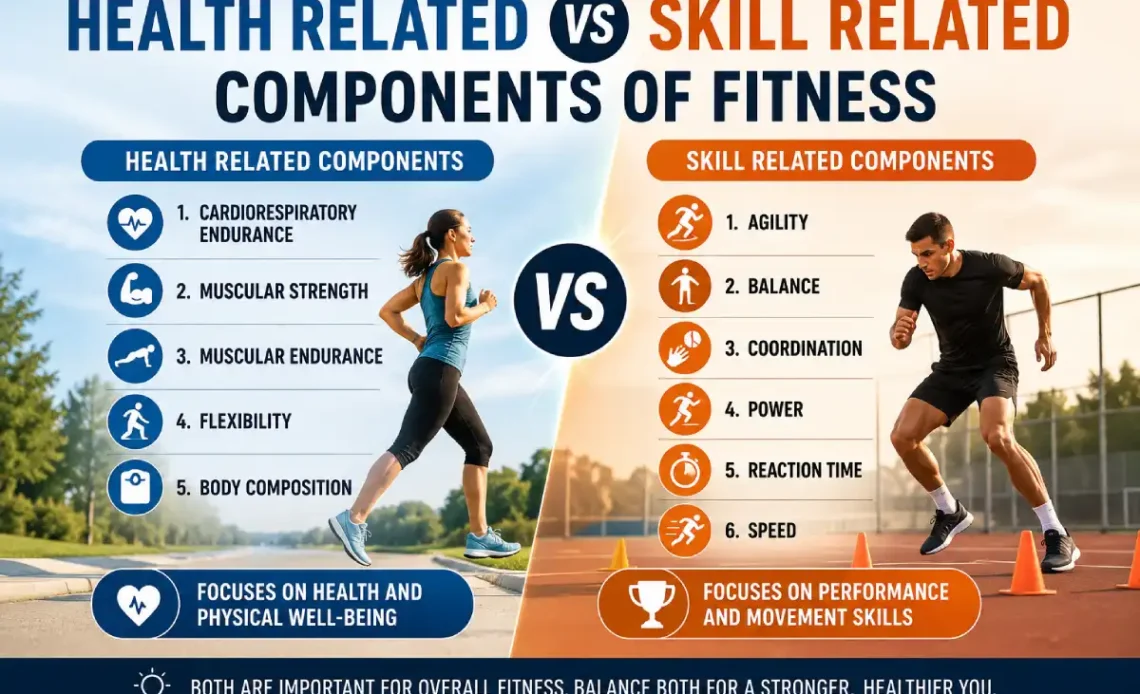
Traditional fitness education commonly divides physical fitness into five health-related components and six skill-related components.
| Health-Related Fitness | Skill-Related Fitness |
| Focuses on health and physical function | Focuses on movement and performance |
| 5 commonly taught components | 6 commonly taught components |
| Important for general health | Especially useful for sports and athletic performance |
| Includes endurance, strength, flexibility and body composition | Includes agility, balance, coordination, power, reaction time and speed |
| Relevant to almost everyone | Particularly important for athletes and sport-specific activities |
The categories can overlap. For example, muscular strength can contribute to power, while cardiovascular fitness can help support repeated movement during sports.
5 Health Related Components of Physical Fitness
1. Cardiorespiratory Health
The power related to the cardiorespiratory cardio-vascular and the respiratory body organs of your body that is enabling you to take part in workout for extended intervals. Examples: going for walks swiftly, working, swimming, biking, or climbing a hike.
2.Muscular Durability
It’s the capacity in your muscle groups or groups of muscle groups in order to do maximum drive on single event. Examples: lifting weights, pushups or squats.
3.Muscular Stamina
The capability in your muscle tissues to continually contract without tiring for an extended period of time.
Examples: planks or sustained bodyweight exercises for example lunges & push-ups.
4. Flexibility
The full movement range of your joints or areas of the body. Examples: stretches of the muscles & motion work.
5. Body Composition
The body make up, which typically implies The extent of your whole body fat. Examples: Measuring the percentage of overall bodyweight that contains lean mass versus your weight that is fat .
A great body mass means an appropriate measure of both the previous mentioned elements in the body of yours and represents body condition as you realize it now; being very heavy and or too skinny also reflect poor Body composition.
Skill-Related fitness components are the skills we all try to refine during athletic instruction.
The 6 Skill Related Factors include
Balance
is the capability to regulate how the area of our bodies stand and also sit still. Examples: The act of standing on 1 foot, walking, and running.
Speed:
The actual capability to work at a faster level. Examples: sprinting quickly, racing with regards to speed, also swinging quickly for tennis or in baseball.
Coordination
is having to work each of our own bodies with the other individuals to perform precisely.
Examples: batting at home plate, dribbling with your feet or hand as well as serving a tennis golf ball in order to a court partner.
Reaction time
the period from if you react to a situation till your own reaction occurs. Examples: a runner’s response to the beginning signal or a swimmer’s reaction to touch the pool when it begins their journey to a particular location.
Power
the ability for the velocity with which your body as well as certain areas could be sped up. Examples; the ability to gain force quickly, for example, the velocity of jumping to throw the baseball, the quick action in order to serve a tennis club.
Agility
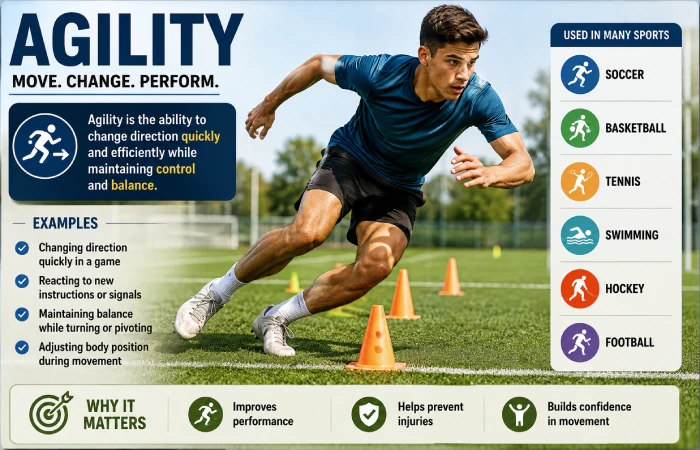
is actually modifying speed together with directing our bodies efficiently; also it would make clear in changing directions with the legs in directions they wouldn’t in any other case transfer such as changing direction quickly.
Example of it: Changing instructions swiftly throughout practice or through games for instance swimming in which the athlete needs to change direction swiftly to perform in other situations of sport as the player runs or is walking in addition to it helps a student adjust and maintain stability when they switch in directions when the instructor shouts direction which might alter their normal motion . These all could include and relate to different sport activities as the player is running during an entire activity.
Health Related vs Skill Related Components of Fitness: Key Differences
The easiest way to remember the distinction is health versus performance.
Health-related fitness supports physical health, functional capacity and general fitness. Skill-related fitness is more closely associated with performing movements efficiently, particularly during sports and other activities requiring quick or precise actions.
| Factor | Health-Related | Skill-Related |
| Main goal | Improve health and physical function | Improve movement and performance |
| Components | 5 | 6 |
| Main examples | Strength, endurance, flexibility | Agility, balance, coordination |
| Sports importance | Helpful | Often highly important |
| General population | Important for everyone | Useful but goal-dependent |
| Training examples | Cardio, resistance training, stretching | Sprinting, jumping, agility drills |
How Health-Related and Skill-Related Fitness Overlap
The health-related fitness and skill-related fitness categories shouldn’t be treated as totally distinct. For instance, to play basketball, you will have to have the stamina to remain active for entire match; but you may additionally want to have agility, strength, power, speed, and response time that can help you compete. Muscle strength could give rise to muscular strength.
That is exactly why many well-balanced workout plans integrate both the forms of health exercise.
Which 1 ought to You focus On?
For beginners who are seeking out to establish their fitness levels, concentrating on building a solid health related foundation is an economical preliminary step. Cardio workouts, strength training, and stretching routines will establish the basis of physical health. If you are seeking out to train for a game you then can add exercises specific into the demands on this sport towards those training goals.
For most beginners, building a solid foundation of health-related fitness is a sensible starting point. Regular cardiovascular activity, resistance training and flexibility work can establish general physical fitness.
If you participate in a sport, you can then add exercises targeting the specific skill-related components required by that activity.
For example:
- Runner: endurance, strength and speed
- Basketball player: endurance, agility, power and coordination
- Tennis player: endurance, agility, balance and reaction time
- Swimmer: endurance, strength, flexibility and coordination
The best approach depends on your goals, experience and activity level.
How to Improve Both Types of Fitness
A balanced fitness routine can combine several types of exercise:
For health-related fitness:
- Brisk walking or jogging
- Cycling or swimming
- Resistance training
- Bodyweight exercises
- Stretching and mobility work
For skill-related fitness:
- Agility drills
- Sprint intervals
- Balance exercises
- Plyometric exercises
- Reaction drills
- Coordination exercises
If you’re purchasing equipment for home workouts, choose equipment based on the component you are trying to develop rather than buying products simply because they are marketed as “fitness” equipment.